Why Did Great Civilizations Fall?
How did it come about that the civilizations created by the Romans, the Maya, and the inhabitants of Easter Island came to an end? It is easy to conclude that there is no hypothesis too absurd for some scholar to have put forward.
By Kamil Kopij
At the end of September 2021, the prestigious scientific journal Scientific Reports published an article that fired the imagination of people around the world. A group of American researchers was arguing that the town of Tell el-Hammam, located in present-day Jordan, had been destroyed 3,500 years ago by an asteroid. They also identified the site with Sodom, thereby confirming the biblical narrative. The authors were soon accused of manipulating illustrations, offering incorrect interpretations, and tailoring their conclusions to a thesis adopted in advance. Today the article is regarded as a scientific botch job and a stain on the journal's prestige.
The popularity of this story was undoubtedly influenced by its biblical connotations and our contemporary anxieties — recently illustrated in the film Don't Look Up. This does not change the fact that the ruins of ancient cultures exercise a continuous fascination: the ruins of Pompeii alone receive around 2.5 million visitors every year. Many people wonder what happened to those who built them. How did it come about that the civilizations created by the Romans, the Maya, and the inhabitants of Easter Island fell?

The fate of fallen civilizations already preoccupied the ancients, who typically sought the causes of collapse in moral regression and the decadence of elites. This is how Herodotus's account of the decline of the Assyrian Empire and its replacement by the Median state was read. Plato's stories about the mythical Atlantis, meanwhile, were intended as a warning to the Athenians that pride goes before a fall. The first "scientific" theory of collapse, developed in the 14th century by the Arab historian Ibn Khaldun, was an elaboration of this kind of reflection. He believed that the successful creation of states rested on a sense of group solidarity — called asabiyya in Arabic. Over time, however, as elites were exposed to the temptations of wealth and power, asabiyya naturally weakened, leading to the downfall of dynasties. New groups with stronger asabiyya — often nomads — took over and created successive dynasties, and in effect successive states. The cycle closed.
Rome
In 1984, the German historian Alexander Demandt published a list of 210 causes for the fall of the Roman Empire cited by historians. Alongside wars with the barbarians and the growing influence of regional elites and sectional interests, the list included Jewish influence, Christianity, and the emancipation of women. It is easy to conclude that there is no hypothesis too absurd for some scholar to have put forward. Today, theories concerning the environmental causes of civilizational collapse — climate change, deforestation, the overexploitation of resources — are in vogue. The emergence of new explanations is connected not only with the development of science, but also with the socio-cultural context in which they arise and with the anxieties of the people who produce them. We are also inclined to seek simple solutions to complex problems, because a complexity woven from dozens of interconnected threads is hard to grasp.
There is perhaps no other civilization whose decline interests us as much as the agony of ancient Rome. We consider ourselves, after all, its cultural heirs — which is partly why the subject has permeated popular culture. The American writer Robert Silverberg created a series of stories set in an alternative reality in which Rome never fell. Few people realize that it was reading Edward Gibbon's The Decline and Fall of the Roman Empire and reflecting on whether that fall was inevitable that prompted Isaac Asimov to write the Foundation series. The year 476, though not particularly remarkable for the Romans who lived through it, is a symbolic date — even though formally speaking the empire continued in the East.

How did it come about that an empire which had conquered the entire Mediterranean world, whose borders stretched from present-day Scotland to the northern reaches of Saudi Arabia, fell? There are historians who challenge this fall to a degree. They agree that a certain political structure collapsed — one whose formula had long been exhausted. The emperors of the western empire were, in the final decades, puppets in the hands of local elites and military commanders, usually of Germanic origin. In 476, this rotten facade was simply demolished, and the empire was formally unified under the rule of Constantinople.
Opponents of the collapse thesis regard civilization as a cultural rather than a political phenomenon. Did Roman culture collapse? We would probably agree that it not only did not disappear, but to a degree is alive to this day, undergoing a slow transformation. Let us focus, however, on political structures — these are what we have in mind when speaking of collapse. Did the Western Empire fall? The question might seem absurd: of course it did. But everything depends on how we define collapse. Most historians and archaeologists believe that two phenomena must be distinguished: collapse and decline. The former, as Joseph Tainter wrote in his book The Collapse of Complex Societies, "must be rapid — lasting no more than a few decades — and must entail a significant loss of sociopolitical structure." Decline, on the other hand, is a longer and less drastic process. It is worth noting that this distinction is already captured in the original title of Gibbon's work, The History of the Decline and Fall of the Roman Empire.
Let us look at the chronology of events in this context. In 410, the Romans withdraw from Britain, never to return, and the capital of the empire is sacked by the Visigoths. The latter event in particular shook the Mediterranean world: Rome had not been in foreign hands since the Gauls had taken it nearly 800 years earlier. The first decades of the 5th century saw the gradual loss of control over the Germanic provinces, Gaul, and Spain — connected not only with the continuous engagement of military forces, but also with the loss of tax revenues and a diminishing pool of candidates for military service. Particularly painful was the loss of North Africa to the Vandals in 439: the African provinces had been the granary of the western part of the empire. In 455, Rome was sacked again, this time by the Vandals. Eleven years later, Romulus Augustulus abdicated, and the Senate dispatched the symbols of imperial authority to Constantinople.
Are 66 years "a few decades" in Tainter's sense — enough to speak of collapse? Or was it decline? Particularly if we take into account that climate change and epidemics may have influenced the ultimate fate of Rome. Perhaps, following Gibbon and Kyle Harper, author of the controversial book The Fate of Rome: Climate, Disease, and the End of an Empire, we should rather be surprised that the Roman Empire survived as long as it did.
Akkad
The wealth of sources means that we can view the decline of Rome from different angles, emphasizing the significance of some factors while downplaying others. In the case of other civilizations we are not so fortunate — here the findings of the natural sciences play a greater role. This is well illustrated by the recently published book Climate Chaos by Brian Fagan and Nadia Durrani, which tells of the influence of climate change on ancient cultures. The closer we get to the present day — and thus as the number of sources grows — the more nuanced the picture becomes. People cease to be passive pawns tossed about the board by the forces of nature and acquire agency that allows them to prepare for change.
Let us look at the brief history of the first empire in history — the kingdom of Akkad, created by Sargon. Like a comet it blazed through Mesopotamia, uniting almost its entire territory under the rule of one king, reaching as far as the Syrian coasts of the Mediterranean. It lasted barely 200 years (c. 2334–2154 BC). The Curse of Akkad, composed during the Third Dynasty of Ur — that is, at the end of the third or the beginning of the second millennium BC — vividly paints the picture of the state's collapse, pointing to crop failure leading to cannibalism, economic ruin, and the invasion of "barbarians" from the north. It is little wonder, then, that when the results of paleoclimatic research for the region emerged, indicating a drying of the climate, scholars eagerly set them alongside the text of the epic. And while the volume of data concerning the so-called 4.2 kiloyear event (4.2 kya event) continues to grow, so too do doubts about whether it was the principal cause of the empire's fall.

Firstly, the power of the Akkadians appears to have been rather ephemeral. We do not know what proportion of the empire they controlled directly, and what remained merely under their suzerainty. We do know that successive rulers were compelled to wage continuous wars against revolting cities. Secondly, the "house of Sargon" was not a family living in harmony — palace conspiracies and assassinations were not uncommon. Perhaps, then, the principal cause of the empire's collapse should be sought in its internal weakness. Particularly since the results of skeletal studies of inhabitants of northern Mesopotamia in the period before, during, and after the 4.2 kya event — published in the summer of 2021 by Arkadiusz Sołtysiak of the University of Warsaw and Ricardo Fernandes of the Max Planck Institute — do not indicate drastic changes in diet that would support the famine hypothesis. Even if the climate changes were serious, it appears that people were able to adapt to them.
And what of the Curse of Akkad? Well, it is a text composed not only at least a hundred years after the fall of the empire, but also within a circle of people who bore the Akkadians no goodwill and were trying to legitimize their own power in the eyes of their subjects. And one of the best ways to do that is to argue that order has been restored to a place where chaos previously reigned.
The Maya
What the fall of Rome is to European archaeologists, the fate of the ancient Maya is to those from the other side of the ocean. The Russian-American Mayanist Tatiana Proskouriakoff wrote in 1946 that "the sudden disappearance of the art can only be explained in terms of some widespread and unforeseen catastrophe that overtook most of the Maya cities shortly after 800 AD."
The climate change hypothesis was first put forward in 1914 by the American geographer Ellsworth Huntington. At that time our knowledge of past climate changes was scanty, and we had almost no data for the region inhabited by the Maya — it began to emerge in the second half of the 20th century. A thesis was then advanced about a great drought that caused demographic collapse and destroyed the civilization. More recent research does indeed seem to indicate a shift toward a drier climate. Moreover, it suggests shorter periods of particularly severe drought around 760, 810, 860, and 910 AD. While the Maya could adapt to a multi-year process of gradual climate drying, sudden droughts and the associated crop failures must have wrought havoc — particularly since they probably covered a large area, making it impossible to import food from other cities. The epigraphic data also fits better with this narrative: contrary to what Proskouriakoff argued, they indicate that the collapse of Maya urban centers was not at all sudden, and unfolded over approximately two hundred years. Some centers coped better with environmental pressure; others, with fewer resources, fell more quickly.
Popularized by the BBC documentary Ancient Apocalypse: The Maya Collapse of 2002 and the preceding book by Richardson B. Gill, Drought and the Maya Collapse, the mega-drought hypothesis as the cause of Maya collapse has spread among laypeople. Most archaeologists, however, are skeptical. Firstly, the overwhelming majority of climate data comes from lake sediments in northern Yucatan. Yet the cities there were experiencing a period of flourishing rather than collapse at this time. Although the total rainfall in the drier north was approximately only half that of the south, it was the cities of the south that fell into ruin. Secondly, one would expect that the first to collapse would be cities lacking access to permanent water sources such as rivers and lakes — that is, those whose water management relied primarily on rainwater collection. Yet many of these, including Tikal, Calakmul, and Caracol, survived longer than those with access to such sources.
A more detailed examination of the histories of individual cities suggests, moreover, that strategies for dealing with environmental change may have varied. Earlier this year, an article by Scott Fedick and Louis Santiago of the University of California, Riverside, presented the results of an analysis of the drought resistance of 497 plants consumed by the Maya. It showed that only droughts lasting several years were capable of reducing the pool of available edible plant species sufficiently — to barely 50 species — that without storing large reserves for lean years or large-scale food imports, the Maya would have faced starvation. And while climate change may have contributed to the final decline of Classic Maya civilization, it was not its sole cause. Equally important were not only armed conflicts between cities, but perhaps also political and social changes that stripped the k'uhul ajaw — the divine kings, primarily responsible for the construction of monumental buildings — of their significance.
Easter Island
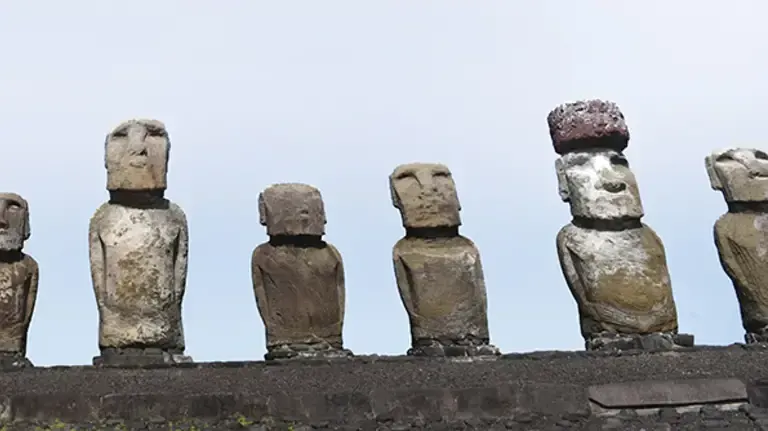
While the Akkadians, the Romans, and the Maya are sometimes seen as innocent victims of environmental change, there is no better example of a civilization that destroyed itself than that of Easter Island. Since the publication of Jared Diamond's Guns, Germs, and Steel: The Fates of Human Societies, the popular image of the inhabitants of Rapa Nui as people who, through the overexploitation of the island's natural resources and its coastal waters, brought about their own downfall, has taken hold. Their greatest sin was said to have been deforestation — connected not only with everyday needs but also with the erection of monumental sculptures known as moai. When the first European ship arrived off the island's shores in April 1722, its society was already a shadow of its former self.

Today we can say that while we have fairly convincing evidence for the rapid deforestation of the island, it had little to do with the moai — for the transportation and erection of which, as modern experiments show, wood was not necessary at all. Wood was needed rather as fuel and building material, and the destruction of the palm forests may have been assisted by the rats brought by the islanders, who — by eating the nuts — hindered the palms' reproduction (though there is no shortage of counterarguments downplaying the role of the rodents). According to the popular narrative, deforestation had a negative impact not only on fishing (lack of material for boat-building) but also on agriculture (soil erosion).
At a recent annual conference of the American Geophysical Union, a team led by Oliver Chadwick of the University of California argued that even before settlement, the soil of Easter Island was less fertile than the soil of other Polynesian islands. The island's civilization was therefore doomed from the start. For many, the proof of its rapid end was the unfinished moai abandoned in the quarries.
A more careful examination of the archaeological and historical evidence, however, suggests that collapse — at least before contact with Europeans — is not really in question. The soil conditions were indeed difficult, but the islanders developed a system of gardening using manavai — stone-ringed circles that protected crops from soil erosion and wind and increased moisture levels. Historical sources demonstrate that they had no particular difficulty either in cultivating food or in obtaining it from the sea. A growing body of evidence points instead to the fact that after the arrival of Europeans, a demographic collapse occurred, connected both with infectious diseases previously unknown to the islanders and with slavery — and later with voluntary emigration to Peru.
Ancient civilizations, like our own, are complex systems that not only evolve but are capable of adapting to change — provided that change is not too rapid and the system is not subjected to too many stressors at once. When reflecting on the decline and fall of given cultures, we should therefore keep in mind the words of the eminent British archaeologist Mortimer Wheeler: "The collapse, like the rise of a civilization, is a very complex process which can easily be distorted by oversimplification."
Orginally published in Tygodnik Powszechny, 4 April 2022. Translated with AI.