In Defense of Tribalism. Three Evolutionary Instincts That Taught Us to Cooperate

Share
In Defense of Tribalism. Three Evolutionary Instincts That Taught Us to Cooperate

Before the bronze medal match in women's ice hockey between Switzerland and Sweden at the Milan-Cortina 2026 Winter Olympic Games. Milan, February 19, 2026 // Photo: Jared C. Tilton / Getty Images

Michael Morris, cultural psychologist: The rise of tribes expanded our circle of trust. Today we can trust a complete stranger if they speak our language, practice the same profession, or share the same ideals.

By Kasper Kalinowski and Michael Morris


Kasper Kalinowski: Aristotle described man as a "social animal," but you argue that a better term is "tribal animal." What is the difference?

Michael Morris: There are many social animals, and by objective measures we are not the most social. Insect colonies put us to shame in terms of collective care for offspring and cooperation in close proximity. We cannot therefore claim to be "the one" social animal.
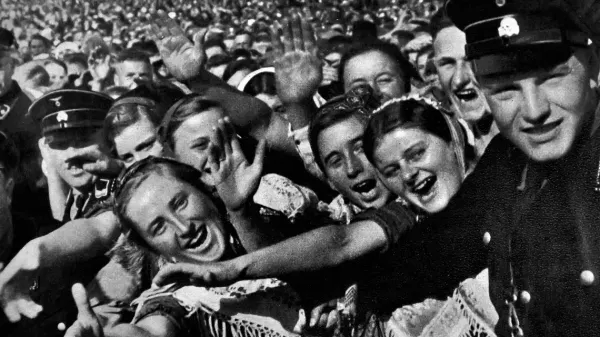
But we are the only animal that lives in tribes — large communities united by shared ideas and cultural heritage. The cooperation we observe in ant or bee colonies is solely a product of their genes. That is why the waggle dance of bees or the way ants build their nests does not differ between different groups. What is encoded in our genes, by contrast, is the absorption of the patterns of the society around us. We soak up culture like sponges.

It is precisely these cultural instincts that have enabled us to achieve diversity. Groups differ from one another because individuals are equally capable of absorbing any culture.

Yuval Noah Harari argues that if you locked a group of chimpanzees in a room, chaos would ensue, whereas humans are able to cooperate with strangers. Is that our superpower?

Yes — the rise of tribes allowed for an expansion of the circle of trust. Chimpanzees can live in groups of up to 40 individuals. Beyond that number, they are unable to form direct bonds with every member of the group, which breeds mistrust and violence.

We humans can trust a complete stranger if they speak our language, practice the same profession, or share the same ideals. It is also worth noting that around 50,000 years ago a "cognitive revolution" took place — cave paintings, musical instruments, figurines, and ritual burials all appeared. All of this emerged at the moment when humans began acting collectively.

And yet many people regard tribal instincts as a kind of bug in the human software.

I don't know how it is in Poland, but in the United States tribalism certainly gets bad press. Many commentators advance the thesis that all contemporary conflicts — whether in the Middle East or between Republicans and Democrats in the US — reflect the resurgence of dormant evolutionary instincts that prevent democracy, international cooperation, and the functioning of pluralistic organizations.

That is not true. Evolutionary theory says that the group instincts specific to human beings are what enable us to live in tribes. These are instincts serving solidarity, not antagonism.

It is quite possible that one of the reasons we prevailed over the Neanderthals was that they remained in constant conflict with neighboring clans. Meanwhile, Homo sapiens were forming broader social networks. Such clans and tribes had a shared language and shared rituals, enabling exchange and peaceful coexistence.

The conviction that our evolutionary heritage is the cause of present-day conflicts is indefensible. It is even dangerous, because it leads to fatalism — the belief that our evolutionary inheritance contains something inherently bad. That is why I decided to write a book grounded in scientific evidence, explaining how tribal instincts evolved to enable cooperation, and that they still play a crucial role in our lives today.

Which of these instincts are the most important?

Three systems, which developed at different periods in our evolutionary history. Each is responsible for a different aspect of social life to this day.

The first, the peer instinct, evolved more than a million years ago. It accounts for our conformism, our desire to remain in harmony with our surroundings, and all the positive feelings that flow from teamwork. It was this that enabled us to hunt and gather in an organized way, which enormously increased our chances of survival.

Roughly half a million years later, the hero instinct emerged. Around this time the species known as Homo heidelbergensis was living. In the fossil record we can observe shelters being built, more complex tools, and evidence of mammoth hunting — which required taking great risks, that is, the sacrifice of the individual for the good of the group.

We also encounter skeletons of people with congenital disabilities who lived into adulthood — meaning that someone cared for them. According to the evolutionary scenario I favor, people began making moral judgments at this time. Gossip emerged, building reputations. The community rewarded those who contributed to the common good by granting them prestige and resources.

The hero instinct also accounts for our obsession with celebrities — we strive to imitate those who have achieved success, even in trivial matters.

The last — the ancestor instinct — inclines us to look back at the past with nostalgia. Today's populists exploit this, speaking of a "golden age." This image is often mythological and exclusionary — blaming immigrants for the current state of affairs, for instance. But the instinct can also be used inclusively. Abraham Lincoln established Thanksgiving during the Civil War, invoking the Pilgrims and George Washington to give people a sense of shared identity at the most polarized moment in American history.

Thanks to these three instincts, the store of shared knowledge began to grow at an extraordinary pace.

We are going deep into the past. Yet as recently as the 20th century we believed that prior to the agricultural revolution around 10,000 BC, people lived in small groups and that no larger societies existed. Were we wrong?

Yes. We now have archaeological discoveries — including from the territory of present-day Poland — such as a network of sacred structures made of mammoth bones, located hundreds of kilometers apart from one another. They stretched along migration routes through Ukraine and into Russia. The construction of each one required the remains of dozens of mammoths. Small, non-cooperating groups could not have built them.

These sanctuaries date back 20,000 years. In the book I defend the thesis that the building of temples paved the way for agriculture, not the other way around. The Marxist view held that as long as there were no food surpluses and no sedentary lifestyle, no one had time for religion. That is not true. Religion united people into communities that cooperated with one another long before agriculture.

If tribal instincts account for our openness to others and our capacity for cooperation, where do conflicts and polarization come from?

In my view, conflicts stem from three more basic systems: the psychology of conformism, the pursuit of status, and traditionalism. These systems usually serve us well — but when social conditions change, a given instinct begins to operate excessively.

Polarization in the United States — and, as I understand from you, in Poland too — stems from a phenomenon known as self-sorting: liberals move to the coasts, conservatives to the center of the country. Added to this is the fragmentation of media and social media platforms, which have become information bubbles.

Our conformism causes us to close ourselves into an environment of like-minded people. When we encounter the other side, we are baffled — we cannot understand how they could arrive at such conclusions. We assume a cognitive deficit: in the United States the standard accusation is that the other side's leaders have damaged brains or are lying. This leads to negative emotions.

If we accept the diagnosis I have outlined, we can develop ideas for combating polarization. We can encourage people to draw information from diverse sources, to cross party lines, and to promote dialogue. In the United States there is a movement creating events that bring Republicans and Democrats together.

The first wave of such programs often ended in failure — people came ready to fight and could not be persuaded. The second wave involves meetings over coffee or a meal, where conversations focus on non-political topics. A month later, participants show lower levels of polarization than after conversations about politics.

We have many theories emphasizing national characteristics. According to them, Russians will always be imperialist, Americans individualist, and the Chinese collectivist. What would you say to those who hold such views?

First, that it is impossible to defend the thesis of a direct genetic influence on such traits. Most of them result from tradition, the way children are raised, and the transmission of values.

Second, our perception of the permanence of national character is exaggerated. We do not observe the past directly — we rely on stories written by people who had their own agendas. And history serving the interests of states is selective. That is why when populist politicians in Poland or the United States introduce radical changes — as the Trump administration has — they say: "This is how we have always done it." They reach back to tradition in order to introduce the changes they desire, but direct attention exclusively to selected elements of that tradition.

In your book you note that a cultural novelty can be just as powerful a driver of social change as hard legislation. And you give the example of Brazilian soap operas, which led to a decline in birth rates comparable to what China achieved through its coercive one-child policy. How could soap operas have such an effect?

In the 1970s and 1980s, Brazil had effectively only one television channel — Globo. The average family size was then over six children. The decline in the birth rate proceeded exactly along the trajectory of the spread of access to cable television.

The soap operas were broadcast daily in prime time in a society with a low literacy rate — people gossiped about the characters as if they were real people. The female protagonists were typically independent women with successful careers who had one child, two children, or none — because it is difficult to write an interesting story about a protagonist with seven children.

NGOs later used a similar mechanism to promote safe sex in Africa or to reduce domestic violence. People simply want to be like the "good ones" from the series.

Another example you analyze is Singapore, which went from a poor country to an economic powerhouse. What does a cultural psychologist see in that story?

Singapore's first prime minister, Lee Kuan Yew, thought like an engineer. Singapore was a mixture of cultures — Chinese, Malay, Indian, and British colonial heritage. When the country gained independence, Lee deliberately constructed a new identity. He chose English as the lingua franca — partly because it was neutral, and partly because it was associated with the norms of the "free port" of the British era, which was meant to attract shipping. His party adopted white uniforms, symbolizing the absence of corruption — but also evoking the uniforms of the British navy.

Unlike other independence leaders, Lee did not tear down statues of the colonizers. He erected a monument to the founder of the colony, Sir Thomas Raffles. He considered this a pragmatic move. At the same time he was critical of the West and did not fully adopt the Western legal system. He drew on many traditions — in the 1980s, as China was growing in strength, he launched a "Speak Mandarin" campaign. He learned the language himself after the age of fifty. It was not just about language, but about the values associated with it — the Chinese way of doing business and managing the family. He saw culture as a tool, not an end in itself.

It should be noted, though, that appeals to tribal instincts have not always led to success.

Many postcolonial countries fell into crisis. Their leaders wanted to reject everything associated with the colonizers — including foreign languages and curricula. Lee Kuan Yew, as I mentioned, did not believe there was some unchanging essence of Singaporean identity to wallow in. He maintained that identity was something to be worked out, and asked: what from our heritage will be most useful to the economy?

This is the opposite of the essentialist approach, which says: we are an indigenous people, we must remove foreign elements. That approach treats culture as an end in itself. And it is often ruinous.

Beyond your academic work, you also advise companies. How can knowledge of human nature and tribal instincts be applied in business and management in a multicultural environment?

Research shows that because each of us has internalized many cultures, they do not all operate simultaneously — the one at the helm changes depending on the environment. Right now, as we are speaking, I can see books behind you, and that activates my identity as a professor rather than as a consultant.

A manager is someone who can shape the environment and thereby influence employees. In the book I write about "tribal signals" (such as language and dress), "tribal symbols" (flags, photos of founders), and "tribal ceremonies" (rituals, such as employee of the month, launch parties for new software releases, or eating tacos together every Tuesday). Although such signals may be arbitrary, after a few years they become meaningful and build a sense of purpose. During the pandemic, people also suffered from the absence of these rituals.


Michael Morris // Photo: Press materials

MICHAEL MORRIS is a professor in the Department of Psychology at Columbia University in New York.


Orginally published in Tygodnik Powszechny, 24 February 2026. Translated with AI.

Read more