The Rebel: What Measure, Monsieur Camus?

Only a properly tuned lyre produces pure sounds, and only a well-tensioned bow allows an accurate shot. The rebel guards against both the "yes" in which no voice of reason can be heard, and the shrieking "no" that changes the world without any principles.
By Maciej Kałuża
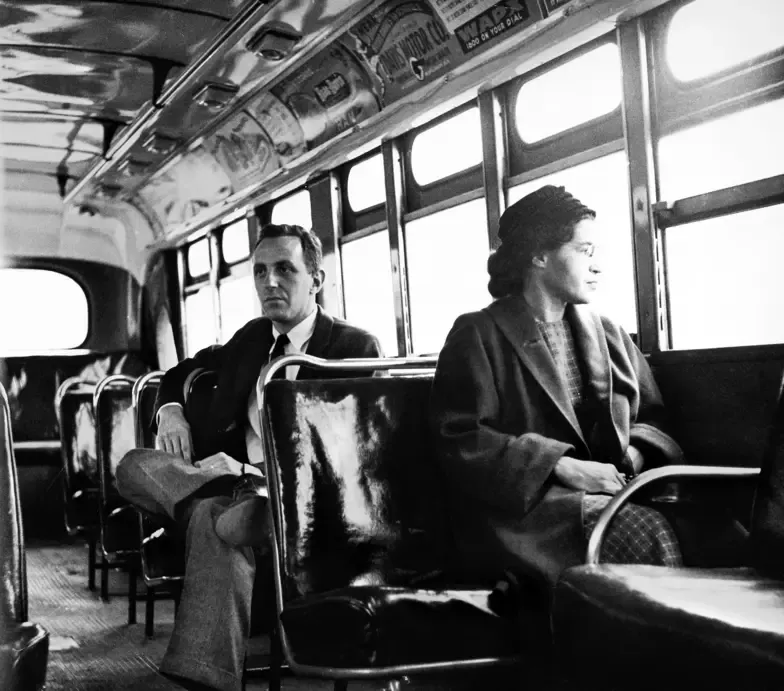
On 1 December 1955, Rosa Parks refused to give up her seat on a bus to a white passenger. The NAACP (National Association for the Advancement of Colored People) activist, who fought for the civil rights of Black Americans, was tired of submitting to the rules of racial segregation. Her individual "no" was soon to become a collective act of opposition to violence, injustice, and social division.
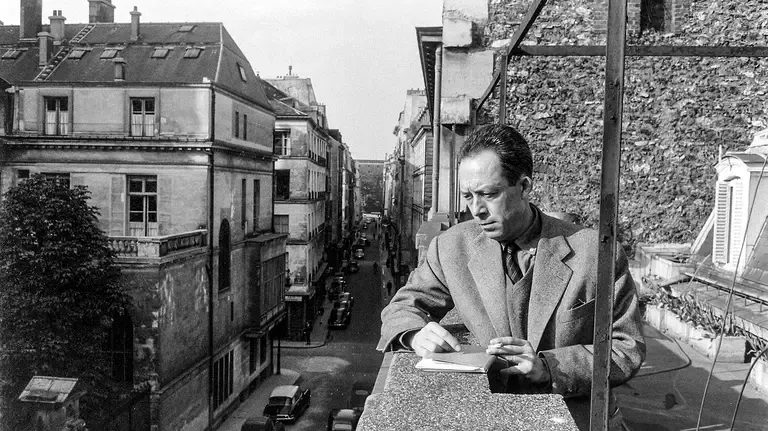
It is not known where or when The Rebel began to take shape — the essay by Albert Camus published by Gallimard in 1951. His Notebooks indicate that the thinker planned to address the question of revolt very early on. The idea was born even before the writing of The Myth of Sisyphus, in which he depicted the revolutionary's action as the laborious rolling of a boulder to the top of a mountain, over and over again, transforming his toil into strength. This resistance, however, was purely individual, and the deep need to transform the existing order — similar to that which accompanied Rosa Parks — required an examination of the problem of revolt in the context of community.
In the second of the Letters to a German Friend from 1943, Camus recounts the story of a sixteen-year-old boy being taken to his execution alongside other condemned prisoners. Some of them had been active in the resistance movement, but others — including the letter's protagonist — had been caught by chance. The teenager tries to escape from the truck, but after the intervention of a chaplain he is caught and driven back to the place of the shooting. What outrages Camus most is not the conduct of the German firing squad, but that of the clergyman — a man who professes Christian values — who supports the executioners by alerting the soldiers to the escape.
The story fills the reader with revulsion and confirms the conviction that shooting others — and above all children — and helping their killers while preaching Christian values deserves particular condemnation. Already in the Letters, then, the core of Camus's idea of resistance appears — an idea developed in The Rebel, The Plague, and the dramas of the postwar period. The most essential aspect of rebel thought concerns limits.
This Cannot Go On
The nature of revolt as Camus understood it is best conveyed by the figure of the historical revolutionary he made the hero of The Just Assassins. Ivan Platonovich Kaliayev refuses to throw a bomb at the carriage of Grand Duke Sergei Alexandrovich Romanov when he sees that children are also inside. Having carried out the assassination on a subsequent occasion, he resolves to give himself up to justice. It is in this drama that the need to establish limits — beyond which disobedience ceases to be justified — rings out most forcefully. Kaliayev has a sense of the rightness of the act he commits, while simultaneously being conscious of striking at a community which — at least at the level of principle — includes even those who represent values and positions different from our own.
In 1958, The Rebel was published by the Paris-based Kultura, infecting numerous Solidarity dissidents with Camus's thought. This is visible, for example, in Adam Michnik's response to Piotr Wierzbicki's "Treatise on Lice" — he opposed the simple division of people into morally pure "angels" and utterly depraved "lice." The transformation of the former into the latter can occur once it is accepted that in the name of the good, all means are permitted. At the moment when the values and limits whose transgression violates individual freedom are depreciated, the moral purity of the rebel becomes a pretense. As such it is particularly dangerous, because it justifies every action that the movement of the disobedient undertakes in the name of the common good.
A large part of The Rebel is a study not of the pathology of executioners, but of noble revolutionaries who erect guillotines in the name of freedom and equality. This recognition leads Camus to search for the measure so important to the ancients.
Heraclitus's Bow and Lyre
The virtue of prudence (sophrosyne), reaching back to Hellenic roots, is the capacity to set limits on oneself and to keep away from extreme positions. Heraclitus wrote of it, adding that "wisdom is speaking the truth and acting in accordance with nature, listening to it." To practice it, one must transcend the individual point of view. The rebel clearly marks out limits, declaring to the Master that his actions have gone too far. In order to be able to establish them, according to both Camus and Heraclitus, the rebel must turn toward human nature — according to which the supreme purpose of existence is the striving for harmony and goodness.
As late as 1945, the thinker maintained that the source of values lay in the "human condition" — a concept evoking associations with existentialism. Under the influence of his reading of the ancient philosopher, however, many passages of The Rebel underwent change: it was in human nature that Camus found a readiness for prudent action. He who listens to it acts disobediently only in order to restore order. The Nietzschean appeal to create values was thus replaced by a reflection on their discovery.
Stripped of categorical demands, The Rebel places its stake on harmony — symbolized by Heraclitus's attributes: the bow and the lyre. Only a properly tuned lyre produces pure sounds, and only a well-tensioned bow allows an accurate shot. The rebel guards against both the "yes" in which no voice of reason can be heard, and the shrieking "no" that changes the world without any principles.
Not every form of power corrupts a person in the same way. Ideologies, values, and institutions are merely tools, and none of them releases a person from responsibility for how they are used. For the author of The Stranger, revolt in the name of self-interest is not only ineffective but dangerous: individual freedom cannot be regarded as superior to social justice. When a rebel's action serves all, it requires respect for everyone and the containment of the act of resistance within determinable limits.
In the Fire of Pride
In the essay "Helen's Exile," Camus, following the thought of Heraclitus, warns contemporary humanity against arrogance. The ancient thinker observed that "hubris must be extinguished even more than a fire." The rebel need not, therefore, shun actions that have the potential to ignite the conflict symbolized by fire. Sometimes they are necessary — as history attests: revolutions occurred above all when people were deprived of any hope of a dignified life.
In the myth of Prometheus — which alludes to the idea of disobedience — humanity gains the power to kindle fires. Camus agrees with Heraclitus: fire in itself poses no threat. It becomes dangerous only at the moment when human pride leads to a loss of control over the flame. It is the savoring of success achieved and the drawing of private benefit from it that causes the rebel to forget the limits and measure of their actions, and the need to justify the resistance they offer. In The Fall, the Algerian-French thinker reflects on European culture, which — after rejecting the ancient ideals of beauty and harmony — strove for dominance through the sharpening of political conflicts and violence, while simultaneously constructing its own unblemished image. This succeeded — and continues to succeed — through the transformation of every moral failure into a success, even by the noble and public admission of guilt.
The Force of the Arrow
Camus was captivated not only by the beauty of Heraclitus's ancient thought, but also by the poetic vision of René Char. A close friend of the author of The Plague, Char searched within himself and in the shadow of postwar Europe for traces of "descendants of the Sun." He wrote of the flight of an arrow released from a bow, to express what he strives to reach in his poetry: "the hidden past and the present from which a certain turbulence emerges, over which flies and which is fertilized by a bold arrow."
According to the poet, an arrow released from a tensioned bow can prove a fruitful disturbance. Measured disobedience, placed at the midpoint between negation and affirmation, can result in revolt being given the right direction. Revolt that challenges the role of the tyrant is to serve as the foundation of a community in which "followers" do not serve or subordinate themselves to the heroic rebel. Rosa Parks does not need monuments, but the readiness of others to consciously reject relationships based on power, commands, and privilege.
The rebel responds with disobedience and an appeal for the setting of limits not only at the sight of suffering. Equally significant is the rejection of the petrifying force that presses human relationships into patterns of subordination. In the celebrated 1939 essay "The Iliad, or the Poem of Force," Simone Weil depicted the mechanism of violence that governs history, observing that "force that kills is a simplified, crude form of force." Simplified, because it is visible and translated into action. The tendencies toward the use of force and the threat of it that Weil examines spring from the same nature as Camus's disposition toward prudent action.
More terrifying for the philosopher is the omnipresent "force that does not yet kill" — paralyzing a person through the mere possibility of its existence. For both Weil and Camus, revolt is not exclusively a reaction to direct and brutal violence, but also to the violence that slumbers in power hungering for obedience.
New Suns of the Modern Age
Human nature alone does not equip us with prudence — it does, however, allow us, in the search for it, to attempt to sketch out limits. The absence of a universally binding moral code means that everything is permitted — including the transgression, the recognition, and the questioning of the existence of those limits. Conscious of this, Camus wrote in "Helen's Exile": "And yet nature is still there. Her calm skies and her reason oppose the folly of men. Until the atom too catches fire and history reaches its fulfilment in the triumph of reason and the agony of the species."
Human pride will kindle a fire we will not be able to extinguish. In pursuit of rational madness, we will light one bonfire too many. The new sun over Hiroshima terrified Camus in 1945. Reading him today, seventy-five years after the first publication of The Rebel, allows us to question anew the drive to incinerate cities, to transform the Earth into an obedient wasteland. To exist, we must be disobedient — but in that disobedience we must act with prudence. The arrow of which Camus writes in the last sentence of The Rebel flies unhurriedly.
Orginally published in Tygodnik Powszechny, 23 June 2026. Translated with AI.