When Someone Close to Me Is Suffering Mentally. How to Care for Them While Also Caring for Yourself

Share
When Someone Close to Me Is Suffering Mentally. How to Care for Them While Also Caring for Yourself
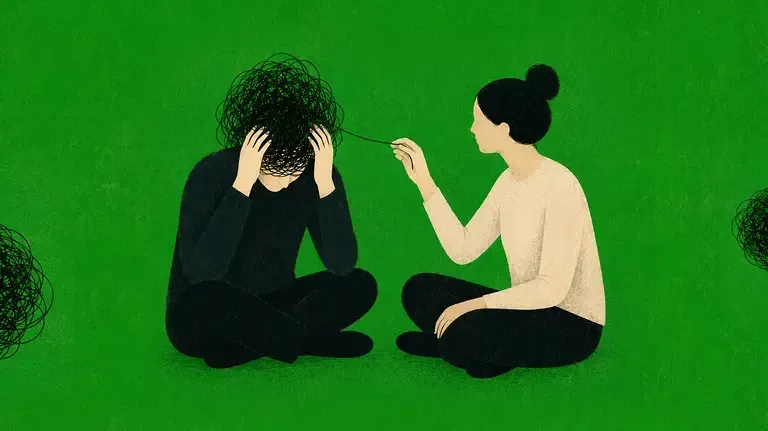
// Przemysław Gawlas & Michał Kęskiewicz for „TP”

A diagnosis of mental illness means the whole family must face change. What difficulties and emotions do the loved ones of a mentally ill person encounter? And how can they help, while also remembering their own wellbeing?

By Anna Goc


"My name is Hania, and this is my story. At the age of 13, I developed depression. I would cut and hit myself to feel less of the pain. Then came the fear and the exhaustion. Panic attacks until I lost consciousness. A suspected bipolar diagnosis. On World Depression Day I ask: don't be indifferent, don't be alone."

Hanna Kmieciak, daughter of Błażej Kmieciak, published her story on social media in 2023. "I ask for reflection, not judgment. My aim is to raise awareness that depression is not sadness, it is not an invention, it is not a flaw — it is an illness. Look after those close to you. Since 2021, on average over 5,200 people have died by suicide each year. Take care of your own smile and that of those you love; help when help is needed," she wrote. She also posted the numbers of crisis helplines available to people in distress.

"This illness cannot be seen in test results, it cannot be located in the body, you cannot answer the question of what caused it. Suddenly there is a mystery, and it concerns the person closest to you," says Błażej Kmieciak, who for many years worked as, among other things, a patient rights advocate at a psychiatric hospital, chairman of the State Commission on Pedophilia, and since 2025 has been the chief coordinator for mental health protection at the Office of the Patient Rights Ombudsman.

When I ask about that period, described by his daughter, he chooses his words carefully. "The pandemic was ongoing. For some time, Hania essentially didn't leave her room. There was not a moment when I didn't want to go in and be beside her. At the same time I knew that every part of her was screaming for me to leave her alone. It's difficult, because every situation is different and each one depends on the specific nature of the illness. But perhaps even when a child tells us to get out, deep down they think and feel: 'stay,'" Kmieciak says.

He adds: "Throughout all of that time I was checking that she was still there. I felt she needed support. After all these years I know that we — the loved ones of those who are ill — need it too. But while there are helplines for children, as an adult man going through his own crisis, I wouldn't have known who to call for help."

Mental health disorders are being diagnosed more quickly and treated more effectively today. They are also slowly ceasing to be a taboo: when those who are ill decide to share publicly what they are experiencing, we can come to know their perspective. There is, however, another experience equally important — that of those close to them: parents, partners, children, siblings.

How can those who support the mentally ill take care of themselves?

What the Report "The Mental Condition of Poland's Residents" Says

"One in every four adults in Poland has experienced a mental health disorder. We are speaking, therefore, of over eight million people," summarizes Dr. Jacek Moskalewicz, scientific editor — together with Prof. Jacek Wciórka — of the report The Mental Condition of Poland's Residents, published in 2021, the most comprehensive study of its kind in the world and one of the largest globally.

Researchers from the Institute of Psychiatry and Neurology in Warsaw coordinated a comprehensive study of the state of mental health in society and its determinants — known as EZOP — for the second time. The results of the previous edition had been published over a decade earlier.

In the first edition, researchers focused on people of working age; in the second, they broadened the scope and distinguished three groups: children up to the age of 6, children and adolescents aged 7–17, and adults. Participants were first selected by lottery from the national PESEL register, after which interviewers arranged face-to-face interviews with those who agreed to take part. In total, over 12,000 adults, over 2,200 children and adolescents aged 7–17, and around 1,000 parents of randomly selected children up to the age of six participated, from across Poland. The average interview with adult participants lasted an hour and a half, though some ran for many hours.

"The scale of mental health disorders and illnesses surprised us — though the results of the first EZOP edition had already made the problem visible. The eight million we speak of are people who have experienced a mental health disorder at least once in their lives. We estimate that between two and a half and three million experienced a mental health crisis in the year preceding the study," says Moskalewicz. "The actual scale may be larger, however, because those who are currently ill are the hardest to reach. Also because families tend to extend a protective umbrella over them."

The interviewers asked about mental illnesses and disorders: depression, episodes of mania, anxiety disorders, including panic attacks, phobias, suicidal tendencies. About chronic fatigue, eating disorders, intrusive thoughts, compulsive behaviors. About the abuse of alcohol and psychoactive substances. About psychotic symptoms, hospitalization for mental health disorders, the use of medication. In other words, about the entire spectrum of illnesses, disorders, and symptoms.

"Among those most frequently mentioned, two categories dominated: substance abuse — especially alcohol — and neurotic disorders, mainly anxiety and phobias," Moskalewicz summarizes. "Importantly, the so-called treatment gap — the difference between those experiencing a mental health crisis and those who seek treatment as a result — amounts in Poland to nearly 80 percent. This means that specialist help is received by only two people in every ten."

Family members did not participate in the face-to-face interviews with the adult participants. We therefore have no data concerning their experiences and feelings. The authors of the study do, however, draw attention to several conclusions that indirectly paint a picture of the family situation of people with mental illness.

Groups Vulnerable to Mental Health Crises

Mental health crises are reported with equal frequency by women and men. The rise in the number of crises and disorders coincides with several significant moments in life.

The researchers draw attention to the age of 16–17. "Young people are finishing school and are not always psychologically prepared to take independent control of their own futures," says Moskalewicz. "It is worth remembering, however, that in this group, mental health disorders are still at a lower level than among those aged 18–29," he adds.

The researchers also drew attention to the youngest group — children up to the age of 6. In this group, the interviews were conducted with parents of the children and concerned not so much mental health crises as developmental disorders. "They show that there is no significant difference between boys and girls. What did surprise us, however, was that developmental disorders in children raised in rural areas were twice as prevalent as in children from cities," Moskalewicz acknowledges. "Perhaps this is a signal that rural areas still lack the institutions that in cities compensate for deficiencies or gaps in parental competence."

The report's authors also observed an important variable among older people, who are frequently cited as a group at significant risk.

"We know that the risk of mental health disorders increases with age. However, when we broke down the post-60 period into five-year stages, it turned out that the highest number of people declaring mental health problems were just past the age of 65 — which coincides with the transition to retirement. After the age of 70, the number of mental health disorders ceases to grow," says Moskalewicz.

As is unsurprising, people in whose lives sudden and difficult changes have occurred — those who have lost partners or dropped out of the labor market — are also among the at-risk groups.

A Mental Illness Diagnosis Changes the Whole Family

The person experiencing a disorder begins to behave differently from before. Previously they went to school or work, led a social life, took care of themselves and their surroundings — and now they may be afraid to leave the house. They become suspicious. They may have delusions. They may no longer find pleasure in things that previously brought enjoyment. They may stop taking care of themselves. Their mood and daily activity may be diminished. There may be dozens of symptoms, depending on the disorder.

Household members, loved ones, partners, and friends begin to notice this. And they do not always understand what is happening.

"It sometimes happens that these changes are described as neurotic — and therefore as less tangible — and consequently are not always recognized as something worth consulting a psychiatrist about immediately," says Prof. Bogdan de Barbaro, psychiatrist, psychotherapist, and former head of the Family Therapy Department of the Psychiatry Chair at the Collegium Medicum of Jagiellonian University. "Research shows, however, that in illnesses such as schizophrenia, the shorter the path to a psychiatrist, the better the prognosis."

Importantly, a mental illness diagnosis means the whole family must face change. "If a young person has been diagnosed with schizophrenia, their parents will have to come to terms with the fact that they may, for example, drop out of university. And that the hopes placed in them may prove impossible to fulfill. In this sense, when illness appears, a certain reset of the relationship must take place," says Prof. de Barbaro. "But this is not about capitulating in that relationship — it is about adapting it to new conditions."

Prof. Dominika Dudek, psychiatrist, head of the Chair of Psychiatry and Psychotherapy and the Adult Psychiatry Clinic at the Collegium Medicum of Jagiellonian University, who specializes among other things in depressive disorders, compares the situation of people with depression — following Antoni Kępiński — to being at the bottom of a deep well. The ill person feels alone. And though rays of light and the voices of cheerful people reach them, they know they cannot get out. The cheerful voices, therefore, are sometimes all the more painful.

Among those voices are the voices of those closest to them and their daily lives — a daily life in which the ill person previously participated and from which they are now slowly withdrawing. The absence of their presence, interest, and willingness to take part in what matters to the family, as well as the sadness — or conversely, the unpleasant and even aggressive attitude and reactions caused by the illness — are for those closest to them a source of anxiety about the person they love, and of their own suffering.

"When a patient is ill, the whole family is ill. It is impossible to arrange things so that the illness does not affect family life. At the outset, those closest to the person, observing changes in their behavior, may deny them. They may even reject the diagnosis or seek alternative treatments," says Prof. Dudek. "From the very beginning, the psychiatrist's role is to provide the family with sufficient support that they do not feel they are sitting on a powder keg. And that even in the most severe mental illnesses, it is possible to manage the symptoms and live with the illness."

She emphasizes: "As well as constantly encouraging people — as far as possible — not to live only through the illness. To notice the other members of the family. Not to give up meetings with friends or their passions. And finally: to see in the person who is ill all those qualities we loved about them, and which — despite the illness — they still have."

What the Loved Ones of People Suffering Mentally Experience

Again: what follows will depend on many factors — on the relationships within the family, on the type of mental disorder, on the course of treatment. There are, however, certain emotions that accompany those closest to the person especially at the beginning — when they are observing the first symptoms and receiving the diagnosis.

It begins with loved ones trying to understand what is happening. They read about what the illness is and what its consequences are. They try to translate what they are experiencing into terms they can grasp. Especially when it concerns their children, or their elderly parents, for whose recovery they feel all the more responsible.

Prof. Barbara Józefik, psychologist and psychotherapist specializing in eating disorders, uses these as an example to explain how parents cope with a diagnosis. "At first they may not understand their child's behavior. They ask themselves how it is possible that their daughter, who until now was developing normally, has suddenly started doing something contrary to biology and harmful to herself. How can she refuse herself food when she is hungry? Or why should she not eat something she used to love very much?" she says.

At later stages of the illness, parents may feel they are losing control of the situation. Rational arguments about healthy eating, urgent pleas to eat lunch, or even pressure exerted on the child no longer work.

"They experience helplessness and a loss of any sense of security," explains Józefik. "Above all, however, they go through enormous fear — because they are beginning to realize that this is a serious illness that, if untreated, can result in death."

Prof. Józefik also draws attention to how the illness changes the relationship between parents and child: "Parents admit that with a child they do not understand, they are unable to establish the closeness they previously had. And not infrequently they also lose trust in the child, because they notice that they are regularly being lied to about food. The loss of closeness, of trust, and the lack of understanding of the child's inner world — all of this is a traumatic experience," she acknowledges.

On top of this comes a sense of guilt. Questions arise: was I always there when my child needed me? Did I make mistakes in raising them? Did I perhaps miss something?

And, not infrequently, loneliness: "Because even when parents begin to understand what a trap their child has fallen into, how profoundly their experience of their own body has changed, and how serious a psychological change this is — they are not always able to find support in their closest family. Especially from older relatives, where they are met with disbelief: 'What do you mean she doesn't want to eat?', 'Can't you make her?'" says Prof. Józefik.

In the book You Can Help: A Guide for Families of People with Schizophrenia and Schizotypal Disorders, first published in 1986 and since reprinted, edited by Bogdan de Barbaro, Krystyna Ostoja-Zawadzka, and Andrzej Cechnicki, the authors gathered dozens of questions most frequently put to them by the loved ones of people who are ill.

Here are a few:

"For the past week I have been observing a clear deterioration in my husband: he has stopped going to work, he does not speak to anyone, and he is probably experiencing auditory hallucinations. He categorically refuses to see a doctor. In this situation, is compulsory hospitalization indicated?"

"Before being admitted to hospital, my daughter attempted suicide. She is feeling better now, but I am worried that the state of depression and tension may return. How can I recognize a state in which there is a risk of suicide?"

"I have noticed that my son has become colder and less kind toward me. How do I deal with the feeling that my child does not need me — and that he has perhaps even stopped loving me?"

"What the family experiences when a loved one begins to suffer mentally is a kind of emotional weight — a burden that the loved ones of the ill person must carry," says Prof. de Barbaro. "Much in this process depends on the doctor, who should invite the patient and their nearest and dearest into a spirit of benevolent cooperation and the creation of a therapeutic alliance. The aim is to encourage parents to move from being accused to being co-therapists. The parent themselves must also be protected from becoming over-enmeshed: so that they are able to understand their child's experiences, but also know when additional intervention is needed."

Society's Attitude Toward the Mentally Ill

The loved ones of those who are ill begin to act on multiple fronts at once. From their stories there emerges an image of constant vigilance and anxiety.

They try to understand and support the ill person themselves. They respond to signs of deterioration or relapse, and not infrequently also watch to ensure the ill person takes their medication regularly. They try not to neglect other relationships within the family — above all, not to lose sight of their other children, who may feel pushed aside by the concentration of attention on the person who is ill. At the same time they act as a kind of family spokesperson — deciding which pieces of information about what they are going through in connection with the illness can be shared with more distant relatives and friends.

This is all the more difficult because — as the experts emphasize — in society there is still a fear of psychiatry and a sense of shame connected with mental illness. "I know of situations in which the parents of someone who is in hospital do not want to tell even their own siblings what is happening to their nephew or niece," says Prof. de Barbaro.

He adds: "It is a common dilemma — whether to open up information about the illness to the wider family or to keep it secret. Much will depend on the kind of relationship that exists between the parents and more distant relatives: how much closeness, openness, honesty, and goodwill there is in those relationships, and how much rivalry, tension, reluctance, or hostility. It is worth emphasizing that the process of stigmatization and social exclusion affects mainly the patients themselves, but also parents and other loved ones — and even the psychiatrists themselves."

Research findings confirm this. A decade passed between the first and second editions of the EZOP study — a decade during which we began to talk publicly about mental illness. Available knowledge broadened, at the cost of myths and harmful preconceptions.

"It was surprising, but between the two editions of EZOP we observed an increase in distancing attitudes toward people with mental illness," says Dr. Jacek Moskalewicz. "It is difficult to explain. Perhaps recent years have increased a general unwillingness toward 'Others' — migrants, people of different sexual orientations, and people who suffer from mental illness."

The EZOP II study shows that only 12.7 percent of respondents would agree to have their child taught by a person who had suffered from mental illness and been treated in a psychiatric hospital. And have such a person as a childminder: only 9.8 percent. Over 80 percent would not want a daughter-in-law or son-in-law with mental health disorders to enter their family. 56.3 percent do not want such a neighbor. A large majority would also not want a member of parliament or a priest who had been treated in a psychiatric hospital.

How Life Changes When a Child Is Ill

There is one situation in particular that sends the whole family into crisis mode. It is described by two mothers of adult children with mental illness, whom we meet just before a therapy session for relatives affected by this problem (similar groups exist in many cities).

Lucyna talks about her daughter, whom she left in a small town today in order to come to the meeting. She describes yesterday's crisis and the emotions still inside her. A conversation that was never finished. Her daughter's anger and aggression. The constant swings, the mood changes. The fact that she has been ill for 20 years. And she interrupts this account to praise her daughter for her successes: a university degree, passions, a job found — though not kept. And finally: how her daughter once stopped taking her medication after reading on a well-known travel blogger's blog that depression is treated not with medication but with placebos. And her daughter concluded that perhaps the same might be true for schizophrenia.

"There are masses of websites that challenge the existence of mental illnesses, the suffering of those who are ill, and their treatment," says Lucyna. "That is why many of us seek out conferences attended by doctors and experts, in order to learn as much as possible. And to have sound, evidence-based arguments."

Halina's son also fell ill 20 years ago, when he was at university. "From a young man with passions who used to go out with friends, he became someone who shut himself away at home and stopped taking care of himself. This state kept building and building," his mother says.

And she talks about how, with the onset of illness, the person who had always been by her side changed. How their shared daily life changed.

"It is a kind of waiting," says Halina. "Constantly watching in a state of tension — how things are. Whether things are bad enough that my son poses a danger to himself or others and we can call an ambulance and the police. The procedure itself is terrible. Just imagine: my son is in a severe psychosis, he hasn't taken medication for a long time. No one knows what he might do in a moment. We call for an ambulance and the police with a friend of his who is trying to support us. Police officers arrive in full uniform. How is a mentally ill person supposed to react to a situation like that? And how are we — the ones who called them — supposed to feel?"

"If a patient does not want to receive treatment, or stops treatment, I ask the family: who does this person trust most? They might answer, for example, that it is their older brother. I then advise the older brother to say to the younger one: 'Brother, do this for me and go for a one-off consultation with a doctor. I hear your anxiety, I can see you are going through something painful, but please — go, just to get an idea of the situation.' In general, the idea of a one-off consultation tends to work. It is then a matter of the consultant's skill to persuade the patient to continue with further appointments — initially perhaps outpatient, and if necessary inpatient," says Prof. de Barbaro.

He adds: "Yes, this is often fragile. Because if someone is gripped by the conviction that the whole world is against them — if every gesture is interpreted through the prism of delusional experiences — then even trust in those closest to them may be destroyed. Sometimes the effect is achieved by saying: 'Brother, you may think I'm wrong, but do this for me.'"

This also matters from a therapeutic point of view, because — as he emphasizes — if a patient takes medication after the first episode of illness and has good family relationships, the risk of relapse in the following nine months is around 10 percent. If they refuse treatment and have poor family relationships — it is over 90 percent.

Agnieszka Lewonowska-Banach, vice president of the Mental Health Families Association and board member of the Association for the Development of Psychiatry and Community Care, draws attention to an important change that has occurred over recent decades. She grew up in a small town in the Podlasie region, where there was a psychiatric hospital.

"Those were the times when patients lived in such facilities for many years — located on the outskirts of town and functioning as a closed site," she says. "Today, hospital stays are still a necessity for many patients, but the aim is for the period of hospitalization to be as short as possible. Thanks to appropriate treatment, more and more people who are ill can function within local communities and with their support. The role of loved ones and family is all the more important," she says. "In the association we have focused, among other things, on the activation of people with mental health disorders in the labor market, supported housing for them, and support groups in which families also participate."

How to Support Loved Ones and Set Limits on the Illness

"This may be the most difficult part of this story, but it does happen that daily life with a person who is mentally ill is difficult enough that support from a doctor or psychotherapist is also needed by those close to them," says Prof. Dudek. "Support through which these people learn to set boundaries in their relationships with the ill person and take care of their own psychological wellbeing."

She gives an example from her own practice in recent days: "A mother came to see me whose son is not taking medication and who is daily cruel to those closest to him. The mother has called the police and ambulance services many times, but her son can dissimulate — when doctors arrive, he is suddenly calm and pleasant. The only thing she can do then is show photos of her son's demolished room. Support for her is therefore just as important as support for her son."

Onto the stories of families and their experiences, there is laid yet another reality: the availability of psychotherapy practices and the capacity of the psychiatric care system itself.

"My daughter looked for a psychiatrist in February to renew her medication. She was offered an appointment in July. She emphasized that it was just about a prescription, but that made no difference. She therefore went to a private practice, where the appointment lasted exactly three minutes. When I found out, I felt like using several unprintable words," says Błażej Kmieciak.

The situation is being changed, as he emphasizes, by the Mental Health Centers, whose consultation points have for several years been present in every county. "Thanks to them, we can reach a psychologist very quickly. Because for us — the loved ones of people with mental illness — what matters is that a 'third person' appears," says Kmieciak. "And I emphasize this as a father whose daughter went through a mental health crisis, a brother of a sister with mental illness, a person who has daily contact with those who are ill and their families. And also as an adult man who himself went through a crisis."

That "third person" who offers support can be a specialist who appears at the first stage and is able to assess the situation. "It can be a school psychologist who knows the child well and sees what is happening. It can be a wise family doctor who knows the family, who will listen and suggest possible solutions," he says. "Especially since family doctors complete a mandatory course in psychiatry and child and adolescent psychiatry, and can immediately conduct basic tests used in the diagnosis of depression, among other things. It can be an expert from a crisis helpline, who will present the available options. The important thing is not to be left with it alone."

And he emphasizes: "Because our love for those close to us who are ill must not mean burning ourselves up in that love. It means seeking help for them — but in doing so, taking care of ourselves, and learning also to set limits on the illness."


Orginally published in Tygodnik Powszechny, 2 June 2026. Translated with AI.

Read more