Tales of the Bizarre — Olga Tokarczuk

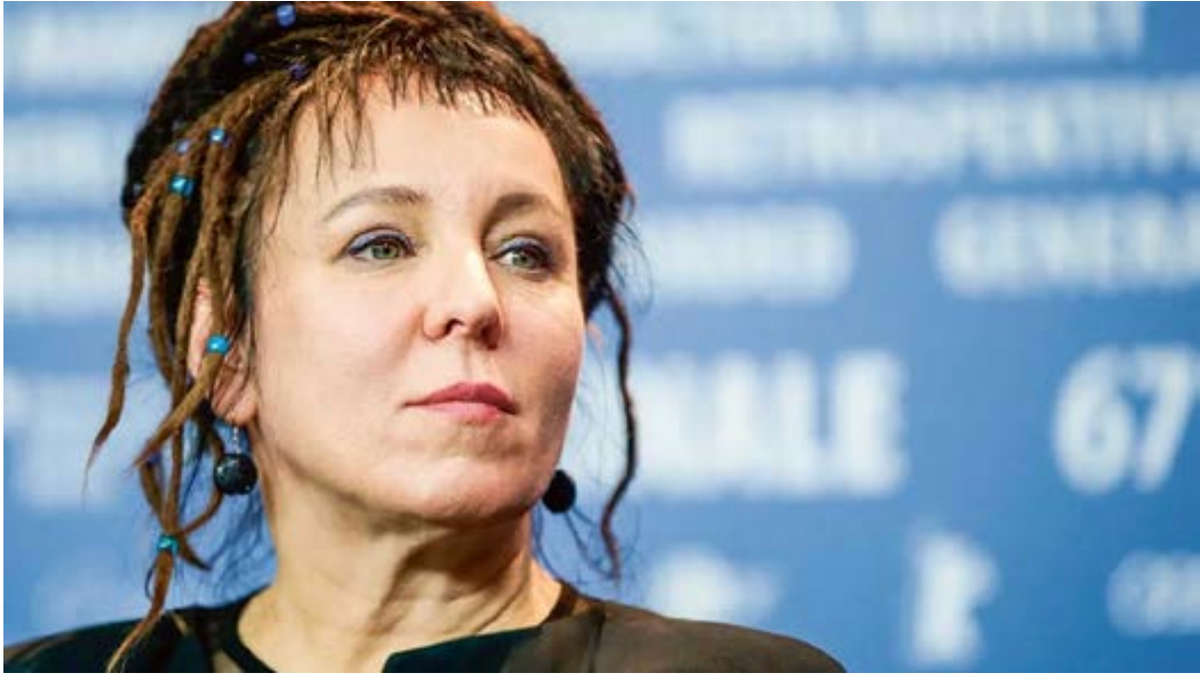
"Several dozen percent of our vocabulary consists of foreign words that have been Polonized in this way. There has been an influx from Czech, Hungarian, French, German, Turkish... Language reflects our position — we are a mixture, which I consider a virtue."
Conversation by Katarzyna Kubisiowska
Katarzyna Kubisiowska: Do you always carry a notebook for writing down ideas?
Olga Tokarczuk: I have two — a large one and a small one. Even a single written word is enough for me. In the evening I sit down and try to develop the idea. I've never had a good memory, so I need external support. My husband is also a notebook of sorts — I ask him to remember something for me, and he does it perfectly.
What word did you write down most recently?
It was three words: "Bees on a gravestone" — and I already know what it's about. These are anchor words that will then, I hope, trigger my memory. The work happens in my head first, then comes the note, and finally the development on the computer. Sometimes I find I have no idea what I meant. I get a strange look on my face then.
Have you always worked this way?
It seems so. Over the years quite a few of these notebooks have accumulated — they're sitting somewhere in boxes, with dried-up, forgotten ideas. It's good to have something that will remember better than I do. My memory is strange, oriented toward the peripheries. For example, I'm a terrible target for advertising — I never remember what a given ad was promoting, what product or brand, but I do remember the color of the model's lipstick, or the landscape through which the advertised car is driving. When I was a student, Professor Włodzimierz Szewczuk, who lectured on the psychology of learning, pointed this out to me during an exam — that I don't retain things that are essential to the subject, but do retain the peripheral ones. I passed the exam, though.
Perhaps it's because of this peripheral memory that you became a writer rather than a scientist.
Vladimir Nabokov also complained about his memory problems. He said he had eidetic, photographic memory for certain things, but couldn't remember events from his own life. There — this shared weakness of memory cheered me up. Because we usually assume that writing is a constant drawing on various strata of memory, a constant engagement of memory. Nabokov in Speak, Memory does, on the contrary, an extraordinary analysis of writing as a way of coping with forgetting.
To write, one must first read a great deal. Will you tell me about your early reading?
As a child and teenager I read enormously — it was my main occupation in those days. It's a bit like Kien, my beloved hero from Elias Canetti's Auto-da-Fé, a compulsive reader who was reading his way through the library alphabetically, and we meet him when he is perhaps at the letter K. I, on the other hand, read "spatially" — I took books from my parents' library in order, from left to right. My parents were lucky, because books were set aside for them at the bookshop — they bought regularly, allocating a significant portion of their teachers' salaries to it. This went on for years and resulted in a considerable library. I read everything that fell into my hands — from Apuleius to E.T.A. Hoffmann, from the Decameron and Gargantua and Pantagruel to Brantôme's Lives of Gallant Ladies and Voltaire's philosophical tales, from Verne to Lem.
Did your parents know about your notebooks and your early writing attempts?
Probably. Literature was lived at home, and there was a lot of talk about books. Besides, in those times, living in the provinces — what else could you do, what better thing was there, than to read? Television was poor but not yet so ubiquitous and dominant, and the internet was an idea from science fiction. My father would type up my first stories on his typewriter. My parents subscribed to the press; from childhood I remember Życie Literackie, to which my father, as a reader, wrote letters. It seems that one of my poems was also published there under a pseudonym.
What does it feel like to see your text in print for the first time?
I don't remember — it was so long ago.
The process of becoming a writer fascinates me.
I would say it is a process of specializing and optimizing certain linguistic and imaginative capacities of our brains. Plus a little madness. And of course patience. It seems that every writer has their own story about this — something like a private founding myth they share with others. I, for example, have always enjoyed telling people that I've never suffered from the blank-page syndrome. That I don't suffer from a lack of ideas — rather from an excess of them. Now I also talk about my own age — the one I'm in right now is interesting in every respect.
Why?
I've mastered the whole economy of writing — I think I know how to pace my energy, how to organize time, how to work and how to correctly judge what is most important and what less so. I've simply learned all of this. I'm more inwardly calm, capable of focused, sustained work; I see more connections and relationships. I no longer thrash about the way I used to.
Was it a planned decision to write Bizarre Stories after the multi-threaded The Books of Jacob, on which you worked for six years?
The ideas for these stories were coming to me while I was still writing The Books of Jacob. I wrote them down, then came back to them, trying to expand them. The texts matured, changed, grew — or on the contrary dried out and had to be revived. I worked on several of them at the same time. They are all a kind of commentary on reality, which is growing more and more bizarre — a commentary on what I read in the papers and see on television. Even when they take a fantastical form, they are firmly rooted in what we talk about, what we fear, what we worry about.
In the Stories, the protagonists are victims of a civilization in a state of collapse.
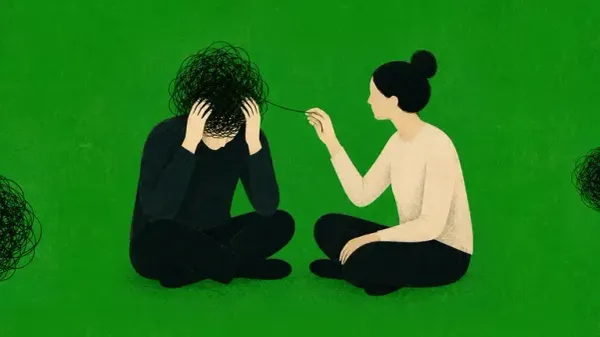
Rather of a civilization that poses some new challenge to people every day, without giving them enough time or opportunity to come to terms with it, to imagine its ultimate possible consequences. Instead, one must confront it immediately and have an opinion about it. Literature gives one the chance to spend time with all this alone, to examine it closely, up close, and then to reflect and imagine another world — also a possible one. A large part of "the new" concerns our body — its capacity for change, for adaptation, its mortality and fragility, the power one has over it or the powerlessness one feels before its biology.
That's the theme of the story "Transfugium."
It's about the possibilities of medicine, which accompanies a person in their search for happiness and deep identity. Art is really the only domain where we can play with all the possibilities of what was, is, and will be — to cross boundaries, to go beyond the margins, to try out different variants, even the most iconoclastic, frightening, and audacious ones. For me, these stories are a return to literature understood as a kind of confabulation, an experimenting with reality, a posing of bizarre questions.
Generically, they are "uncanny stories."
Many writers wrote them, and I particularly loved this type of fantastical story. Throughout my youth I read Edgar Allan Poe — I adore him, and I loved the genre of the uncanny, fantastical story generally, which was quite popular in the nineteenth century. The naturalist Zola wrote such stories; the great realists wrote them too, as did Dostoyevsky, Chekhov, E.T.A. Hoffmann, Alfred Kubin. Their themes and form belong to a specific era, because "uncanny" and "bizarre" mean different things in different times. Once, these were stories of ghosts and the afterlife, as in Poe. At other times the themes drifted toward extraordinary inventions and science fiction in general. What they share is that they always reached beyond the horizon of what we call reality.
And what moves me most in this collection are the stories closest to reality. For instance "A True Story" — an account of a man who, through a series of coincidences, goes from being a titled academic to being nobody.
A naked body stripped of everything — deprived of the attributes of social status and any sense of belonging to a community. It is actually a situation that is possible, even highly probable, especially in certain parts of the world. Reality is still dangerous and can quickly turn into a nightmare — something we easily forget.
A real nightmare. It reminds us that in social life we are constantly on the threshold of exclusion. I knew a man who was an outstanding expert on Italian novels and poetry. He ran a secondhand bookshop; he could conjure rare books from nowhere, and bibliophiles adored him. But unfavorable times came, the building's owner raised the rent, and this man had to close the shop. He tried trading in books in other ways, but it went badly for him. He gradually lost his assets, his marriage fell apart, and in the end he sold his flat and began living on the streets. Two years ago he froze to death.
When we make choices that are very significant but also conscious, one can say to some degree that we are responsible for what happens. But many things happen outside of us and we have no influence over them. That's what "A True Story" is about. If any kind of loosening occurs — if the order we assume to exist breaks down — we can quickly lose control of everything. The world doesn't care about human fragility; at bottom it is hostile to it.
Where do you draw ideas for these uncanny stories?
Many come from ordinary conversations with people, often entirely random and barely known to me. People entrust me with interesting things — though usually these are just anecdotes, fragments. Sometimes I even warn them not to forget that I'm a writer, that I'll steal the subject or story from them, use it, develop it, or give it a new meaning. I also read a great deal in newspapers and on the internet, and every time I'm convinced anew that the world is full of improbable, extraordinary stories. When I briefly worked as a journalist for a local newspaper, I had enormous difficulty writing reports on events. I was tempted to add something of my own — something that would make the whole story more coherent and meaningful. I had to restrain myself, and in essence it exhausted me. In that sense, literature goes against reality.
Against?
Despite incredible access to information, some people still reach for literary narratives. You can read thousands of newspapers and press articles, yet you're still drawn to literature. It's an entirely different plane of human communication. Literature connects us in a refined and deep way — through it one can try on different identities and enter another person's life; it gives meaning to events and transforms events into experience. That is the great work that writers the world over perform, until the day someone invents a novel-writing or story-writing machine.
"A self-writing machine" — that sounds like the title of a bizarre story.
I think it won't be possible for a long time yet. Though the devil knows what scientists have in their laboratories. Such a machine would have to be equipped with an improbable quantity of information concerning human experience as a species, plus some "soft" way of organizing it. Perhaps the fact that a given phenomenon cannot be imitated by machines will be what is truly valuable and distinctively human. On the basis of such findings, philosophers will pose the question of the precise definition of humanity. I'm quite sure that while a machine might be able to write perfectly competent genre books using certain algorithms and heuristics, it will never be able to create that literature where there is multi-layeredness, madness, and unpredictability. Perhaps special sections will appear in libraries: creative human literature and specific unhuman literature.
Which writers are your masters of the short form?
I adore Chekhov. His stories are genius; I keep them constantly by my bed and return to them often. Their endings are always overwhelming, revealing something deeper in the structure of the world, in its metaphysics — even when they appear to be about something ordinary or banal. I don't know how he does it, that he transports all events to another level. Chekhov gives the reader a genuine "insight" — a deep experience that changes one.
Why is the title Bizarre Stories rather than Strange Stories?
I had long missed this word in the Polish language. "Strange," "odd," "peculiar" weren't enough for me. In Polish, in the place of the missing word "bizarre," there was a grimace — a slightly crooked face with raised eyebrows — as an expression of disbelief, mild shock, and ambivalence.
Language purists are now tearing their hair out, though you had a predecessor — Ewa Szumańska titled her book "Bizary" in the 1980s.
Absorbing words from outside is, in my view, proof of the vitality of a language. I admire Polish for it — it draws in everything interesting and then subjects it to the strong and demanding rules of Polish grammar, which sometimes considerably changes the original sound. With added declensional or conjugational endings, such words end up looking very familiar — like leczo or majonez. Apparently several dozen percent of our vocabulary consists of foreign words that have been Polonized in this way. This shows what a great influence our neighbors have had on us, how actively we entered into dialogue with them — how we traded, quarreled, and went to war with them, but also admired them. In the Polish dictionary one can see historical currents, political alliances, and fashions. There has been an influx of words from Czech and Hungarian, from French and German, and quite a few words of Turkish origin. Language also reflects Poland's position — always in between, on a thoroughfare. And that is precisely what we are — a mixture, a melting pot. I consider that a virtue. Once, in one of my older stories, I struggled with the word "gate" — the boarding gate at an airport. Someone was heading to the gejt, someone was waiting at the gejt. I received an outraged letter asking why I wasn't using the Polish word: brama or bramka.
Well, why weren't you?
Because that's how the word functions at most of the world's airports. Besides, no English speaker hearing the form "w gejcie" would recognize the root "gate" in it — we've domesticated the word. In this way a differentiation of meanings has also taken place: today "brama" and "gejt" mean entirely different things. In other words, we've enriched Polish with an additional word. "Gejt" is a boarding gate at an airport or station, while "brama" goes on with its old meaning as a gateway through a wall or fence.
And what word do you not use in everyday life?
"Naród" — "nation." It belongs to a different era, to different circumstances. In some sense it's anachronistic. On top of that, recent events have made it a dangerous, exclusionary word. That alone is sufficient reason for me not to use it. I believe in a kind of political linguistic correctness. Words that were once used unreflectively to describe reality — for example, the word "hunchback" — I would never consciously use about a person with a severely curved spine. That's part of the responsibility we have for the words we utter. They are powerful and potent, because they invoke an entire context of meanings, of ideology, of prejudice, of a history of violence. When you say "nation," there is an idea — or even an ideology — concealed behind the word that is today practically impossible to fulfill, at least not in its original, nineteenth-century sense. One would have to revise it, redefine it. What is a nation? People who hold Polish citizenship? No, those are citizens of Poland. People who speak Polish? No, that's a linguistic and cultural community. People who have so-called Polish blood — meaning their mothers and fathers also had "Polish blood"? How would one measure that? The question of blood ties is slippery and exceptionally tangled. Women have essentially more to say about this throughout all of history, because it is they who become pregnant and give birth. They know how it is. To speak today of "ethnic Poles," as I recently heard someone say, is to display one's own ignorance. The concept of the nation is an exclusionary concept and as such I consider it ethically dubious. One can treat it as an antique and use it in names that have already become established — the National Museum, for instance. And I don't use the word "truth" either — in recent years it has been completely discredited and reduced to serving only the interests of politics.
I have a problem with that too. I think that broadly speaking we understand very little about the world, and that intuition still tells us more than knowledge. Empirical science — the kind that can be trusted — is only two hundred, perhaps three hundred years old — a babe in arms, and despite many brilliant discoveries that have made it possible for many of us to live in a reasonably hospitable world today, to have enough to eat and not to die from a cut, we still don't really understand what our body is, how the mind works, what this time is in which we live, or what the universe is in general.
I feel that one must maintain this broad perspective for the sake of one's own mental health, and not let oneself be pulled into small, opportunistic little theories and little truths. All the effort of politics and religion should go in the direction of making it better and happier for people to live in the world — of minimizing the suffering of all living beings. That seems to me a fairly simple postulate. Truth is too general a concept. One would immediately have to ask: which truth, whose truth, when is something true? The only things that are truly true are perhaps the axioms of mathematics.
And is there a word you have a soft spot for?
"Uważność" — mindfulness, or attentiveness. I always loved that word, though once, long ago, it sounded exotic. It came to us from Buddhism, but now it's spreading nicely. Its first meaning refers to a kind of concentration on the details of existence — on one's own body and others', on signs, gestures, on nature and every smallest crumb of reality. In its second meaning, uważność is an awareness of the moral consequences that flow from our words and actions. In both senses, it can be treated as the simplest, most condensed moral guide for an ordinary, decent person.
Orginally published in Tygodnik Powszechny EXTRA, "Our Nobel laureates Conversations", 2 September 2025. Translated with AI.