What Happened to the Cro-Magnons? The Tangled History of Europe's Hunter-Gatherers

More than 50,000 years ago, anatomically modern humans began migrating into Europe and interbreeding with Neanderthals. The genes of some of them survive to this day.
By Łukasz Kwiatek
Paul Broca is most easily encountered in a neurobiology textbook. This French physician became famous for performing the autopsy of Louis Victor Leborgne, who had lost the ability to speak in adulthood. Leborgne could articulate only the syllable "tan" — which gave rise to his hospital and scientific nickname — despite understanding what was said to him. After Tan's death, Broca observed extensive damage in the left hemisphere of his brain, and this region is still called Broca's area today and associated with speech.
Broca was not solely a neurologist, however. In 1859, even before the publication of Charles Darwin's On the Origin of Species by Means of Natural Selection, he founded the Société d'Anthropologie in Paris — the first scientific society focused on studying the biological diversity of humans and our prehistory. And it was onto Broca's desk that remains arrived, excavated from a rock hollow in the village of Les Eyzies in southern France, found on land belonging to the Magnon family — remains that would shape the debate on human evolution for many decades
Cro-Magnon Man. How the famous discovery came about
Archaeological work at Cro-Magnon (the name given to the site; cro in Provençal means hollow or opening) began in the 1860s, shortly after workers building a railway line came across an ancient human burial.
In total, the remains of at least five individuals were found there, buried together with stone tools, fragments of animal skeletons, and ornaments made from bone and shell. Among them was the skeleton of a woman with a pierced skull above the forehead — traces of the wound healing suggested she survived several more weeks after sustaining the injury — accompanied by the skeleton of a newborn or a well-developed fetus. The deceased may therefore have been a young mother whose infant also did not survive, or a woman in an advanced stage of pregnancy.
The most important feature of the skeletons examined by Broca turned out to be that they… are in no way distinguishable from modern humans. That is why Cro-Magnon Man became synonymous with "anatomically modern human." In the nineteenth century, Broca and other scholars debated at length exactly when the people who left these remains might have lived. Over time, the view prevailed that it was a distant period, preceding even the era known as the Reindeer Age (named after the accumulation of these animals' bones at archaeological sites; before it came the Elephant Age and — the most recent — the Cave Bear Age). Today the age of the Cro-Magnon remains is estimated at approximately 28,000–30,000 years.
Another subject of lengthy dispute was the relationship between Cro-Magnons and the Neanderthals, also discovered in the mid-nineteenth century. Neanderthal fossils were found in even older sedimentary layers than those of Cro-Magnons, and the two also differed in appearance (Neanderthal skeletons are more robust, with a skull that is elongated rather than rounded, with brow ridges and a protrusion at the occipital region, but lacking a chin). Were Neanderthals the ancestors of Cro-Magnons? Or did the two populations evolve separately? Or did they interbreed?
These questions were not answered until genetic studies carried out in the twenty-first century. Subsequent discoveries meant that the once-popular term "Cro-Magnon," which had become established in school textbooks, virtually disappeared from the scientific literature. One of the rare exceptions is Trenton Holliday's 2023 book Cro-Magnon: The Story of the Last Ice Age People of Europe, which recounts, among other things, how the name "Cro-Magnons" fell out of use.
This happened because we learned quite a lot about the people who colonized Europe and replaced the Neanderthals there — enough to begin tracing their cultural evolution and migration routes. A single archaeological site in southern France was no longer sufficient to capture the richness of this part of our continent's prehistory.
Did modern humans conquer Europe thanks to the bow?
Our species — Homo sapiens — originated in Africa. Around 200,000–300,000 years ago, across the entire continent, people lived whose fossils are today classified as early H. sapiens. These fossils do not yet look like ours — or like those from Cro-Magnon — but specialists identify in them anatomical features that would become more pronounced in later H. sapiens skeletons. They are therefore considered to belong to our line of development.
The first migrations of H. sapiens to the Middle East, and from there to Europe, may have taken place as far back as over 200,000 years ago. Our ancestors did not manage to establish a permanent presence in Eurasia until around 60,000 years ago, however. Only then did a migration occur as a result of which H. sapiens, over the course of several to over ten thousand years, replaced the previous inhabitants of the Middle East and then of Europe and the rest of Asia (having previously interbred with them), and eventually became the first to colonize the remaining parts of the world.
One of the most important archaeological sites that may contain traces of anatomically modern H. sapiens in Europe is Grotte Mandrin in southern France. It lies in a strategic location — the Rhône valley, which forms a natural corridor connecting the Mediterranean coast with the vast expanses of central Europe. In the past, herds of animals must have migrated through here, providing the people living in the area with food and clothing in the harsh conditions of the Ice Age.
The oldest sedimentary layers of Grotte Mandrin contain traces of Neanderthal presence, but around 52,000–57,000 years ago a mysterious population appeared in the area, leaving behind a highly advanced set of flat stone blades and refined points known — after the name of a neighboring site — as the Neronian assemblage. Who were their makers — the Neronians?
Ludovic Slimak and colleagues in 2022 described the only human tooth found among the Neronian tools — a milk tooth — which they classified as belonging to our species. A year later, the same researchers analyzed further Neronian artifacts from Mandrin and concluded that the smallest of the stone points found there — less than one centimeter in length — could only have been suitable for making arrows fired from a bow. And that, at least in Europe, would have been something new.
How often did Homo sapiens interbreed with Neanderthals?
These discoveries thus fit together into a narrative in which H. sapiens arrived in Europe more than 50,000 years ago equipped with bows — a weapon we have not found at any Neanderthal site (though Neanderthals may have used other projectile weapons — spears, and perhaps even spear-throwers).
Such an interpretation naturally appeals to researchers who believe that it was the technological superiority of H. sapiens that allowed our ancestors to occupy territories where Neanderthals had lived for hundreds of thousands of years. But even if that is so, the bow was not a miraculous technology that instantly changed the rules of the game and led to the extermination of our Neanderthal cousins. The more recent traces from the same Grotte Mandrin are persuasive on this point.
Above the Neronian layer, further traces of Neanderthals are found. If this site does indeed document the incursion of H. sapiens around 57,000–52,000 years ago into territories previously occupied by Neanderthals, that colonization was not yet permanent. After a few thousand years the trace of the Neronians vanishes, and the Rhône valley was again — for around 10,000 years — dominated by Neanderthals, ultimately replaced by a subsequent wave of H. sapiens migration.
Interestingly, Grotte Mandrin shows no traces whatsoever of cultural contact between the Neronians and the Neanderthal populations that inhabited the site before and after them. Each of these groups appeared to live entirely in its own way — so it is possible these people never encountered each other at all. We know, however, that somewhat later, contacts — including sexual ones — did occur in Europe between early H. sapiens and Neanderthals.
One such site is Bacho Kiro in Bulgaria, where tools similarly advanced to those of the Neronians were found, along with several bones dating to approximately 46,000–42,500 years ago. Genetic analyses conducted by Svante Pääbo's team in 2021 showed that three of the Bacho Kiro inhabitants — belonging to H. sapiens — had Neanderthal ancestors just a few generations back. Moreover, these individuals turned out to be more closely related to present-day inhabitants of Asia and Indigenous Americans than to Europeans. Their relatives or descendants must have traveled far to the east.
At the Romanian site Peștera cu Oase, finds included a jawbone dating to 42,000–37,000 years ago belonging to a H. sapiens individual who also had a recent Neanderthal ancestor. In this population's case, however, no present-day relatives have been detected — it therefore appears we are dealing with a group that ultimately died out. Neanderthals subsequently reclaimed that same territory.
The world's oldest boomerang was discovered in Poland
The period around 55,000–40,000 years ago, when successive groups of H. sapiens were flowing into Europe, sometimes interbreeding with local Neanderthals and attempting to survive in a hostile climate, is associated with dynamic technological development — marked by the production of ever thinner (and ever sharper) points and blades, as well as needles and other tools needed for processing hides or plants, and elaborate ornaments made from stones, bones, teeth, and animal antlers. Artifacts of this kind are found across vast stretches of Eurasia and Africa, inhabited by H. sapiens, Neanderthals, and Denisovans, and we are not yet certain whether they represented a technological innovation brought to the world by our species.
Perhaps the most contentious is the so-called Châtelperronian culture (named after the town of Châtelperron in central France), covering northern Spain and France, dating back to around 44,000–40,000 years ago, whose characteristic products are flat, curved blades (though it also left behind various ornaments and tools made from animal horns, typical of this period of technological transition). We are dealing here with an archaeological culture — that is, a set of similar tools found at sites sometimes hundreds of kilometers apart — whose creators we know little about when the stones are not accompanied by any skeletons, or at least individual bones from which genetic material has already been successfully extracted.
Individual bones (genetic studies have not yet been carried out) point to a connection between the creators of the Châtelperronian culture and Neanderthals, and the scientific literature has seen suggestions, among others, that this more sophisticated set of tools — more elaborate than those at older Neanderthal sites — came about through contact with the more technologically advanced H. sapiens. Nobody knows whether proponents of this view are right, or simply biased.
Equally unclear is, for example, the identity of the creators of the Szeletian culture, present in a similar period in Central Europe — including Poland. One of its archaeological sites is Obłazowa Cave near Białka Tatrzańska, where the world's oldest boomerang was found — dated to 39,000–42,000 years ago — made from a mammoth tusk. Whether it served Neanderthals or H. sapiens is unknown.
Did European hunter-gatherers create writing and their own calendar?
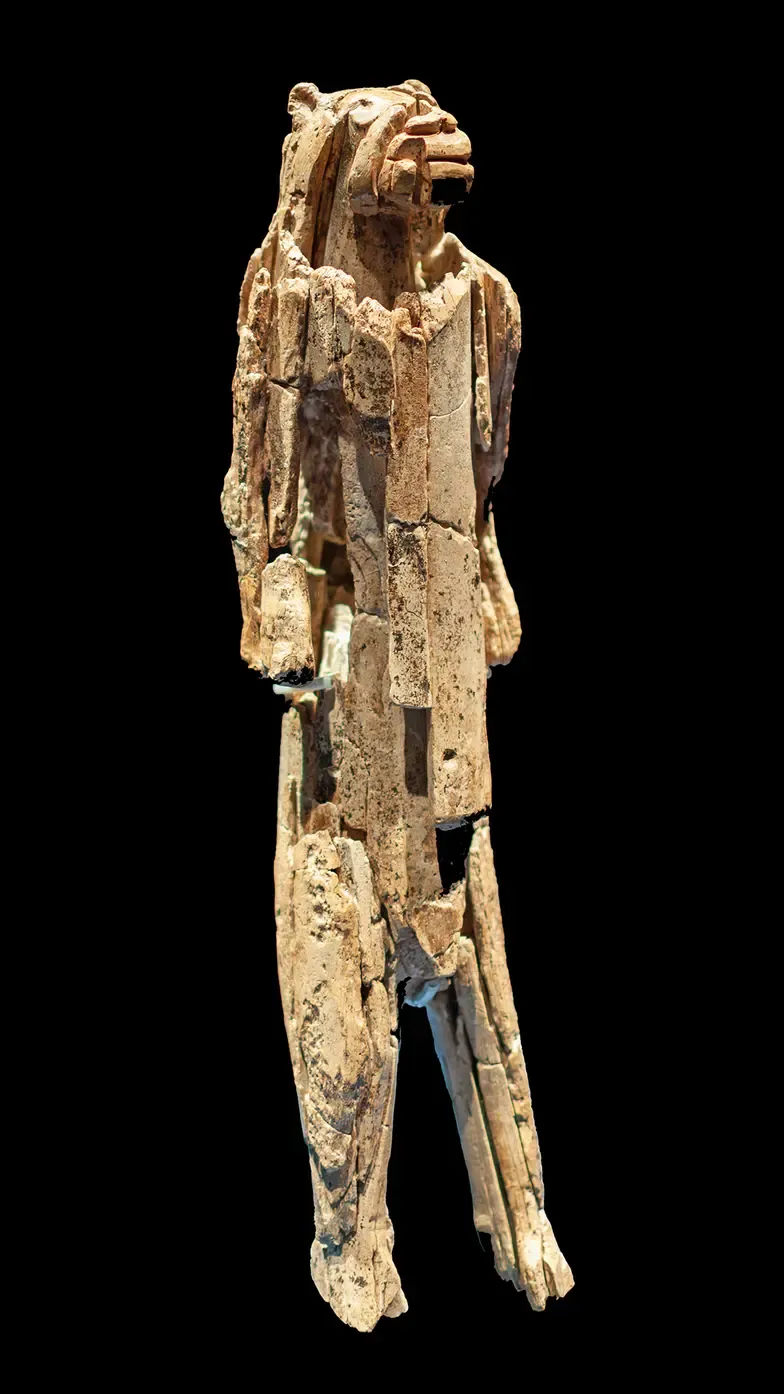
The first great cultural complex of pre-agricultural Europe that has so far been linked exclusively to H. sapiens is the Aurignacian culture, covering almost the entire continent. It appeared around 43,000 years ago and disappeared around 29,000 years ago — its members thus witnessed the extinction of the last Neanderthals. They left behind, among other things, stone points designed to be hafted onto wooden handles, as well as various works of art — such as the Lion-Man of Hohlenstein-Stadel, carved from a mammoth tusk — and the earliest paintings in European caves depicting hunting scenes.
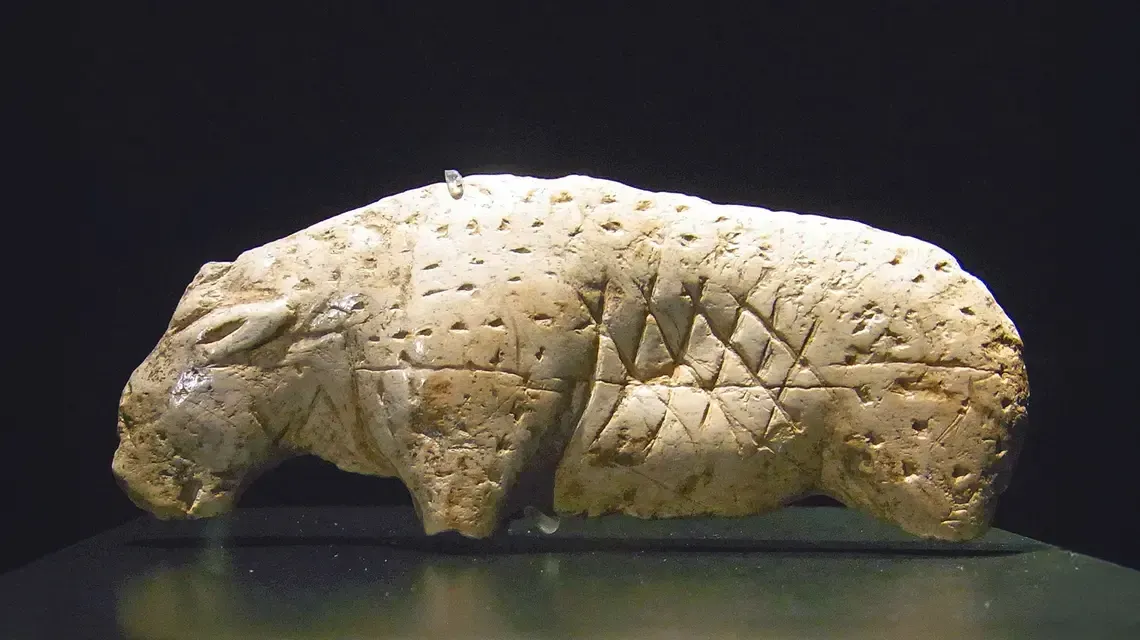
The creators of the Aurignacian culture carved geometric signs on many objects which, according to research published this year by Christian Bentz and Ewa Dutkiewicz, appear to form a system as complex as the earliest cuneiform writing. They may therefore have served to convey information. What kind? Several years earlier, a team led by Bennett Bacon put forward the hypothesis that hunter-gatherers of the Aurignacian culture and several later ones may have used dots, lines, and signs resembling the letter Y — placed on sculptures or alongside hunting scenes — to record information about the seasonal behavior of specific species (for example, when they give birth).
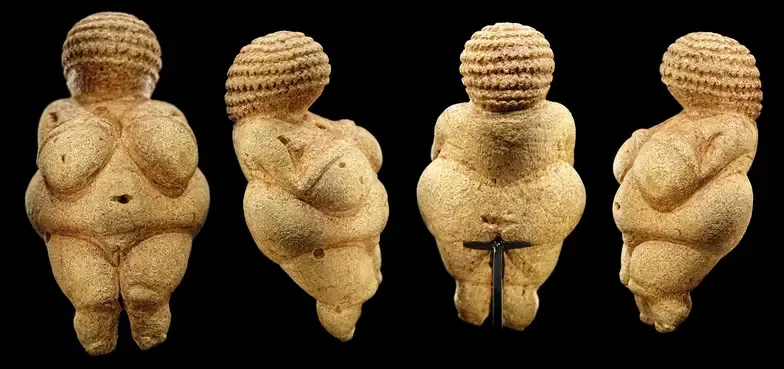
Other works of art — the famous Paleolithic Venus figurines — are a hallmark of a still younger complex: the Gravettian culture, present between 35,000 and 21,000 years ago, also covering almost the entire continent. The largest accumulations of mammoth bones date from the same period. It is not entirely clear whether the Gravettians hunted them themselves or made use of the meat, hides, and bones of animals that had died naturally, but traces of these people's presence are frequently found near large mammoth graveyards. Also associated with this culture are the earliest known examples of ceramics — fired clay figurines — which may have had artistic or ritual significance.
The last pre-agricultural cultural complex was the Magdalenian, present around 18,000–12,000 years ago. This is a time when the climate is warming and Europe, gradually filling with forest, is being traversed by herds of wild horses, bison, and reindeer. The most celebrated hunting scenes known from the walls of Spanish and French caves — Lascaux, Altamira — are precisely the work of the creators of the Magdalenian culture.
We still know relatively little about the genetic structure of pre-agricultural Europe, but genetic research published in 2023 reveals a complex picture of expansion, population interbreeding, and extinctions. A team led by Johannes Krause analyzed 356 genomes of hunter-gatherers from the period 35,000–5,000 years ago, representing various archaeological cultures. One of the more intriguing findings was that the Gravettian culture was in fact created by two genetically distinct populations (one from Central-Eastern and Southern Europe, the other from Western Europe), and that the descendants of this lineage survived for tens of thousands of years in refugia in southwestern Europe and passed their genes on to the Magdalenians.
The latter built their culture by spreading from the southwest to the rest of the continent, shortly after the Last Glacial Maximum (around 20,000 years ago), but they were soon to face an even greater challenge: the agricultural way of life, which appeared in Europe around 10,000 years ago with the arrival of people from Anatolia.
Orginally published in Tygodnik Powszechny, 9 June 2026. Translated with AI.