Weavers of History. A British Historian on the Place of Women in the ancient world

Share
Weavers of History. A British Historian on the Place of Women in the ancient world
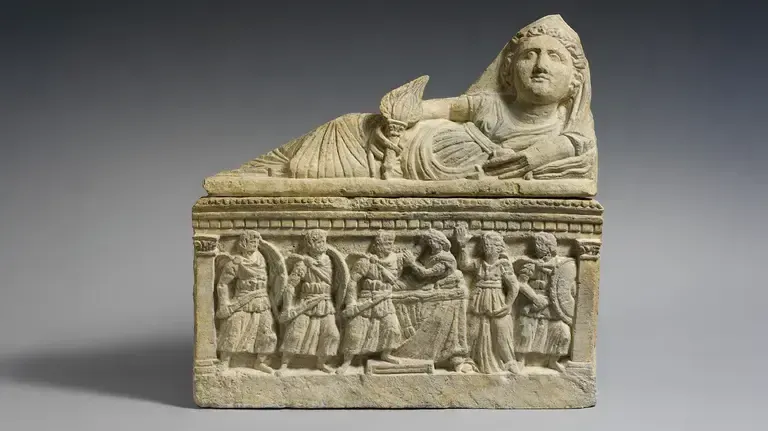
Etruscan urn, 2nd century BC. In Etruscan culture, women enjoyed a higher social status than in Rome or Greece at the same period. The frieze depicts a scene of a woman's murder — possibly the mythological Ismene, the youngest daughter of Oedipus // Alamy / BE&W

Daisy Dunn, scholar of the ancient world: On Roman tombstones, women were praised for their virtue and their spinning of wool. Yet without poets, priestesses, prophetesses, and rebels, the history of antiquity cannot truly be told.

By Kasper Kalinowski and Daisy Dunn


Kasper Kalinowski: What irritates you most about popular representations of women in antiquity?

Daisy Dunn: The simplifications, which are especially visible in films. Women are usually portrayed in one of two ways. Either they are shown as creatures incapable of anything beyond cleaning and weaving — entirely uninteresting and passive — or as manipulators, schemers, and murderesses plotting to kill their own husbands.

We almost never encounter anything in between. And how many women in the modern world can be described as "entirely evil" or "saintly"? Most of us fall somewhere between the two. It must have been the same in antiquity.
In The Weavers. A History of Antiquity and the Women Who Made It, I focused on what women did and how they shaped the history we know. It is a history of the ancient world — but one in which women have been given slightly more space than is usually the case.

Let us start at the beginnings of the West. What was life like for women in the Minoan civilization of Crete, whose origins stretch back 5,000 years?

This is one of the earliest civilizations in the western world. Unfortunately we have no literary sources, because the Minoans used Linear A script, which has still not been fully deciphered. We have only lists and administrative records, from which little can be extracted. We therefore do not know the names, we do not know exactly what kind of political system prevailed there, and we cannot be certain of anything — which is precisely what makes the Minoans so fascinating.

We base our theories on works of art and archaeology — the remains of palaces. We do, however, have a great many small clues suggesting that women may have occupied a high position. One piece of evidence is the luxurious "Queen's Quarters" at Knossos, equipped with bathrooms and a drainage system. In art, women are depicted in central positions and are sometimes larger than the male figures.

The central figure of the cult was probably one principal goddess, and the famous "snake goddess" figurines — showing women with bare breasts holding snakes — suggest that snake-handling was a skill reserved exclusively for women. Women also participated in dangerous acrobatic performances with bulls. They were accorded respect in ways that are entirely absent in later periods.

You believe the position of women in the Greek world deteriorated after the Trojan War. Why?

In the Minoan world, women also played an important role from an economic point of view. One of Crete's major export goods was textiles, produced by women. Later the island was taken over by the Mycenaeans, about whom we know somewhat more thanks to Homer — and the whole Minoan world collapses.

When we read the Iliad and the Odyssey — stories from Mycenaean times — warriors and strong men already dominate. The weight of social life had by then shifted more toward the battlefield.

The Trojan War may have been a historical event, or a description of a whole series of real conflicts, but in Homer's narrative it marks the end of the Mycenaean world and the end of the Bronze Age. The latter brought gigantic transformations across the entire Greek world. It was a time of mass migrations and a sharp decline in population. Today we also have evidence of climate change, droughts, a volcanic eruption, and intense rainfall during this period.

The misfortunes of women are visible in a story recounted by Herodotus. A group of Athenians sailed to Miletus, where they killed the men and raped the women, whom they made their wives. The women of Miletus are said to have sworn never to sit at table with their new husbands or to address them by name. The custom was said to have been passed down to subsequent generations.

Your book opens with Hesiod, who claimed that women were created to make life difficult for men, and with the myth of Pandora — who was supposed to be a punishment for men. Was this a popular view in antiquity?

Hesiod speaks of himself as a farmer. He was writing in a fairly harsh, rural setting. It is possible that in a more provincial region women were indeed seen as a nuisance. Many of his complaints come down to the fact that women want a roof over their heads and access to men's property. He saw them as "beautiful evil."

According to Hesiod, the first woman was Pandora, created at Zeus's command by Hephaestus as a pawn in the dispute between the king of the gods and Prometheus. She was a punishment for the theft of fire, and it was from her and from her jar that all the misfortunes of humanity began. Pandora, like her Christian counterpart Eve, represented in the minds of men the raw essence of femininity.

A similar attitude is visible in other poets of the period. Semonides of Amorgos, a contemporary of Hesiod, distinguished among women: sow-women, who did not clean their houses or wash their bodies but spent their days gorging; fox-women, whose attention nothing escaped; she-ass women, who gave themselves to everyone; thievish weasel-women; lazy mare-women; ugly monkey-women; and... bee-women. Only the last of these were industrious and clever.

The advice for other men is therefore: find yourself a woman who is like a bee. The analogies with contemporary culture are easy to spot.

Yet the first person known to us by name who created literary works was a woman — Enheduanna. Is she an exception?

The fact that she came from an elite family helped her work survive, but I do not think she was the only one. Enheduanna was the daughter of Sargon, king of Akkad and founder of a great empire in Mesopotamia around 4,300 years ago. For several decades she occupied the prestigious position of high priestess of the moon god Nanna at Ur, where she composed hymns and poems — the first author in history to sign her works with her own name.

Her stories are timeless. She also documented a personal tragedy: she fell victim to a man named Lugal-Ane, an enemy of her father, who raped her, abducted her, and tried to silence her "honey-sweet" mouth. The poet did not yield, however, and in a hymn she publicly accused her attacker and implored Inanna to punish him.

In antiquity, religion and poetry were closely intertwined. Women in religious service had the right to compose hymns and tell stories. While working on the book I was struck by how many women in the ancient Near East — particularly in the Persian Empire — had their own voice, owned property, managed funds, and organized banquets.

Alongside the high priestess Enheduanna there were also temple prostitutes. What do we know about this phenomenon?

Similar stories recur across different cultures. Evidence for the universality of sacred prostitution is lacking, though there are accounts of women offered by their own families for religious reasons.

The mythical founder of Carthage, Dido — we are speaking here of the turn of the 9th and 8th centuries BC — is said to have brought from Tyre some eighty girls who, according to custom, earned their dowries through prostitution, giving themselves to foreign visitors on the coast. A similar tradition is said to have existed in Cyprus, where girls earned their dowries by giving themselves to strangers, and the goddess Aphrodite was later believed to protect their virtue. According to Herodotus, the inhabitants of Lydia also had a custom of prostituting their daughters as a means of accumulating funds for their dowries.

We know that harems existed at the Persian court to serve the ruler, though we would not call these women prostitutes in the same sense as the workers in Roman brothels. Their status was complex.

It was around this time that the most famous poet of antiquity was writing — Sappho.

Sappho became a legend, but today she is often attributed characteristics she did not have. She was born in the 7th century BC, around 80 years after Hesiod, into a wealthy family. She appears to have grown up in a culture considerably more liberated than the rest of the Greek world, which gave her self-confidence. Her life was not easy — as an aristocrat she experienced exile to Sicily for political reasons. It is often forgotten that she wrote beautiful poems for her daughter — for instance about buying her a headband from Turkey. She was a multidimensional figure.

Important is the place where she wrote: the island of Lesbos. In antiquity there existed a Greek verb lesbiazein, meaning "to behave like a woman from Lesbos" — referring to sexual behaviors attributed to women from that island. Erotic scenes from Lesbos depicted on Roman and Greek vases have often been interpreted as an expression of female independence, though they were also an element of male fantasy.

Was religion a refuge of freedom for women?

Religion was the only socially accepted way for women to leave the home, giving them a degree of autonomy of thought and action. In Greece, the priestesses of some cults were required to make sacrifices — such as shaving their heads or surrendering their property — but in return they were freed from daily life: from laundry, cooking, and raising children. In Athens, the role of priestess of Athena Polias — that is, Athena as guardian of the city — was the most respected position held by a woman.

In Rome the Vestal Virgins were of enormous importance. Although they were required to maintain their chastity for 30 years, it was believed that the fate of the empire depended on them, since they tended the eternal flame. Were it to go out, it would be a bad omen for the entire state. The Vestals were among the very few women who enjoyed freedom of movement and the right to make their own wills without a male guardian.

Can we then regard the Pythia, who presided over the oracle at Delphi, as a powerful politician?

Yes, she was a politician — though no one at the time would have said so directly. She offered her wisdom for only nine days a year. She delivered her prophecies in a trance-like state, induced in all probability by inhaling natural gases rising from fissures in the rock at Delphi.

She was visited by kings and statesmen from across the Greek world, who sought her counsel before wars and invasions. The most famous example is Croesus, who, after receiving an ambiguous prophecy about the destruction of "a great empire," resolved to go to war with Persia — bringing about the downfall of his own kingdom. During the Persian Wars, the Pythia — known to us by name as Aristonice — predicted that the enemy would flood Attica. Thanks to her advice, most of the inhabitants of Athens managed to evacuate to safety in time.

We have convincing evidence that the Pythia was bribed on numerous occasions to give an answer favorable to one party or another — Sparta, for example. Its authorities frequently justified expansion by invoking the words of the oracle. She was neither infallible nor immune to manipulation, but her words were taken extremely seriously, even though they were often unclear and ambiguous. Sadly, we know almost nothing about the many other women who served as prophetesses.

From antiquity we also know figures such as Queen Boudicca — the leader of a revolt against the Romans in the British Isles in the 1st century AD. Did women take part in wars?

Not necessarily in the front line, but they were present in military camps. They accompanied King Darius, for example, before his battle with Alexander the Great.

In the Roman world, an extraordinarily interesting figure was Fulvia, the wife of Mark Antony. During the siege of Perusia in 41-40 BC, Octavian's soldiers hurled lead sling bullets at the defenders bearing obscene inscriptions such as "I aim at Fulvia's clitoris." It was she who commanded the defense and addressed the troops.

And might the legend of the Amazons be partly true?

I believe they existed. They were described as "equal to men." Today they are associated with women from nomadic Scythian tribes on the shores of the Black Sea, who grew up in the saddle and took part in fighting. In this region, skeletons of women have been found bearing skull injuries typical of combat; they were buried with weapons. They were distinguished by shaved heads on which they wore wigs, and by elaborate tattoos. It was they who inspired the myths. The Greeks encountered them around the 7th century BC.

Before we move on to Rome, we must mention the Etruscans. Why were the Greeks shocked by the customs of Etruscan women?

The Etruscans were fascinating. Their women enjoyed respect and an extraordinary degree of social freedom. Unlike Roman women — whose names were the feminine forms of their father's family name — they had names of their own and could write.

The Greeks spoke of them with outrage, because these women could dine with men, lying with them under the same blanket and drinking wine. Archaeology confirms this: on sarcophagi we see sculptures of couples lying under shared covers. The Greeks exaggerated, claiming that Etruscan women slept with so many men that they did not know who fathered their children. The truth was simply that they had greater freedom — they took care of their appearance, wore beautiful jewelry, and used cosmetics.

On one Etruscan mirror case, a woman declares: "I will win," to which her partner replies slyly: "I doubt it." The couple is depicted as young and semi-naked, engaged in entertainment — a game resembling modern backgammon. The image radiates a modernity and ease of manner that one simply does not find in Greece at that time.

With the dominance of Rome, did everything change?

Rome was an extremely patriarchal society. In the early founding myths, there was almost no place for women. Only when the Romans realized that their city could not survive without offspring did the famous Rape of the Sabine Women take place — which says a great deal about the position of women.

In that story, women were for the Romans a belated afterthought, something considered only after the fact. The ideal Roman woman, as funerary inscriptions reveal, was to be devout, virtuous, loyal, and... excellent at weaving. The formula that constantly recurs in inscriptions reads: she spun wool beautifully. Sometimes that was the only thing written about a woman.

And yet Roman matrons were capable of taking to the streets. In 190 BC they blocked access to the Forum, demanding the repeal of restrictive laws.

Over time, Roman politics became increasingly dependent on women. Some of them held real financial power. During the wars with Carthage, they were repeatedly asked to donate their jewelry and money for the war effort. Men frequently married them precisely for their fortunes. This protest showed that women had had enough of living in times of austerity and, after years of war, wanted a return to normality — to their clothes and their jewels. Although they officially could not sit in the Senate, their influence over husbands and brothers was enormous. Many politicians in the late Republic made decisions under the influence of their wives.

Even the reforms of Octavian Augustus were shaped by his conviction that women had gained too much power, which he claimed was leading to immorality and divorce. The laws enacted by men cannot be understood without understanding the role that women were playing at the time.


Orginally published in Tygodnik Powszechny, 2 June 2026. Translated with AI.

Read more