Animals Can Learn What Death Is. But They Will Understand It Differently From Us

Share
Animals Can Learn What Death Is. But They Will Understand It Differently From Us

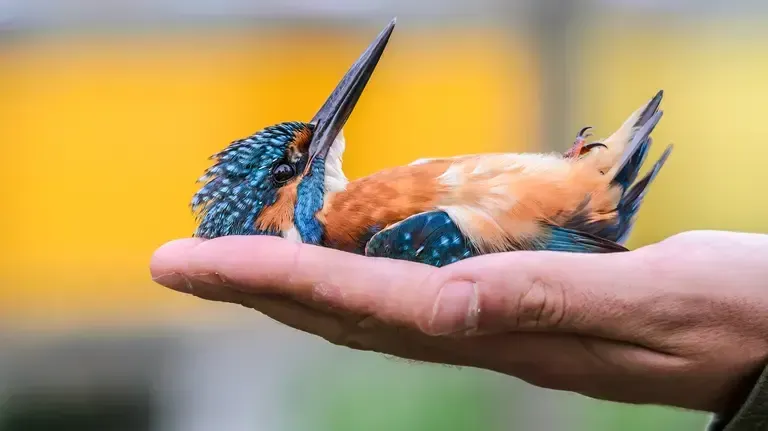
The common kingfisher can freeze motionless to confuse predators or make itself less visible to them // Photo: Raffaella Coreggioli / Adobe Stock

Philosopher Susana Monsó: Many of us have watched a cat torment a mouse without killing it. The killing bite is distinctly different from that cruel play. This is evidence of cognitive control over behavior. The cat chooses when it kills.

By Maria Hawranek and Susana Monsó


Maria Hawranek: Is the view that animals possess minds still controversial among researchers?

Susana Monsó: Among comparative psychologists, no — animal minds are the subject of our research, and we agree that animals have beliefs and desires that guide their behavior. Controversy is more likely to arise around the question of whether they have consciousness. In the history of philosophy, however, which takes a very intellectualist view of what it means to have beliefs or desires, there have been many who consistently defended the idea that animals have no minds at all.
You work in comparative thanatology. What is that field?

It sets itself the goal of studying how animals respond to dead or dying individuals, and of analyzing the physiological processes that underlie those responses. It also considers what these behaviors tell us about animal minds. The field was founded by James Anderson, a comparative psychologist.

Few researchers work in it full time, but many biologists and primatologists who observe populations of a given species over long periods record observations about death and publish them in field reports. Several academic conferences have already been held on the subject, but it is a difficult field to work in because of ethical and environmental constraints.

The immediate impulse for the field's creation was the death of a chimpanzee named Dorothy in 2008 at a chimpanzee sanctuary in Cameroon. The other chimpanzees seemed to accompany her on her final journey as the keepers carried her out of the enclosure.

Do comparative thanatologists agree on how animals understand death?

They do not, in fact. It is a very anthropocentric field, and many of its representatives adopt very intellectualist or emotionalist criteria for the concept of death that exclude most animals from the possibility of having it. That is why I proposed what I call the Minimal Concept of Death, which limits itself to recognizing two features: the non-functionality of bodies and the irreversibility of that state. If an animal understands these two aspects in relation to a body it encounters, then it understands the concept of death.

Anderson is more interested in complex aspects that resemble the human understanding of death. For me, the question of how animals understand death is interesting in its own right, even if they understand it differently from us.

In your book Playing Possum: How Animals Understand Death you write about ants and necrophoresis — the carrying of dead colony members outside the nest. But this behavior does not indicate that the insects understand what has happened to the bodies they carry. Why not?

In ants, it is a stereotypical, not a cognitive, response to a chemical substance released by dead ants. You only need to smear a living ant with oleic acid, and the other ants will carry it out of the colony — even if the ant is moving and clearly protesting. Ants therefore do not grasp death; they simply have genetically encoded responses to specific environmental stimuli.

So which species meet the criteria of your Minimal Concept of Death?

The concept of death in its minimal form is probably widespread, because the conditions I set — understanding the non-functionality of a dead body and the irreversibility of that state — are easy to meet and essential for survival. Think of predators, for instance: their hunting strategies, whose success rates in many species are very low, and the threat posed by prey to the predator — a buffalo to a lion, for example.

Hunting situations force animals to observe the moment of death carefully and draw conclusions from it. We can therefore expect many animals to understand death, particularly when they combine cognition with emotion and experience — what I call the "holy trinity of the Concept of Death."

What do you mean by this "holy trinity"?

By cognition, I mean that animals are capable of understanding that the vital functions of an individual have ceased, and they stop expecting behaviors from it that would be characteristic of the living — expecting instead things characteristic of the dead. The ants mentioned earlier do not demonstrate this.

Experience means the opportunity to be in contact with death and corpses. Animals raised in isolation, such as household pets, have no opportunity to develop a concept of death, because they cannot experience contact with the dead bodies of others and learn what death means.

Emotions cause animals to take an interest in corpses, and as a result they also acquire knowledge about death. These three factors are necessary for a concept of death to develop in an animal.

Why should we not treat it in binary terms — either animals have it or they don't?

Let us look at our children. Their understanding of death does not arise overnight; it usually takes them several years to fully grasp what it is. The rarer their opportunity to interact with the dead, the harder it is for them to understand — and in Western culture today that opportunity is very limited, because the dead are taken away from our homes. The concept of death exists on a spectrum, in humans and animals alike. It is multidimensional and can take different forms.

Another mistaken assumption concerns the uniformity of our minds. In reality, every person, by virtue of their experiences, has a slightly different concept of death, which changes over the course of their life. In animals, the same applies. How we understand death will therefore differ both between species and between individuals within a given species. In humans, religious beliefs and cultural customs also play a role.

In your book you describe two extreme behaviors relating to offspring. One is carrying a dead infant — common in chimpanzees but also seen in orcas. The other is infanticide. What do they tell us about animals' understanding of death?

In 2018 we followed Tahlequah, an orca whose calf died half an hour after birth, and who for seventeen days of ocean travel carried its body across thousands of kilometers, barely eating or sleeping. Such animal behaviors arouse our empathy and sense of connection. But when approaching the analysis of the concept of death, we must rid ourselves of emotional anthropocentrism.

If we follow that anthropocentrism — if we look only at behaviors that resemble human ones, such as grieving after the death of a child — we will arrive at only a partial understanding of animals' relationship with death. Besides, how can we be certain that what Tahlequah experienced was an experience similar to what we call grief?

You wrote that grief, understood as a stress or sadness response to someone's death, is not necessarily evidence of an understanding of death, but it is certainly evidence of strong emotional bonds.

And yet the carrying of dead infants, most common among primates, has received far more attention in the comparative thanatology literature than infanticide, which is far more common in the animal kingdom. We are moved by images of mothers carrying the bodies of their children, nursing or grooming them.

These are of course important behaviors that tell us something significant about animals, but we cannot focus on them alone. All the more so because carrying dead infants is not the best place to look for evidence of an understanding of the concept of death. A mother and child are bound by a powerful emotional bond, which may lead the mother to want to treat the child as if it were still alive — to groom it, hold it, nurse it, carry it.

Besides, the question of whether animals grieve is an entirely different question from whether they understand death. Unfortunately, the thanatology literature conflates the two.

You write that we should guard against both anthropomorphism and anthropectomy. What is that second concept?

I borrow it from Kristin Andrews and Brian Huss, who coined it out of a need to complement the concept of anthropomorphism — to add the other side of the coin. It comes from the Greek words anthropos — human — and ectomy — to cut out. If anthropomorphism is the error of attributing human characteristics to an animal, anthropectomy is the erroneous denial of human characteristics to an animal.

Historically, among scientists there has been a tendency to regard negative errors as less harmful or dangerous — denying animals certain capacities can even be seen as a sign of rationality, caution, cool-headed judgment. And yet this too is an error, one that leads us to a false description of reality and mistaken assumptions about animals. There is no reason to value one of these errors more than the other.

Let us return to infanticide.

In the case of infanticide, what is a loss for the mother is a gain for other members of the group — that is why animals kill. And since they are capable of intentionally causing death, they must understand what death is. Among hyenas, infanticide accounts for as much as 20 percent of juvenile deaths, and in some chimpanzee communities as much as 60 percent. There are many hypotheses to explain the phenomenon. According to one, a male kills an infant in order to copulate with the female and father his own offspring with her.

It has been observed that a male will sometimes stalk a mother and her infant for hours, days, or even weeks, waiting for a moment of her inattention in order to snatch and kill the child. Very rarely is the mother harmed during such an attack. This is evidence of strong cognitive control — the male knows what he is doing and what will happen as a result.

Let us remember that animals are not immersed in our culture; they do not share our sense of political correctness or our social norms. They may feel various emotions — sadness, joy at climbing the social ladder, fear that a companion's death signals nearby danger — and they may also respond in ways unlike ours, for example by eating parts of a dead individual.

Orcas, on one hand, are capable of carrying a dead calf for many days; on the other, they kill narwhals without any need to eat them and toss parts of their bodies around like a ball. Dolphins may help a dying companion — at Kyum Park, a group of twelve common dolphins was observed lifting a companion with paralyzed flippers to the surface so he could breathe — but they also kill porpoises in elaborate ways and then do not eat them. Probably for practice or... for fun. In this respect they resemble humans.

It is just that this aspect of humanity is one we contemplate with discomfort, which is why we usually do not look for such examples of death-related behavior among animals. The key is to approach the subject with an open mind, ready to accept and integrate knowledge regardless of whether it aligns with our beliefs or wishes. Respect for animals also means not expecting them to behave like Disney characters.

Many of us have witnessed a cat cruelly toying with a mouse without killing it. Research has shown that the killing bite is distinctly different from the playful behaviors that precede it. This may be an unpleasant but nonetheless compelling piece of evidence for cognitive control over behavior — the cat chooses when to kill its prey.

On the cover of the English and Spanish editions of your book there is a possum — an animal that is expert at playing dead, but does not necessarily understand what death is.

In the possum, this response is probably stereotypical in situations of threat, on much the same basis as the narrowing of our pupils or our hair standing on end. Bodies simply do this; there is no conscious decision involved. From an evolutionary perspective, however, there must be some explanation — how did the possum come to develop this complex behavior?

When threatened, a possum undergoes paralysis: it falls onto its side into a fetal position, curls its tail, opens its eyes and mouth wide, sticks out its tongue, its color changes to blue. The animal does not respond to external signals; it drools, urinates, defecates, and emits a repulsive odor.

This response — known as thanatosis — probably evolved from the more widespread phenomenon of tonic immobility, which also involves freezing. Young fire ants undergo tonic immobility when another group of ants invades their colony, and some toxic species of frogs freeze in a way that provokes a predator to try to swallow them — only to spit them out immediately and whole. After that, the predator remembers what it is dealing with.

In the possum, body temperature drops by 0.6 degrees Celsius, heart rate by 46 percent, and breathing by 31 percent. None of this could have happened by chance in evolution, and there is no physiological reason for these responses to appear simultaneously. The only thing that connects them is a semantic property. The best explanation we can therefore offer is that the possum's behavior is evidence of a concept of death in the minds of its predators.

And yet they have not learned to distinguish dead possums from ones that are playing dead.

In the possum, many favorable circumstances converged: it is hunted by various animals — coyotes, foxes, snakes, birds of prey — it has no single specific predator, and these animals also have a broad diet. But since all of them are fooled by the possum and are capable of classifying it as a corpse, this means they have a generalized concept of death that applies across different species.


Susana Monsó // Princeton University Press

SUSANA MONSÓ is a professor of philosophy at the Universidad Nacional de Educación a Distancia in Madrid. She works on animal minds and animal ethics. Her book on animals' understanding of death has been translated into 13 languages.


Originally published in Tygodnik Powszechny, 26 May 2026, Translated with support of AI.

Read more