Why Caravaggio Moves Us: We Put It to the Test at His Rome Exhibition

Forgotten by his own era and rediscovered only decades later, he speaks to us with tremendous force. Rome has just opened an exhibition of Caravaggio's religious paintings — the ones in which the saints have dirt under their fingernails.
By Grzegorz Jankowicz
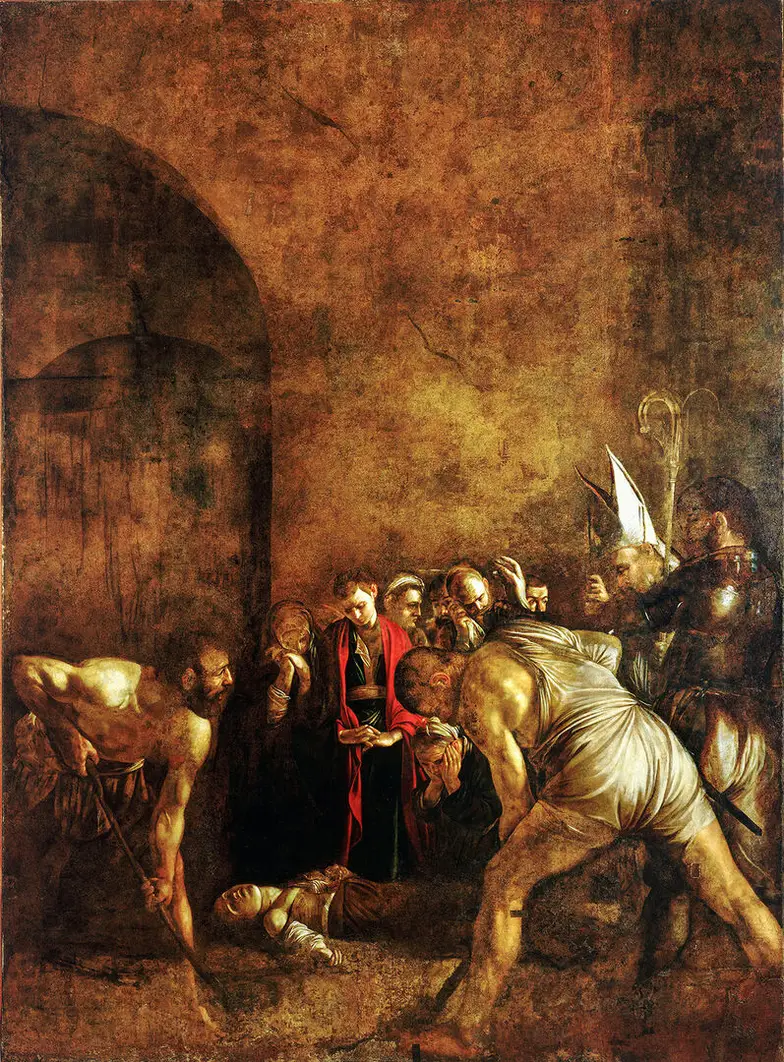
A few years ago I visited the Sanctuary of Saint Lucy in Syracuse. I was not making a pilgrimage to a "sacred site" (it is said that it was here, on 13 December 304, that Lucy was martyred when a spurned suitor denounced her as a Christian) — but, more prosaically and in a sense more banally, to see the painting kept there. In the autumn of 1608, Michelangelo Merisi da Caravaggio arrived in Syracuse. He needed money more urgently than usual, and since he could not stay in the city for long, he quickly agreed to paint a picture depicting the burial of Lucy.
The work is placed behind the altar, in the apse, so it is best seen when standing directly opposite the chancel. In the foreground are two gravediggers — powerfully built and absorbed in digging. To be precise, only the one on the right is actually working. The other, bent over a spade driven into the earth, looks toward a priest surrounded by a group of people — mostly the faithful, but soldiers too — performing a farewell rite. Between the gravediggers, somewhat further back, lies the limp body of Lucy. The dark lower part of her dress merges with the earth. Her head is partially tilted toward the viewer, her neck unnaturally positioned with a visible wound; her left hand rests on her chest, her right lies loosely with the palm open toward an absent sky.
This order of description is suggested to me not so much by the eye as by a mind trained to seek out figures and objects. In reality, what greets those entering the church is a dark — rust-brown — enormous shape, as though someone had hollowed out a cave in the rock behind the altar, drawing into it everyone and everything. The dominant and overwhelming element of the painting is the background, whose model must have been the Syracusan latomie — the quarries used as prison dungeons by the tyrants who ruled here. One wonders why the gravediggers are digging a grave when the entire world imagined by Caravaggio already is one. Unless their task is to deepen the catacombs.
While still outside, I had noticed that a wedding was taking place in the sanctuary. Inside, gazing (greedily) at the canvas and (discreetly) at those gathered, I kept asking myself how it was possible that the young couple could sustain their joyful elation with such an overwhelming scene before them. I don't know whether it was love that protected them, or a sense-numbing habit (if they were locals, they must have been encountering Caravaggio's vision since childhood) — but to the heavy luminescence emanating from the canvas they did not react at all. "Why aren't they running away?" asked the person with me.
A Sojourn on the Margins of the Great World
Caravaggio arrived in Syracuse after more than two years of unbroken flight. He was wanted in Rome for the murder, committed in May 1606, of the pimp Ranuccio Tomassoni, with whom he had reportedly quarreled during a game of pallacorda (resembling modern tennis). Some biographers maintain that the popular pastime was merely a pretext, and that the true cause of the dispute — or perhaps of an organized duel — was Caravaggio's affair with Lavinia, Tomassoni's wife, or rivalry for the favors of one of Tomassoni's prostitutes, Fillide Melandroni, who fascinated the artist (her features can be recognized in several of the figures he painted). Others claim that Caravaggio had a child with Lavinia, and had abducted Fillide intending to profit from her trade himself.
At the time of the murder, the painter was approaching his 35th year. He was considered extraordinarily talented, and many wealthy residents of the eternal city made use of his services. But the works of religious subject matter he produced aroused extreme reactions. He took his models from the street, adhering to the conviction that a Gypsy woman walking across a piazza deserved to be immortalized more than the nobly born. He was accused of deliberately degrading the saints, whom he depicted as ordinary people — entangled in everyday affairs, afflicted by illness, caught almost by surprise by the grace of faith — and who therefore appeared in biblical scenes with dirt under their fingernails and in torn clothes.
He ended up in prison many times over brawls, robberies, slander, illegal possession of weapons, and theft — but someone always extended a helping hand. Even his most influential clients, however, could not protect him from punishment for murder. He first took refuge in the hills outside the city, then in a village near Palestrina, where he found hospitality with the Colonna family, friends of his.
Life on the margins of the great world was torture for Caravaggio. At the Colonnas' he was safe, but real life was happening in Rome. Part of this was about art — about the realization of a certain idea that had formed the basic driving force of his work from around 1597 (more on this shortly). But it was also about the rhythm of metropolitan existence, about its dizzying intensity, which allowed one to forget the passage of time — the only adversary Caravaggio truly feared.
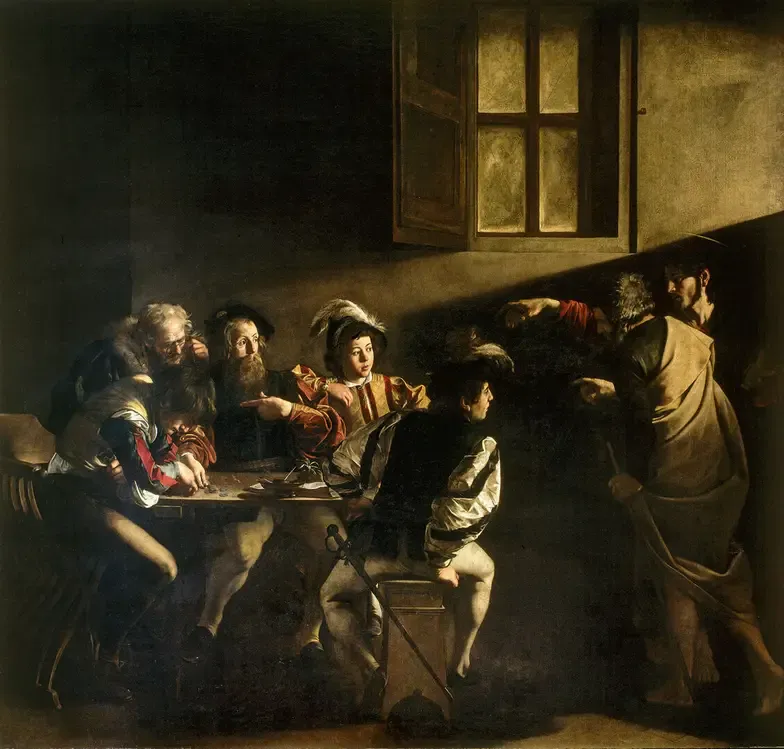
Unable to return to the center, he sought its semblance in Naples. He had to paint in order to survive, but the growing conviction that he was being hunted also drove him to work. He began sleeping in his clothes with a weapon beside the bed. Working on The Seven Works of Mercy for the chapel of the church of Pio Monte della Misericordia, he was not only studying the Gospel according to Saint Matthew but also reflecting on the structure of Neapolitan society — and society in general — analyzing the sources of its tensions, and arriving at the conclusion that the truth about a person can be captured not when they perform a good deed, but when they are pierced by a spasm of suffering or ecstasy. Hence — I believe — his recurring return to the motif of parted lips: a sign of terror, bewilderment, stupefaction, anger, and more rarely of wonder or rapture.
The Breathless Flight
Rome called to him with tremendous force. He resolved to travel to Malta, to seek admission to the Order of the Knights of Saint John. As a member of the venerable Order of the Hospitallers of Saint John, he might receive a pardon from the Pope and — perhaps — finally return to the city, that is, to himself. Circumstances favored his plans, as the Knights were looking for a skilled painter. Although the Order admitted almost exclusively those of noble birth, Caravaggio managed to convince the Grand Master Alof de Wignacourt that he deserved the honor. And when it seemed he had finally gained control of his fate, his temperament asserted itself once more.
For a long time historians believed that Caravaggio had concealed from de Wignacourt the fact of the murder, and that when it came to light he was arrested. It is now known that the reason for his arrest was a furious attack on Giovanni Rodomonte Roero, one of the highest-ranking knights of the Order. The artist was thrown into an underground dungeon in the Fort of Sant'Angelo. He managed to escape after a month — no small achievement, since it was considered the most impregnable military installation of the time.
What followed was little more than a breathless retreat punctuated by brief halts. Nine months in Sicily — on the way, the already-mentioned Syracuse, then Messina and Palermo (in each place he produced outstanding works). Then a return to Naples, where someone attacked him — perhaps Roero accompanied by hired assassins, or vengeful associates of Ranuccio — and beat him so savagely that Caravaggio lost his face (literally as well: after the beating he was unrecognizable) and the use of his hand, which affected the way he painted his subsequent canvases.
It is not certain what happened next. According to some accounts he was arrested again before boarding a ship for Rome (the vessel sailed off with his belongings and paintings, including an unfinished Saint John the Baptist). Released from prison, he set off in pursuit of his lost goods in a small boat, but something went wrong and he put in at a port, continuing his journey on foot along the shore. Biographers suspect he died at Porto Ercole from exhaustion or malaria.
Today the small town contains a modest monument to Caravaggio: primarily a cloak thrown over a travel chest, also covering a saber. The insignia of the artist-fugitive.
Return Home
I recount these four years in such detail in order to bring Caravaggio's temperament a little closer. The biography of the artist simply cannot be overlooked — not least because the emotions he aroused in his contemporaries influenced the reception of his work. Giovanni Baglione, a Baroque painter and art historian, maintained that the author of The Burial of Saint Lucy deserved no recognition, since his paintings were devoid of the splendor of truly inspired art — that in fact they were not art at all.
Caravaggio could only imitate, Baglione argued — whether other masters such as Giorgione, or nature itself — and on top of that he had not a jot of imagination, which was why he gave his figures such repellent exteriors. He simply could not tear himself away from reality. This crushing criticism should come as no surprise: in 1603 Baglione had taken Caravaggio to court for defamation. Merisi loved a quarrel; in a little poem composed with friends, he apparently wrote of Baglione's works that the best use one could make of them was to wipe one's backside.
The necessity of fleeing Rome, and then his premature death, gave Caravaggio's army of opponents the advantage in shaping the memory of him. Hard to believe today, but for several hundred years the painter virtually disappeared from the artistic scene. The turning point came only with the retrospective exhibition organized by Roberto Longhi in 1951 at the Palazzo Reale in Milan.
Half a million visitors saw it, and Caravaggio returned to favor practically overnight. He began to be presented as a visionary in search of a pictorial form capable of expressing a modern sensibility. Books, essays, and biographical films poured forth. Subsequent exhibitions — few, but always attracting enormous interest — consolidated his status and opened new interpretive perspectives.
"Caravaggio 2025": An Exhibition for the Jubilee
On 7 March, an exhibition titled Caravaggio 2025 opened at the Palazzo Barberini in Rome. The pretext for organizing it is the Jubilee Year, which in the Christian tradition is a reminder of the divine provenance of the human person. Its organizers have chosen to draw attention to the religious dimension of Caravaggio's work, tracing his creative path from his arrival in Rome in mid-1592 until his flight. Twenty-four works are presented in four lower rooms of the palace. The rooms form an arc — which might be taken as an unintended metaphor for the fate of an artist who did not manage to close the circle of his life and return to the city.
Merisi was born in Milan, grew up in the town of Caravaggio — where the family had taken refuge from plague — then traveled to Venice, where the paintings of Giorgione genuinely captivated him. Though on arriving in Rome he had no prospect of swift employment, he concluded that only there was it worth creating. He was eventually taken on at the workshop of Giuseppe Cesari, considered a ruthless operator who sought not pupils but obedient subordinates. In his first period Caravaggio worked as an assistant painter, completing decorative elements — flowers and fruit.
The exhibition at the Palazzo Barberini begins with works that would not have existed without Caravaggio's experience as a journeyman. Immediately to the left of the entrance is a "permanent resident" of the palace — part of its collection — the Narcissus. As famous as it is controversial, since researchers have for some time been questioning its attribution. The decision to place this painting here seems inspired: after all, struggle with oneself and uncertainty of fate were essential elements of the artist's path. Even if the image of Narcissus gazing into the abyssal depths of a dark pool was painted by another hand, Merisi might have recognized it as his own symbolic portrait.
In the same room are lighter works, including one of the two versions of The Fortune Teller, Boy Peeling Fruit, The Cardsharps, and The Concert. And also Sick Bacchus — most probably a self-portrait painted during a prolonged illness. Caravaggio ended his collaboration with Cesari after a quarrel. Some point to artistic differences as the cause — more precisely, the conviction forming in Merisi that the purpose of art is not to beautify reality but to approach as closely as possible the rough matter of existence.
In the second room one can view, among others, two portraits of Maffeo Barberini — a church dignitary and later Pope Urban VIII — for whom the palace hosting the exhibition was designed. It is known that Caravaggio painted more portrait works in Rome, but most have been lost. One of those presented here is privately owned and not normally accessible to the public. The display of these two canvases is treated as a symbolic return of the owner to his home.
Caravaggio's Double Self-Portrait
The organizers have ensured excellent lighting for each work. The palace is kept in half-darkness. Precise, carefully directed point lighting draws individual paintings out of the dark — a perfect counterpart to their contrasting style. One can really "see" each picture only when standing directly in front of it. The convex mirror in the famous The Conversion of the Magdalene, with its darkened surface and single point of light suggesting an external source of grace, is like a magnet drawing not only the eyes of those who look at it but everything within its reach. Standing before that work, I had the sense of a subtle but unyielding gravitational force holding me in place, preventing any movement.
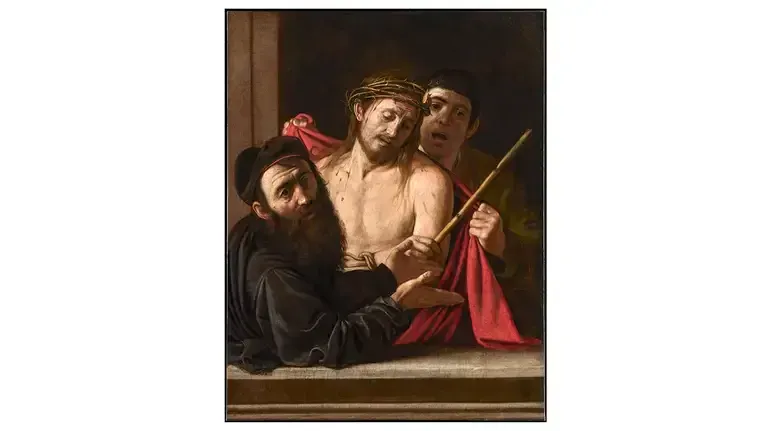
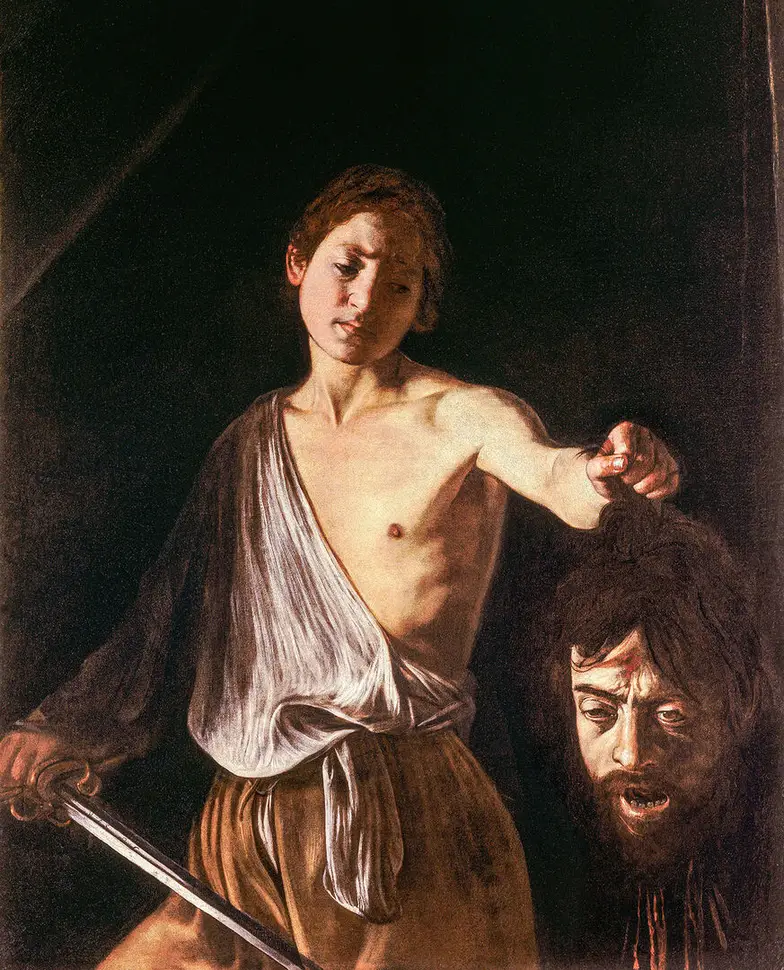
I overcame it, however, since ahead lay things well known but never before presented together in one place in such a combination: Judith Beheading Holofernes (it is in the face of Judith that one can recognize Fillide's features); David with the Head of Goliath (the version from the Borghese Gallery in Rome, not the one in the Kunsthistorisches Museum in Vienna — a double self-portrait by Caravaggio: the young David gazes with compassion at the seemingly disfigured head of Goliath; the painting may have been made after the Naples attack on the artist); Ecce Homo ("discovered" in 2021 at a Madrid art auction, originally valued at 1,500 euros as a work by José de Ribera)...
Moving from image to image, one can discern the process by which a certain idea becomes concrete. Initially its presence is only suggested; later it becomes distinct, permeating every form imagined by the artist. It connects them to one another, but does not bestow full coherence on the representation — which is why the frenetic state of the depicted figures communicates itself to us.
Always the Light
I saw the exhibition twice. The first time in the morning, entering the palace with the spring sun in my eyes. The second time in the evening, walking out afterward into the darkened streets of Rome. I exaggerate slightly, since of course there were many sources of artificial light — but I am writing not about what was there, but about what I saw — what I could see — after the encounter with Caravaggio's canvases.
The organizers encourage visitors to seek out other works by the Baroque master elsewhere in the city. Some await where they have always been — in the church of Saint Louis of the French, for instance. Fans of the series Ripley (based on Patricia Highsmith's novel) will likely remember the place. The protagonist — a brilliant psychopath who steals the identity of a wealthy young man and attempts to sever himself from the past forever — comes here to look at works by Caravaggio.
The fictional Ripley is interested in painting, but Highsmith does not mention his fascination with Merisi. That thread was added by the creators of the series. An attentive viewer immediately recognizes it as yet another appropriation of Ripley — but there is also a superb and at the same time perverse interpretation of Caravaggio's work embedded in it.
Ripley enters the church and stands before the paintings. To see them, he must drop a coin into a box that activates the lighting mechanism. We hear the sound of a ticking clock. Time is running out, so Ripley's eyes dart from one canvas to another, concentrating on details. A priest approaches him and pronounces a curious formula: "La luce, sempre la luce." The implication: it is always about the light.
This is an illustration of Caravaggio's worldview and his artistic intention. The world is steeped in darkness, and within it we thrash about like prisoners of the ancient quarries. We can count on occasional flashes — points of light that cleave the dark for only a moment. We imagine that the light comes to us from elsewhere. We want it to be so, because then even the feeblest ray would give hope of something other.
Caravaggio does not settle the matter. He seems not to be interested in debating it at all. He feverishly paints successive images of a person utterly entangled in existence, because the creative gesture alone strikes him as a meaningful response to the experience of pain. The abundant sources of pain spring in the same place where something we sometimes call time is born. Ripley understands Caravaggio, but draws a false conclusion from his existential diagnosis: that light can be purchased (hence the coin dropped into the box).
Leaving the Sanctuary of Saint Lucy in Syracuse, I said to my companion that I had no idea how, after gazing at Caravaggio, one could believe in God. The reply I received was: how, after experiencing something like this, could one not?
The exhibition "Caravaggio 2025" at the Palazzo Barberini in Rome (curators: Francesca Cappelletti, Maria Cristina Terzaghi, Thomas Clement Salomon) will be open until 6 July 2025.
Orginally published in Tygodnik Powszechny, 25 March 2025. Translated with AI.