Small Towels. What My Mother's Illness and Death Taught Me

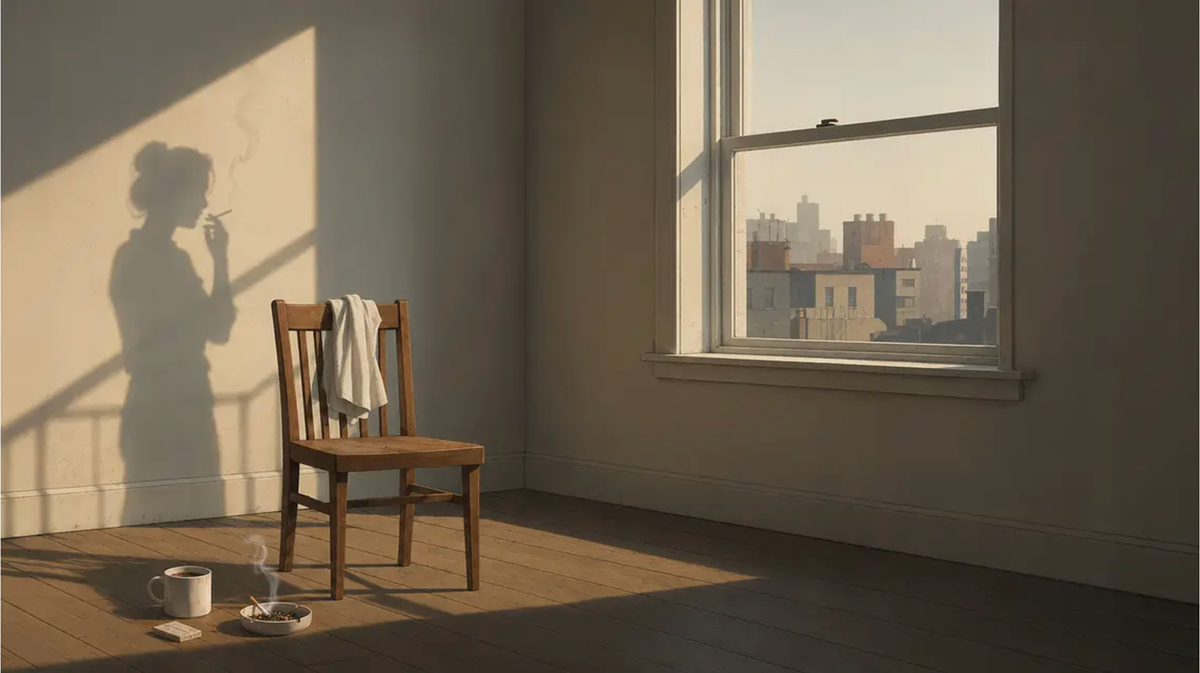
Her faith was probably a bit like smoking: she'd have just one cigarette in the evening, standing under the awning and savoring that moment of relaxation before sleep — which I'm not sure ever actually came.
By Bartosz Sadulski
Two things give me no peace and never will: tinnitus and the grief after my mother's death. Both are hard to get used to. Probably because, as Joan Didion wrote: "Grief, when it comes, is nothing like we expect it to be." I don't know what I expected, but I desperately didn't want to go through it.
Recurring grief after a mother's death
This year will mark fourteen years since her death — soon I'll be able to watch Czterdziestolatek ("The Forty-Year-Old") and say it's a film about me, and the unprocessed grief still returns in waves. I started writing this piece in January, quite suddenly in the middle of the night, because I realized what I'd been doing: before every time I leave the house, I nervously peer through the kitchen window, hiding behind the large leaf of a monstera plant perched precariously on the fridge, to check whether my neighbor is smoking a cigarette.
I do this with the greatest discretion, as if it were military intelligence work, or a near-phobic dread of brief small talk on the way to the tram. But it's neither of those things. My favorite neighbor is ill, and every conversation with her reminds me of my own — seemingly deeply buried — loss.
I don't even believe myself when I tell her that everything will surely be fine, and when I say nothing, I feel even worse. My neighbor's reactions — she's a chain smoker who, after a heart attack, tried switching to e-cigarettes, and is now at a stage where quitting would only harm her and would certainly deprive her of a rudimentary pleasure — make things harder, because they vividly remind me of my dying mother's behavior.
What all fathers should know
When afterward I inherited her laptop — a silver, oddly square Lenovo, on which I could play games that hadn't run on my own machine — lurking in the very corner, sticking out like the shoe of a high school smoker around a corner, was a Word file containing what were her final notes. Just a few sentences, including an opening one expressing concern for the family whose core was about to split apart. That's what my mother was thinking about before she died. About her family. She must have known by then that not much time was left.
My neighbor doesn't talk to me about her family, but before her first round of chemotherapy she cleaned the apartment so her husband — who shares a name with my father — would have an easier time, because after all, he doesn't even know where the small towels are.
He doesn't know where the small towels are.
She repeated that sentence exactly like that, twice, and I vaguely recall from my mother's illness that small towels are very important — perhaps even more essential than the impractical large fluffy towels that look good on a beach or at a mountain spa, but not necessarily on a body being consumed by cancer. I would very much like all fathers to know not only where the small towels are, but also, for instance, the pillowcases and the garlic press, before their wives fall ill.
The Diagnosis and the process of Dying
I remember almost everything as if through fog, time condensing to the size of a shoebox that can hold postcards: the diagnosis, a quick operation during which there was nothing left to remove, morphine tablets, a room on the mezzanine floor at home, the hospice, hope and suffering, home, suffering and hope, hospice, a funeral on a sunny day — the day of the first Poland–Ukraine match at Euro 2012. Funeral or not, you have to watch the opening match. I think I actually said that, sitting down in front of the television. It was warm and bright.
The fog is not just a metaphor for me. One winter evening I arrived by train from Warsaw. My father was waiting outside the station, and when I got in, he asked if I wanted to go to the hospital. I did. For the next several dozen minutes we drove in silence through a forest, and when my father switched on the high beams, the eyes of wild animals flashed between the trees in the fog and darkness — frozen motionless, waiting for us to pass.
In early December, when my mother received her diagnosis, I was at a concert by an artist I liked. I couldn't bear the music; it filled me with revulsion and dread. When I shared with a friend at the concert how I felt and why, she looked at me exactly the way I now look at my neighbor — and probably at anyone who tells me about their cancer diagnosis.
I imagine I have an expression that's vacant to the point of idiocy — charitably it could be called stunned — but the truth is, some news simply cannot be heard a second time. When my neighbor told me about her diagnosis, I heard something entirely different and smiled at her before I understood what she was actually saying.
The five stages of grief in practice
My neighbor is a doer. She moves through all the phases with the grace of the world's best pole vaulter. By May she's smoking with the same commitment as a year ago — perhaps slightly less often — and I'm no longer hiding behind the monstera, which has for my benefit unfurled a new, enormous holey leaf. Although the five-stage model isn't linear or universal, professional patients take it to heart. When I speak with her a second time in winter, she already carries within her an acceptance of everything, and an enormous strength to fight.
My mother didn't have that chance. In her case, the metaphor of "fighting" cancer sounded like a particularly grim joke — I would have had better odds in a bare-knuckle fight with a gorilla than she had against her illness. She moved through the stages so quickly that I don't think she even had time to bargain.
After seeking a shaman in the Amazon, like Andy Kaufman in Forman's film, and covering herself in magnets, through clinging desperately to the house where her mother and father cared for her, she moved into a brief period of despair. It lasted as long as early spring. I tried reading her Etgar Keret stories at the time, but she could only bear one or two, because laughing hurt her tumor-swollen belly. Once a week she'd go to a drip in the big city, but it seems to me she might just as well have stayed home and drunk smoothies or taken jelly intravenously. Can acceptance be born from helplessness? Perhaps it must be.
How to prepare for death
My mother was also a doer, but her task was not to recover. She had no such option. Recovery is for management — for her, there was Lipton tea. So she decided to die well, without the hysteria of departing, which was a kindness she did for those left behind. In her final weeks she resembled a figure from a medieval treatise — diligently, despite pain and fear, carrying out the guidelines from the handbook of A Good Death Over the Weekend.
A priest even came to her, although my mother was not only not devout, but also held a seat on the local council representing a left-wing party. Her faith was probably a bit like smoking: she'd have just one cigarette in the evening, standing under the awning and savoring that moment of relaxation before sleep — which I'm not sure ever actually came.
The older priest used to frighten me when he thundered from the pulpit at the Church of the Holy Cross on Sundays, or when he heard the confessions of us angry young middle schoolers about sins of masturbation and lying — but I eventually made peace with him when I noticed his striking resemblance to Mel Brooks, the director of my favorite comedy, "Robin Hood: Men in Tights".
With my mother he was surprisingly gentle, and assured her that even after cremation she would be able to rise again. I wouldn't object to that, because I miss her terribly. Her beautiful dying would certainly have been highly rated by the medieval Stoics, but it did not protect me from grief paid out in installments, with the first payment deferred.
A son's bond and the fear of loss
She cried in front of me perhaps only once. When two magnets painfully caught the skin on her thigh, she came to my room. I separated them with what must have been the same force with which mothers lift cars that have fallen on their children. My mother could lift less and less — almost nothing — she was barely carrying herself, and perhaps that's why she broke down then and hugged me.
She never said she didn't want to die, because mothers are like that — they don't want to be a burden. Even Louis C.K. knows this — the professionally sidelined comedian and reprobate who, in one of his routines, claimed that of two parents, it's always the wrong one who dies. The good one goes. Sometimes we say the devil looks after his own.
She told me it wasn't hard to leave when you leave behind something as precious as me — but at the time I was at best a shabby scaffold of a person. My nostalgia is not for the past, but for the shared future that was taken from us, because we never talked to each other as adults.
Reactions to the death of a loved one
I should have written about the light. There was more of it than a healthy person could bear. In her private room, large windows looked out onto a car park and sprawling oak trees. Sometimes I stared through them for a long time, counting passing cars. In that same hospital, a quarter of a century earlier, I had been born on a Saturday morning in early December. Apparently the crows were cawing terribly. I remember her grey hair, which she'd dyed for years, and her thin legs. She still had the strength to laugh that she'd always wanted legs like that. I remember the orange juice on the bedside table and the water in a container with a straw.
Throughout all of it I deceived myself that everything would surely be fine, and I moved through the stages far more poorly than my mother had. From denial and bargaining I suddenly found myself in the stage of washing up — because that's what I compulsively did when, six months later, my father called to say it was all over. Many people, upon hearing of someone's death, do something apparently senseless — make tea they don't drink, reply to emails, tidy a wardrobe. I started washing up, and to this day I feel as if I haven't finished.
The psychology of grief in adult children
I never really went through grief. After my father's call I went into the city to talk to my partner, and mainly worried about what would happen to my grandmother — my mother's mother — who is still alive today. It didn't occur to me that I should worry about myself.
I'm a doer too, so I decided it would work itself out somehow, and before I knew it I was sobbing over Julian Barnes's stories about loss and spectacularly dismantling my life. I didn't know how to grieve, I was afraid of it, I was an immature twenty-five-year-old kid. I should have taken my cue from my grandmother, a woman experienced in loss, but I thought I could manage, because managing was my task.
My neighbor has three adult sons, and however prepared she may be for any scenario, they are not. I can't be certain of this, but I am. I was a mama's boy — my parents used to joke that if I ever got married, it would probably be to my mother — and they weren't far wrong, since somehow I still haven't married anyone. But I don't think it's only about that. Families function because of mothers. Not all families, of course — but some work exclusively because of them. It's mothers who know where the small towels are, the ones that make life imperceptibly better, or at least bearable.
How men experience grief and stress
When I hear about my neighbor's cancer, or a friend's — also a mother's — I'm paralyzed. I feel the fear and helplessness that accompanied me fourteen years ago, and I know I'm incapable of responding properly. Research confirms that social expectations of men suppress their ability to express and process grief in a healthy way.
Many men avoid support and suffer in solitude, which in the long run leads to isolation, distracting oneself from grief through compulsive activity, or recurring outbursts of anger. Men have been observed to experience higher levels of acute stress than women. Jake Gyllenhaal's spectacular self-destruction after his wife's death in Demolition is not an aberration or an oddity — it's a barely suppressed male fantasy, a brutal cry for help.
I know something about that. Not knowing any socially sanctioned way to show grief, I took up escapism, reverse archaeology — burying what mattered to me — and multilayered destruction. I nearly ended up on the street, because I had no strength to work. In my case, time was the one counting the wounds.
Adaptation after losing a parent
For most people, grief adapts within six months to a year — I could practically move into mine by now, paying it off like a mortgage. It was only after several years that I became convinced I was doing something wrong. That beneath the surface something was constantly simmering and churning.
I processed my mother's loss by displacing it onto a failed romance and falling into exaggerated despair. I was afraid of closeness, but I was also afraid of loneliness. The memory of my mother buying me a rabbit on the way home from school would send me into spasms. Days passed, years passed, I thought it was getting better — and then I saw myself hiding behind the monstera leaf in the kitchen, peering to see if my neighbor had finished her cigarette.
She isn't even afraid of death. She tells me she's ready for anything, and I believe her, because I'd like to be ready too.
Staying afloat
I can talk about my mother now without tears in my eyes. Sometimes, when I can't bear the tinnitus, I envy her for having dealt with it. It runs in the family, like weak teeth. I don't remember her voice, but I remember that the way she read newspaper articles and books aloud used to irritate me. "Read normally!" I'd shout at her. "What do you mean, normally?", "Normally!"
Life after loss is a sequence of apparently rational and normal moves leading to a painful catharsis. In John Cheever's story "The Swimmer," Neddy Merrill makes his way home through the wealthy suburbs by stubbornly swimming through his neighbors' pools. The undertaking has an openly compulsive character that cannot be disrupted by a broken chain of pools, by the weather, or by prolonged small talk.
Neddy must complete his odyssey — a metaphor and a reckoning of his life — in the manner he has chosen, or that has been revealed and assigned to him. An empty pool will not stop him. By the end of the day he is exhausted, he cries perhaps for the first time in his adult life, because "he was sure he had never felt so sad." He swims the final pool with an undignified little doggy-paddle and arrives at his house, where no one is left.
Deferred grief is an attempt to stay afloat. Days and years are like pools to be crossed so as not to sink. The last ones you swim on your back, or in some ungainly style, stopping every so often at the edge to catch your breath. At the end is an empty house, and with a little luck — someone with a small towel.
Originally published in Tygodnik Powszechny, 19 May 2026. Translated with AI.