People of Blades. Spain's Last Itinerant Craftsmen

In Spain, the knife grinder's whistle is heard less and less on the streets. The last itinerant craftsmen are fighting to keep an ancient trade alive.
By Agnieszka Zielińska
Mario recalls that his uncles used to roam the streets of Madrid always accompanied by their trusty mule. Back then, the Spanish capital didn't even have pavements yet. The animal's movement powered the grinder, and his uncles — itinerant knife sharpeners — could restore new life to the dulled knives and scissors of Madrid's residents.
Over time, mules were replaced by bicycles, then scooters, then vans, but the characteristic sound remained. It is called the chiflo: the sharpener's whistle. Along with its accompanying cry: "¡Ha llegado el afilador!" ("The sharpener has arrived!").
In the old days, such an itinerant craftsman would travel from village to village, from town to town, with his grinding wheel, repairing worn and chipped tools. The short melody he played moved from low to high notes. Today the whistle is heard less often — recordings are used instead, played through a loudspeaker mounted on the roof of a van. And even that sound grows rarer with each passing year.
For many, it stirs a sense of nostalgia. Jesús remembers that the moment his mother heard that sound, she would rush out of the house carrying a handful of knives and scissors. Her neighbors did the same. Waiting patiently in line for your blades to be sharpened was also an opportunity to exchange local gossip.
The Royal Sharpener of Madrid
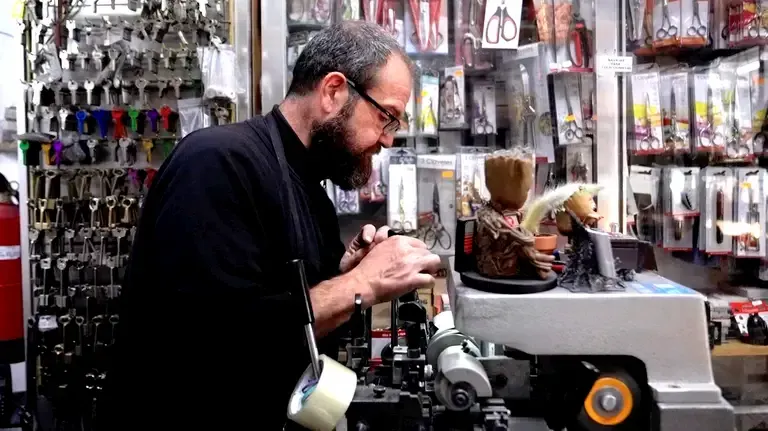
53-year-old Mario Fernández Luna began his adventure as a mobile knife sharpener twenty years ago. He learned the trade from his uncles, as there were no schools for knife grinders.
Mario is the fourth generation of sharpeners. Today, eight members of his family practice the craft.
"It was a profession for those who didn't want to go to university. You inherited it from your father or your uncle. First you learned by watching, then one day you picked up the first knives yourself," Mario recalls, as I visit him in his small workshop at the Mercado Antón Martín, a famous market in the very heart of Madrid.
He is a tall, well-built man, with a beard and glasses, and he hardly stops smiling. His greying hands and calloused fingers, however, betray the demanding nature of the work. Many hours on your feet, in noise, beside hot machines. After hours of work, you lose feeling in your hands. That is when Mario soaks them in a bucket of cold water, which he always keeps close by.
Mario became known as the "royal sharpener": it is to him that the chefs of King Felipe VI and Queen Letizia entrust their most precious blades. He is proud of this, but takes it in stride. "A knife from the royal household or from my downstairs neighbor — you sharpen them the same way," he smiles. "Usually the clients from the royal court are more demanding, because they are in a hurry and expect the very best results."
Blades With History. Old Knives, Family Heirlooms, and Keys
Mario speaks fondly of his loyal 90-year-old client, who brings him a pair of scissors that once belonged to her grandmother.
"They must be around 200 years old. When I hand them back to her beautifully polished, perfectly sharp, as if they were brand new, I can see a tear of emotion in her eyes," says Mario.
Today it happens less often, but in many Spanish homes kitchen scissors are still used — for cutting pizza, for instance.
The white walls of his workshop are decorated with yellowing calendars, shelves of tools and knives, and pieces of fabric on which Mario tests the sharpness of the blades. Though the best test of all are soft, overripe tomatoes, which a friend from a nearby vegetable stall leaves for him.
As I watch him work, a new customer appears in the doorway — not with a knife to be sharpened, but with keys. Because Mario, alongside sharpening, also cuts keys. With Madrid's growing population and the ever-increasing number of so-called tourist apartments, this has become a genuine boom.
The thing is, today very few ordinary Madrid residents come in to have their knives sharpened. They manage at home, or simply buy a new knife when the old one goes blunt. Among Mario's clients who do ask for sharpening, it is mainly elderly people, along with the owners of fishmongers and butchers, and restaurant chefs.
History and Legend. Where Did Spain's Knife Grinders Come From?
The origins of the knife-sharpening trade in Spain date back to the 17th century.
According to legend, an itinerant sharpener from abroad arrived in a small Galician municipality in the province of Ourense. He was looking for a carpenter who could repair his damaged grinding wheel. The carpenter became interested in the visitor's craft: he not only fixed the machine but also sketched it and took its measurements, so that he could later build his own copy.
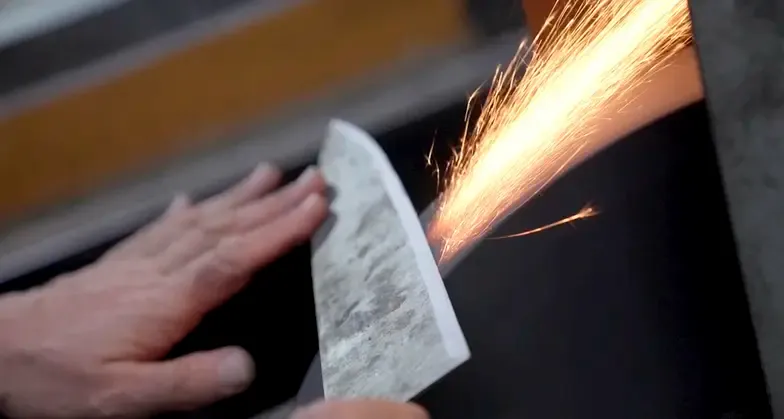
This is said to be the origin of the expression tierra de chispas — "land of sparks" — referring to the sparks that fly from the stone during sharpening.
In times of poverty, knife sharpeners were indispensable figures. Nothing was thrown away back then; every household item was repaired, patched, and mended for as long as possible. Pots, saucepans, and frying pans worn with years of use would also end up with the sharpener, who knew how to give them a second life.
Today, the number of knife grinders in Spain is dwindling. Only those who have their own established, fixed workshops — and a firmly rooted place in the local community — have generally managed to survive.
In the old days, every large market in Madrid had "its own" knife sharpener. Now, year by year, stalls are disappearing from traditional markets too — instead of going to the market, customers prefer to shop at the supermarket.
Jesús: One of the Last Itinerant Sharpeners
Jesús Galache Martínez would never move to a fixed workshop. For more than three decades he has been circling Madrid and its surroundings, going to his customers in person.
In his van, Jesús carries a generator that powers two machines fitted with grinding stones: the first gives the knives their proper edge, and the second removes scratches and polishes them. At the very end, out comes a stone that Jesús found on a mountain hike — used to put on the final, definitive sharpness.
51-year-old Jesús is probably one of the last mobile (once called itinerant) knife sharpeners. Tall and slim, with a thick head of grey hair, he cannot sit still. He is full of energy.
His profession has, on more than one occasion, landed him in trouble with local police. How do you explain to officers who pull over your van for inspection that you're carrying so many knives? "The situation gets a bit complicated," Jesús says. "The police have to check that I'm not doing anything wrong. In the end, it's mainly a matter of the time it wastes."
350 Knives a Day and 12-Hour Shifts
Jesús says he prefers going to his customers himself. He doesn't like waiting — he'd rather be moving. Sometimes he works up to 12 hours a day, three days a week, because on the other days he looks after his sons.
On average, it takes him just 2 to 3 minutes to sharpen a knife. In the course of a day he can sharpen as many as 350, earning around two euros per knife. He admits you can make a decent living from it. But young people are not drawn to the trade.
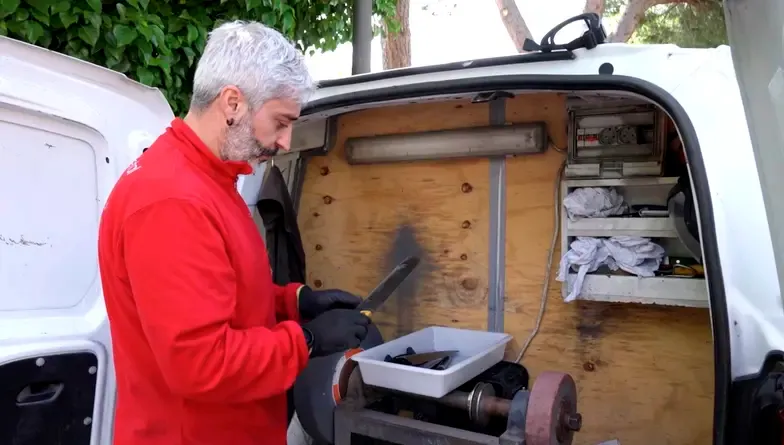
"It doesn't surprise me that they prefer to do other things. But I wouldn't trade it for anything else. I've always been drawn to craft trades — the kind where you work with your hands. You can learn the technique, but when it comes to sharpening, no one can tell you what the right moment is. Every knife sounds different; it depends on the type of steel," he explains.
Jesús's uncle used to say that you need at least eight years to understand all of that and begin to sharpen well.
Why Chefs Need Knife Grinders
I accompany Jesús on a working day. We visit the restaurant Cazorla in the town of Alcorcón, on the outskirts of Madrid. Jesús greets the head chef — a man who shares his name.
"Restaurants need a professional, because this is about extremely precise sharpening. Every person is different," the sharpener explains. "You have to get to know someone to understand how to sharpen their knives — for example, whether the chef is left- or right-handed, how they use the knife and for what specifically, so that you can give them back a tool perfectly suited to their work."
His namesake Jesús, head chef and owner of restaurant Cazorla, explains to me that the speed and precision of his work depend on a well-sharpened knife. "A good knife is like an extension of the chef's hand. On average, they need to be sharpened every two weeks," he says.
The chef must also endure the sharpener's scolding — it seems to be something of a ritual between them. The latter knows the former's knives intimately and gets irritated that they are washed in the dishwasher. "He gets angry and says that in the dishwasher the blade dulls more quickly, and that the high temperature causes corrosion. But we have to sterilize them," the chef smiles.
Madrid's Youngest Knife Sharpener
27-year-old Javier is probably one of the youngest knife sharpeners in all of Spain.
He came to the workshop two years ago, and by chance. Trained as a mechanic, he recalls quickly realizing that tinkering with engines wasn't for him. Around that time, a friend of his parents — a knife sharpener — was approaching retirement. He invited the young man to do an apprenticeship.
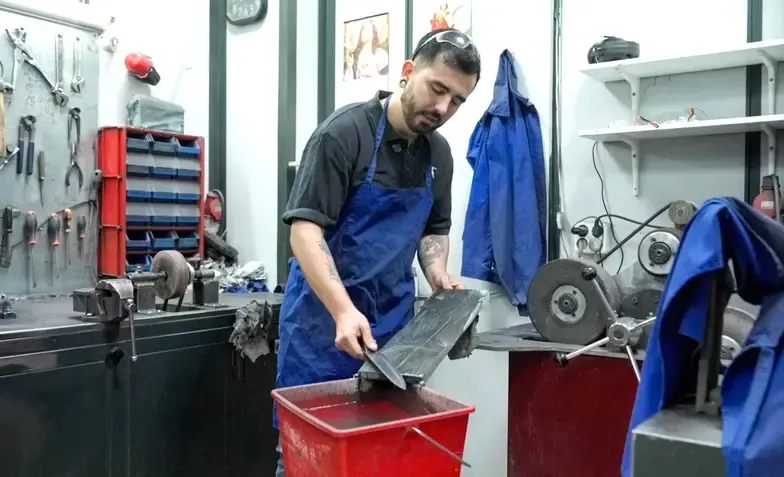
"Back then I didn't even know such a profession existed. You ask what my first days were like? I nearly lost my fingers, I was constantly cutting myself, burning my fingers — until one day I finally managed to do one sharpening properly. That's something only someone with experience can teach you," says Javier.
Tall, dark-haired, with tattoos and stretched earlobes, Javier Medel took over the workshop from a knife sharpener at the market in the Tetuán district in northern Madrid. He may feel out of place among the craftsmen here, whose average age hovers around sixty. But he doesn't complain. He has come to love his work. He is his own boss.
He admits it wasn't easy to win over the previous owner's loyal customers. Today he has a regular clientele of his own.
Does the Knife Sharpener's Trade Have a Future?
Jesús Galache Martínez has two sons, aged nine and sixteen. On one hand, he would like both of them to learn his trade and carry on the family tradition — that is what his heart tells him. On the other hand, he also hopes they will go to university and find lighter, more future-proof work.
Mario Fernández Luna wishes the same for his sons. He doesn't want them to have to work the hours he does. "Neither my sons nor my nephews see themselves in my trade. And perhaps that's for the best. They would only end up in my workshop if things hadn't worked out for them in life," says Mario.
Javier Medel insists he has no intention of giving up his trade. "It gives me satisfaction," he says. "I'll be a sharpener even in retirement. I'll sharpen knives for family and friends until the day I die."
Originally published in Tygodnik Powszechny, 2 June 2026. Translated with support of AI.