Out of Habit: On the Strength and Weakness of Cultural Catholicism

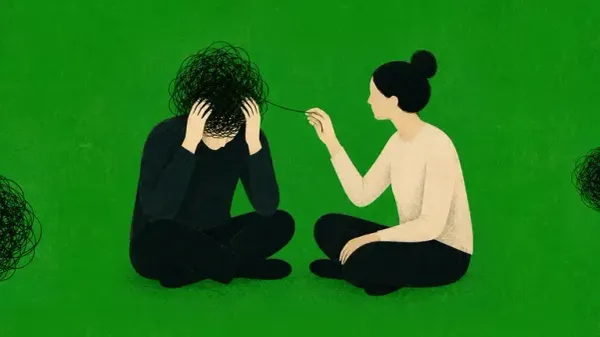
Attachment to Christian culture and tradition alone is not enough to preserve Polish religiosity. Yet secularization does not weaken the longing for spirituality.
By Adrian Burtan
Dariusz, around 40, considers himself an atheist. He says:
"Europe has two pillars: antiquity and Christianity, which shapes us as a society. Even non-believers draw from this legacy."
He emphasizes that while the institution of the Church deserves criticism for its scandals, many of the norms it preaches should be accepted and lived out. Ideals such as helping one's neighbor, recognizing the inherent dignity of the human person, and goodness as an objective value have not lost their relevance.
"They still form the foundation of the law. As a criminologist, this matters to me — guided by Christian ethics, I focus on punishing acts, not people," he explains. He sees Catholicism as the bedrock of cultural identity, which is why he does not want to forget that tradition, but to preserve and nurture it. Even if this involves no religious commitment.
For Dariusz, Catholicism is not a weapon against other religions or cultural influences. Quite the opposite — he sees it as the binding agent of the European community. A universal concept, suited to serve as the foundation of functioning societies.
Dariusz's views testify to the vitality and cultural strength of Christianity. But is that enough to slow the secularization of Polish society? For many nominal Catholics, pausing at the cultural value of Catholicism turns out to be a stage on the road to severing ties with the Church altogether. This process is especially visible across several generations.
Values Yes, Ritual No
Poles still consider themselves Catholic in the majority. According to CBOS, around 90 percent of society described themselves as "believing" or "deeply believing" in 2024 — though this figure fell during the pandemic. The lockdowns that came with it further loosened already weakening ties to religion.
The drift away from religious practice among many "declarative" Catholics did not begin recently. Attendance at Masses and church services has been declining for decades, as have the numbers of baptisms, church weddings, and declarations that faith defines a person.
30-year-old Katarzyna from Kraków recently became a mother. She stopped participating in Church life long ago, but feels pressure from her mother-in-law and her husband's grandmother to have the child baptized.
"I resisted. It should be up to the child, when the time comes, to decide whether they want to be baptized," she says.
Religion in her family home followed a fairly standard pattern: Sunday Mass, prayers, church services. She remembers the Church through the lens of fear and judgment. The hypocrisy of the "spectacle" she participated in for years irritated her. The gold and grandeur of the churches grated on her. The clergy disappointed her. She gradually drifted away from religion. Her "last rites" with the Church came at her confirmation.
"I knew that most people in my family circle went to church only to tick the box. Because it wouldn't do not to," she says.
The problem arose at her wedding. Her family insisted on a church ceremony. But Katarzyna felt that would be a deception — of herself and of God.
Yet even though she does not want to operate within the cultural conveyor belt of religion, driven by the motto "it must be done" — baptize the child, take first communion, have a church wedding — she also knows that Christianity remains an important part of her identity. She does not deny her roots.
"I recognize that I was raised in this faith, that it is part of me. A part that cannot simply be removed," she says.
For Katarzyna, however, this identity-based bond with Christianity is something different from practicing religion according to the rules dictated by the institution. She keeps her distance from the Church. Today she attends services barely at all. She enjoys Christmas, but does not celebrate it in a Catholic way. She does not want to raise her child religiously — but recognizing the valuable elements in religion that she herself absorbed, she imagines some of them may prove useful to the child in life.
"They'll choose for themselves. Above all, I'd like them to be a good person. Being good, to me, is associated with Christianity," she says.
Religion on Autopilot
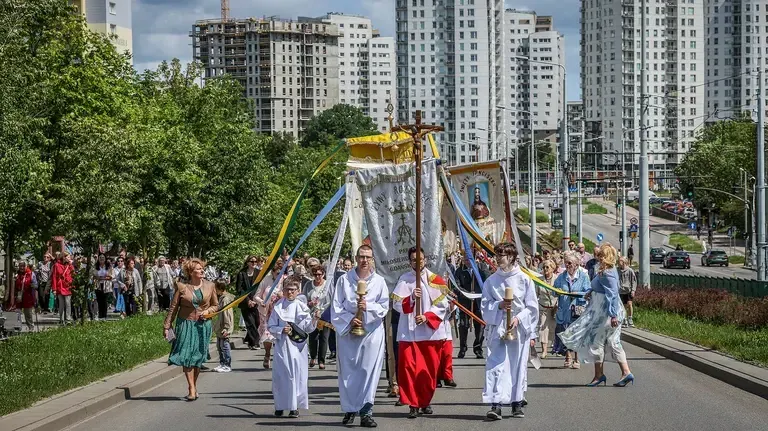
In the growing gap between declared religious affiliation and actual practice, a phenomenon increasingly visible in Poland can be discerned: cultural Catholicism. It places greater emphasis on ritual than on the spiritual experience of faith or engagement with the community. This leads to the gradual abandonment of religious practice while certain Catholic traditions are maintained — such as the blessing of Easter food or sending children to first communion.
"People do things simply because that is what their father, mother, and grandmother did," says Radosław Tyrała, a sociologist of religion at the Faculty of Humanities at AGH University in Kraków. "It is something that was instilled in me and that I accepted as right, but not necessarily something I internalized. It is not a religiosity born of deep reflection or experience. Rather something that might be called inertial Catholicism, based on routine."
The trouble is that in the long run, such an approach deepens the generational drift away from religion — even in its cultural dimension. And it is precisely this shift that may be driving secularization most powerfully.
Faith as a Cultural Habit
Many factors have contributed to this state of affairs. Some stem from global contexts: the formation of worldwide cultural trends and new spiritual currents, a general rise in prosperity, and emancipatory narratives. There are also many problems specific to the Polish landscape — the intellectual and theological weakness of the local Church, the scandals that have come to light, and the instrumental use of religion by politicians.
"It is largely local factors that determine how secularization unfolds in Poland," says Tyrała. "For example, after the death of John Paul II, experts wondered whether that moment would change something in our religiosity. Initially, secularization seemed to be 'frozen,' but a few years later things began to reverse. The pandemic had a similar effect. It showed just how deeply religious practice was rooted in routine. It was enough for someone to stop going to church for a year, and they then found they had no desire to return," the sociologist says.
Catholicism reduced almost entirely to a cultural habit — stripped of depth and regular practice — is the result of the progressive erosion of religious significance. When you speak with younger people about their experiences of faith, a certain generational pattern emerges.
At the top are the grandparents, typically strongly devout. For them, religion is still not merely a ritual obligation but a genuine point of reference in everyday life.
Then come the parents — who believe less. Participation in religious rites and practices does not carry the same fundamental spiritual weight for them. Nevertheless, for many, faith remains a strong element of identity, which they try to pass on to their children. Those children, however, often end up abandoning religion over time, or practicing it only at holidays or exceptional moments — such as when deciding whether to have their own children baptized.
Young People Redefining Spirituality
Cultural Catholics, even those with only a marginal connection to Church life, can always return to it or draw on their own roots. Their children, however — often raised without a Catholic framework — are already cut off from that path. It is the youngest generation that is leaving religion the fastest.
This reflects a shift in social perception: a few decades ago, being a practicing Catholic in Poland was the default. Deviation from the norm brought ostracism and incomprehension. Today the reverse is increasingly true — the absence of religious identification falls within the social norm.
"For years we had a model of folk Catholicism in this country. People were not taught the Gospel. Either you went to church, or hell awaited you," explains Fr. Grzegorz Strzelczyk, a theologian and priest of the Archdiocese of Katowice. "That kind of religious narrative worked within a monoculture, when the faithful had no access to other sources of information. Today that has collapsed. People are confronted with other ways of thinking, and simple messages are no longer enough. If faith does not become an experience — a relationship with God and with community — it will be rejected as unnecessary baggage. And that is precisely what is happening in Poland. People are 'shaking off' ritualism and the trappings of belief, because they have begun to see something infantile in them," he adds.
This does not mean that young people have abandoned spirituality. They define it, however, in an entirely different way from older generations. A report prepared by SWPS University and the agency They.pl, titled What Are Polish Gen Z-ers Like?, found that 64 percent of young people do not participate in religious observances, but for one in three, spiritual development remains important.
Generation Z is not, however, religious in the institutional sense. For them, spirituality means working on oneself, caring for mental and physical wellbeing, setting goals in life, and acting in accordance with one's own values.
As Radosław Tyrała emphasizes, this reflects the development of individual spirituality. In such a model, communal ritual is no longer necessary. This means that today one can consider oneself a spiritual person without participating in traditional observances.
"There is a stereotype that a non-religious person is spiritually 'empty.' That is unfair. When religiosity in the traditional sense disappears, what is spiritual does not disappear with it. Spirituality can manifest in emotions, in art, in experience. Even an atheist going into a church in silence, without participating in a Mass, can be a spiritual experience. Religiosity and spirituality may overlap in part, but they are not the same thing," the sociologist explains.
Honesty Toward Oneself and God
Marta (whose name has been changed at her request) defines spirituality this way:
"For me, spiritual life exists — but somewhere entirely different. It is contact with art, music, theater. It is wonder at nature, a walk in the forest. I don't need religion for that," she says.
She comes from Warsaw's Bródno district, from a family with strong Catholic roots. In that environment and during her childhood — in the 1970s — it was simply a given that everyone practiced.
"If we hadn't gone to church, it would have been a sin — that's how my mother explained it to me and my brother," Marta recalls. "Sunday Mass was therefore compulsory, along with various other services. We were more religiously engaged than other families, but I accepted it as normal," she adds.
She describes her mother's religiosity as dogmatic and firmly rule-bound — including, for example, abstaining from meat on Fridays and not listening to music during Lent. But over time, Marta did not want to subordinate her life to religious rules. One of the impulses was meeting her future husband. Her mother looked unfavorably on them holding hands or wanting to travel somewhere together. Marta could not understand why religion took such a restrictive approach to sexuality.
"I questioned that attitude. So at the age of 19, I went on a pilgrimage to Częstochowa. But it was only a pretext to meet my boyfriend. We arranged to meet at the station in Częstochowa and I spent the day with him," she recalls.
By her thirties she was already, as she puts it, "with one foot on the other side of faith." Her departure was gradual. She would probably have made it sooner, but her children came into the world, and there was no time for dwelling on spiritual doubts.
The result was that she practiced the rituals more or less on autopilot. She had her children baptized, took them to church, sent them to first communion. She did it also for "the sake of peace," so as not to offend her parents. But maintaining the rituals did not stop her from drifting away from the Church.
Today Marta does not feel like an atheist — she prefers to describe herself as a rationalist. She no longer practices any religious observances, not even preparing the traditional Christmas Eve supper. For her, a situation in which one participates in religious practice while simultaneously doing things that one's professed religion forbids is simply unacceptable.
"I prefer to be honest with myself," she says.
New Generations Outside the Church
What, then, is the role of the Church in shaping religiosity at a time when culture is gradually detaching from Catholicism and secularization is accelerating? According to Fr. Strzelczyk, change must occur on three levels of credibility: that of the Church as an institution, that of parish communities, and that of Catholics themselves, who should be witnesses to the Gospel. The theologian believes, however, that the outflow of the faithful cannot be stopped.
"If a young person does not encounter a good community, a wise pastor, or parents who are conscious in their faith, they are effectively destined to leave. Even if the pace of secularization slows, that does not mean Catholicism will hold on. People may just as easily move toward entirely different forms of spirituality, or abandon it altogether," he argues.
There are already voices, however, pointing in the opposite direction — toward a gradual local revival of Christianity. In the West, the first signals of such a turn are visible. Interest in religion is growing among young Britons; the number of adult baptisms in France increases each year. For some, religion is becoming an answer to the challenges of the modern world: the dissolution of community bonds, a sense of chaos and meaninglessness.
"This shows that these processes are not one-directional. We live in a time of great uncertainty: wars, migration, social tensions. All of this can influence a return to religiosity, which for many people is a familiar and safe space," says Dr. Tyrała.
The fact remains, however, that Katarzyna and Marta are today outside the Church. The chances of their return are slim. In their children's case, the break with religion will probably cease to be a stage in life and become the default direction. Dariusz believes in the identity-forming role of Catholicism in Poland and the region — but will cultural memory alone be enough to make future generations want to reach back to their Christian roots?
Originally published in Tygodnik Powszechny, 2 June 2026, Translated with support of AI.