On the Sofa at Bella Freud's. The Fashion for the Art of Listening

Her podcast is breaking records. Freud's great-granddaughter is reminding a busy world what it truly means to listen to someone.
By Beata Chomątowska
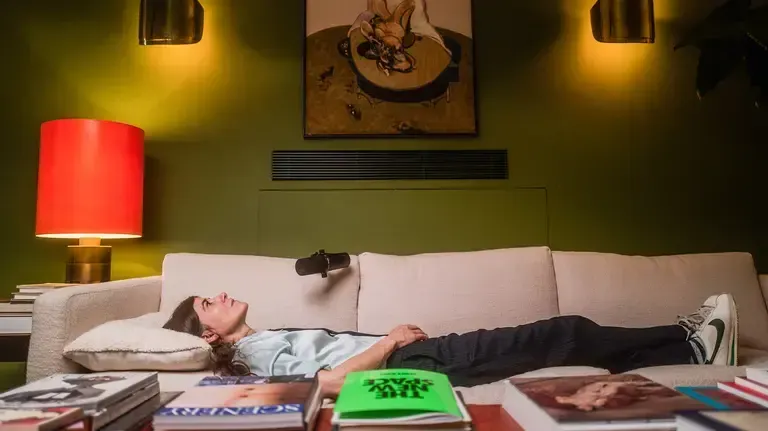
It always begins the same way. A doorbell. The hostess, sitting in a leather armchair with a notebook in hand, calls out: "Come in!" And once the guest has lain down on the cream sofa, beneath a Francis Bacon print of a Reclining Figure hanging on the wall, the first question is posed: "What are you wearing today? Tell me about it.
On Bella Freud's Sofa
It is a deliberate wink in the direction of the famous ancestor — the "father of psychoanalysis," Sigmund Freud — whose patients reclined in a horizontal position during their consultations. In the consulting room arranged in the Freud family's Vienna apartment on Berggasse, they lay on an old-fashioned wooden sofa stuffed with horsehair, with a firm headrest, covered in a woollen Persian rug.
The guests of his great-granddaughter, appearing in her podcast (titled, naturally, Fashion Neurosis), are considerably more comfortable. They can also count on exceptionally flattering overhead lighting, in which features appear soft, skin flawless, and double chins invisible.
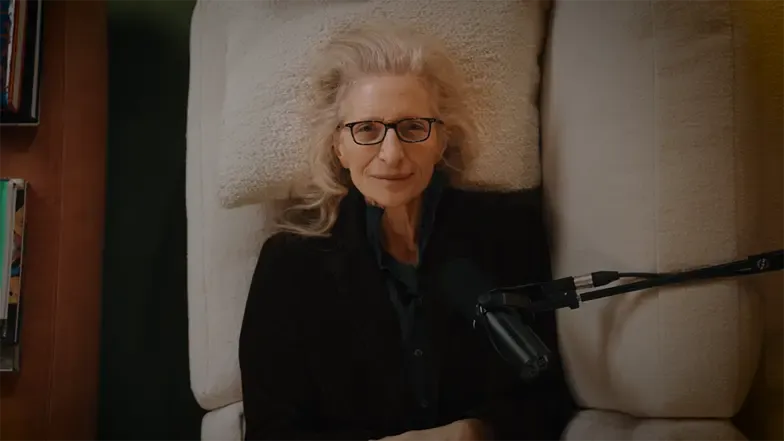
Among them are Bella Freud's long-standing friends, such as Susie and Nick Cave, but also other artists and creators — among them Marina Abramović, Kate Moss, Jonathan Anderson, Annie Leibovitz, Karl Ove Knausgård, Cate Blanchett, Zadie Smith, and more recently the Spanish singer Rosalía.
The guests, more or less famous, are people who resist the label of "celebrity." They are rather exceptional personalities who have reached their goals through talent and hard work, and who still have a great deal to say about how they perceive the world, other people, and their own identity. A conversation about what they wear and why they like to dress the way they do reveals a surprising amount: ambitions, fears, sensibilities.
Fashion as a Pretext for Conversation
It is almost hard to believe that just a few years ago Bella Freud was not widely known outside her native London. And even then, only to the initiated — those in circles of international bohemia and lovers of independent fashion.
Little Bella, born in 1961, wants to be a nurse, then a London bus driver. In both cases the reason is not so much the profession itself as the uniform that goes with it. She admires horse handlers and falconers. She wears leather gloves far too large for her hands, imagining that they will make people take her for one of those magicians capable of luring proud, independent birds.
Then she discovers Claudine, the heroine of Colette's novels — a rebellious girl from a good family, whom she sees as clearly as if she were real. Claudine's uniform is a dark dress with a white collar. Growing up, Bella develops a weakness for the style of rock musicians and the actresses of Godard's films. She herself dreams of being a rock star, but will never quite find the courage to try her hand in the music world.
The childhood dream of wearing a uniform is briefly fulfilled at an alternative Steiner school. The progressive institution — which places emphasis on the individual development of pupils in harmony with nature — abolishes the requirement shortly after she begins her studies. Bella pretends to share in the general rejoicing, but is deeply disappointed.
Years later, Bella Freud's first fashion collection will draw on these earliest inspirations. Alongside knitted dresses with white collars — copies of Claudine's uniform, only in micro versions that might be worn by actresses in French New Wave films — it will include elegant tweed coats for adults styled to resemble garments from the children's department, and loose jackets that look borrowed from a husband's or boyfriend's wardrobe.
To this day, when working on a collection, Freud imagines a specific person for whom she is designing a wardrobe. Inspirations from years past return in successive designs. She combines masculine elements with feminine ones, prioritizes good cut, classic silhouettes, and natural, high-quality fabrics — merino wool, tweeds, corduroy.
Her first order comes from a shop in Japan. This is the beginning of an adventure that has now continued uninterrupted for nearly 35 years. The Bella Freud brand, though it has acquired investors over time, has not expanded, and consistently prioritizes quality over quantity. To this day it has only one boutique in London. There was even a collection consisting of a single garment — a sweater bearing the slogan "Ginsberg Is God."
The logo — her first name, surname, and a drawing of a racing greyhound with its tongue hanging out, enlarged to decorate the shop window — was designed by Bella's father. One of Britain's most famous artists, and the most highly valued.
Freudian Props
Fashion Neurosis is not the first nod to the great-grandfather's legacy. A decade earlier, the first of the famous Freuds appeared in a series of collages. Bella superimposed sweaters from her collections — bearing various slogans — onto photographic likenesses of several family members. Among the slogans: "Psychoanalysis."
She gave the same name to the unisex perfume sold in the boutique: a blend of cigar smoke, leather, and cedarwood, intended to "evoke the romantic obsession that accompanies psychoanalysis, together with the scent of a traditional consulting room and the aura of sensuality emanating from a brilliant intellect."
As with Sigmund, the podcast recording sessions take place in a private home. It is Bella's studio and home in west London, concealed at the back of an industrial warehouse, in a courtyard where after the war numerous workshops and sheds were housed. At the center of this cleverly designed building is an internal courtyard, through which light floods into all the rooms from above, through original large windows salvaged from Battersea Power Station.
The upper floor is occupied by Bella's former husband, the writer James Fox — they remain friends; the courtyard has also been converted to provide a flat for the couple's adult son. Inside, as at Freud's, it is something of a cabinet of curiosities: colorful walls, few furnishings — mainly mementos and works of art, including paintings and drawings by Lucian.
"Freudian slips" reads a self-adhesive note on the inside of the front door. It comes from the museum shop at the London house where Bella's great-grandfather spent the last year of his life after leaving Nazi-occupied Vienna. She dipped into his writings but finished none of them.
At the museum, however, she came across a graphic novel — a guide to the world of the father of psychoanalysis. She devoured it in no time and, as she says, in reading it learned everything — discovering even in Sigmund's disposition a good deal of anarchic humor.
When Clothes Ruin Your Day
Bernardine Coverley, Bella's mother, wears long floral dresses and knee-high boots — as befits a true hippie. She looks wonderful, though she shops mainly in charity shops selling second-hand clothing, and dresses her daughters there too. They cannot afford new clothes. Bella and her sister Esther, two years younger, visit jumble sales in search of boys' shirts. They are too large, but you can simply cut the sleeves.
Ten-year-old Bella feels wonderful in this outfit, while dressed in a round-neck dress with puffed sleeves she looks in the mirror and thinks: I look ridiculous, like a clown. It turns out that simply changing the dress for her favorite shirt is enough to lift her mood. Sigmund Freud's great-granddaughter discovers the link between clothing and emotion.
Clothes become for little Bella a way of overcoming shyness. As she recalls, they gave her time to think of a reply before anyone spoke to her — because what the other person noticed first was how she looked. The masculine provenance of the favorite shirt matters too: boys are strong. Today Freud enjoys playing with androgyny, believing that breaking gender conventions in fashion produces a very sensual effect.
As a girl, Bella also notices that the kind of attention received by originally dressed people depends on criteria such as power and privilege. The London neighbors in pastel coordinated outfits from department stores, and the parents of other Steiner school pupils dressed in narrow cords, Birkenstock sandals, and folk-patterned sweaters, look down on her mother — they dislike flower children, but they also know that Bernardine barely makes ends meet.
Lucian Freud, on the other hand — who looks like a tramp one day and an elegant gentleman with a cravat instead of a tie the next — stands out favorably among people of his own social class. They admire him, seeing in his unconventional dress a strength and independence from others' opinions.
An Unconventional Childhood
The daughter of Irish Catholics who kept a pub in Brixton, Bernardine met Lucian in one of the bars or nightclubs in Soho. She was seventeen, he thirty-six, with two ex-wives and several children. Bernardine's parents were closing the business at the time and returning to Ireland. Fearing a scandal, they took their daughter with them so she could complete her education at a school run by nuns.
After a year she ran away back to London, to work by day as a secretary at a press editorial office and party by night — including in Lucian's company. A memento of those times is her portrait, heavily pregnant with Bella, later valued at 16 million pounds. She told neither her parents about the pregnancy, nor about the next one.
She was afraid they would send her to one of the notorious mother-and-baby homes run by nuns, where unmarried mothers had everything taken from them and were given new names. For three years after giving birth they were required to work without pay, in return for the nuns' care. Children were frequently sold to wealthy foster parents.

The Irish grandparents therefore learned of the existence of Bella and Esther only when the girls were already several years old. Shortly after the birth of the second sister, the relationship between Bernardine and Lucian broke down — if it could ever be called a relationship, since they never even lived together, apart from brief shared holidays. The young mother had to manage on her own.
She did so in hippie fashion, setting off with a group of friends to wander through Morocco. She took the girls with her and they settled in a run-down hotel in Marrakech. The next two years would pass in constant movement, amid a different culture and an ever-changing procession of people.
Lucian Freud: Sex, Power, and Painting
While Sigmund Freud was obsessed with sexuality — which he dragged into the light from Victorian darkness and insisted lay at the core of human nature — his grandson Lucian apparently set out to prove the point in practice. He slept with almost everyone who posed for him, regardless of gender. (The saying goes that his sexuality was neither homo nor hetero, but painterly.)
Possibly with the exception of his own offspring and Queen Elizabeth II — who, in the portrait he painted of her, resembles one of her favorite corgis. He was not in the habit of flattering his models, nor did he seek beauty — showing bodies stripped of attractiveness, wrinkled, covered in blotches and veins, in unappetizing yellow-brown tones.
The Artist and His Legend
As adults, Bella and Esther spent a good deal of time getting to know their many half-siblings. Biographers have counted fifteen children fathered by Lucian with various partners — though some maintain the number is twice as many. It is said, however, that it was with the mother of Bella and Esther that he had a particularly strong bond — almost metaphysical, as it happened that both of them died in the same hospital, just four days apart.
"Mum was a risk-taker who didn't like compromise. They were alike in that respect, except that Father — unlike her — had money," Bella recalls. Fortunately, toward the end of her life, alongside her independence Bernardine Coverley was finally able to achieve stability, because Lucian gave her one of his paintings. She sold it and bought a small house.
Lucian's children — like Rose Boyt — do not spare him in their memoirs. A predator, an egotist with an aversion to everything commonplace, capable of seducing and threatening by turns — he refused on any account to consent to a biography, terrifying potential authors with the threat of lawsuits, while himself spreading scandalous rumors about his own life. He hated being photographed, though he was capable of staring fixedly at strangers in restaurants. Addicted to gambling, fast driving, and above all work.
Bella's Father
Yet Bella, despite Lucian's difficult character, had a very good relationship with him and often recalls the time they spent together. To this day she considers her father the most fascinating man she has ever met. And one of the best dressed. The flannel jackets made by Savile Row tailors, worn by the artist with his characteristic nonchalance, had a powerful influence on the way she thinks about fashion today.
When Bella was small, her father would take her to lunch at restaurants. They did not talk much, but even then she felt comfortable in his company — evidently with a mutual ease, because from the age of fourteen she participated in the long, drawn-out dinners at his favorite restaurant, where everyone knew and greeted Lucian, and at whose table Francis Bacon, Frank Auerbach, and Michael Andrews joined them.
It was quite possibly then that she developed her acceptance of everything strange, and her ability to get along with eccentrics of every kind. Shortly afterward she began to sit for him — she greatly enjoyed sitting motionless for hours, because they talked a great deal during those sessions.
Punk and the Patron Saint of Tailors
In Rome, where she encounters the finest tailors, Bella will deepen her early interest in the psychology of dress. She is enchanted by the Italian obsession with detail, by the secret language of tailoring in which everything carries meaning — the type of lining, the number of buttonholes, the way they fasten, and even which ones are left done up. To master it, she first enrols at the prestigious Academia di Moda, but leaves after a year to spend a year at a school for seamstresses. There she quickly learns Italian — including a prayer to the patron saint of tailors.
But before elegant Rome, there is still rebellious London. In 1978 Bella is 17, has dropped out of school, and has been living for a year with her half-sister Rose and her boyfriend. Rose and her friends are punks — they wear heavy lace-up Dr. Martens boots, leather jackets, masses of studs, safety pins, and torn, deconstructed clothes with provocative slogans. The more repellent to their elders, the better.
Their mecca and source of supply is the boutique run by Vivienne Westwood and Malcolm McLaren in Soho, which changes its name from time to time: first it was "Sex," now "Seditionaries." Rose works there as a shop assistant. Bella wants to follow in her footsteps. Before approaching Vivienne about it, she cuts her waist-length hair in a punk style. "I like your haircut," she hears — and is given the job on the spot.
Their paths will cross again a few years later in Rome. The designer is collaborating with a Florentine manufacturer and drops into the Eternal City at weekends. Bella, then a student at the tailoring school, shows her a coat she is designing. Instead of the criticism she expects, she receives encouragement and practical advice.
Back in London, she becomes the designer's assistant. At first they work in Westwood's private flat, just the two of them. The inexperienced helper compensates with bravado and makes a great many mistakes. She watches as many ideas that at first seemed too extravagant gradually become classics. Her father takes a similar approach to his work.
"Hideous Kinky!"
"Hideous kinky!" — the Freud sisters sing out at the top of their voices to attract the attention of the adults sitting over mint tea talking about something. Two words repeated by the wife of one of the men with whom their mother will become involved in Morocco.
The hippie lifestyle in which flower children flourish does not necessarily serve their offspring well. Moving around and constantly wandering is hard for the girls, who at this age need stability in order to feel secure. Bella's longing for a uniform has its roots precisely there — a standardized outfit represented for her order in any form.
Fortunately, they have each other for support. Esther and Bella are inseparable, creating their own rituals, such as telling each other made-up stories every evening before sleep. The strong bond between the sisters endures to this day, though the growing Esther, on her return to London, was irritated by the constant question: "Are you perhaps Bella Freud's sister?" — because it was Bella who was the more outgoing and recognizable of the two. Physically similar, they have differed in style since childhood. While Bella always looked like a tomboy, Esther resembled a little princess.
The phrase "hideous kinky" will stay with them forever. Esther will use it as the title of her debut book. Do you remember Hideous Kinky with Kate Winslet? That is the English title of the film adaptation of Esther Freud's autobiographical novel, which has yet to be published in Polish. Bella too posts brief memoirs on her website from time to time — they are disarming in their honesty and elegant literary form. She has let it be known she is working toward writing a book. Time for her own version of the story, independent of her sister's.

Words inspire her more than images, she says — a legacy of growing up in an era without the internet, when she devoured book after book. The by-now iconic "Ginsberg Is God" sweater design, a nod to the popular 1970s slogan "Clapton is God," reaches back to Bella's early literary fascinations: reading Kerouac's The Dharma Bums and being captivated by his innovative approach to language, which translated into a lasting affection for the Beats.
Her sensitivity to words was apparently inherited from Lucian. He had words he hated and never used. He also liked giving sharp nicknames to people he knew. Bella — whom he called Bloni — has for years carried notebooks with her, always the same kind, regularly writing or sketching specific words and phrases that fire her imagination. She chooses ones that don't sound like instructions or slogans, but that spark various associations and carry a high potential for interpretation. As a teenager, walking home from school, she would stop at the neighborhood record shop and stare at album covers, trying to work out what the images and symbols on them meant.
She has never forgotten what a market stallholder once told her: "Remember always to tell the story of your clothes." In the narrative that clothing represents for her, there must be an intrigue that entices people to buy. After all, in the way we dress, each of us tells our own story — wanting to be seen in a particular way.
Fashion Neurosis
The idea for Fashion Neurosis was born from countless stories reaching Bella's ears in dressing rooms and bathrooms, backstage at fashion shows — initially in the form of traveling the world and making films with interviews. "I knew that if I didn't do it myself, someone else would get there first."
Things turned out the other way: it is others who visit Freud's "consulting room." The conversations are accompanied by visuals. The host seems a hundred percent focused on her guests — there is not a trace of stardom about her, though she frequently shares details from her own life. Viewers appreciate her naturalness. During the conversation she plays with her hair, glances into the notebook resting in her lap.
When she poses questions in her calm, therapeutic voice, there is a distinctly journalistic curiosity shining in her eyes, but one also senses warmth and understanding for her interlocutor. It may be precisely for this reason that Fashion Neurosis is breaking popularity records — in a busy, self-absorbed world, Freud's great-granddaughter is showing afresh what it truly means to listen to someone.
It is hard to believe she will turn 65 next year. Slim, long-haired, with a girlish face, in her favorite "uniforms" she looks like the vocalist of a rock band. Beyond the podcast and the continuously running Bella Freud company, she has to her credit the successful rejuvenation of the legendary British brand Jaeger. For two years she was also responsible for the women's collection of the Biba brand (founded by the Polish-born Barbara Hulanicki), and she tried her hand at journalism and is the director of several short films.
John Malkovich had occasion to discover her powers of persuasion — she was determined that he and no one else must play the lead role. When she flew to meet him he initially said no, but changed his mind after their conversation. They appeared on screen together twice more after that.
In the past, she says, she was lazier — but with age she has felt that there is not a moment to lose. She senses that her time has come. The time to put on your best jacket.
Orginally published in Tygodnik Powszechny, 29 December 2025. Translated with AI.