"I'm Staying in the Church." Who Are the Young Catholics?

Share
"I'm Staying in the Church." Who Are the Young Catholics?

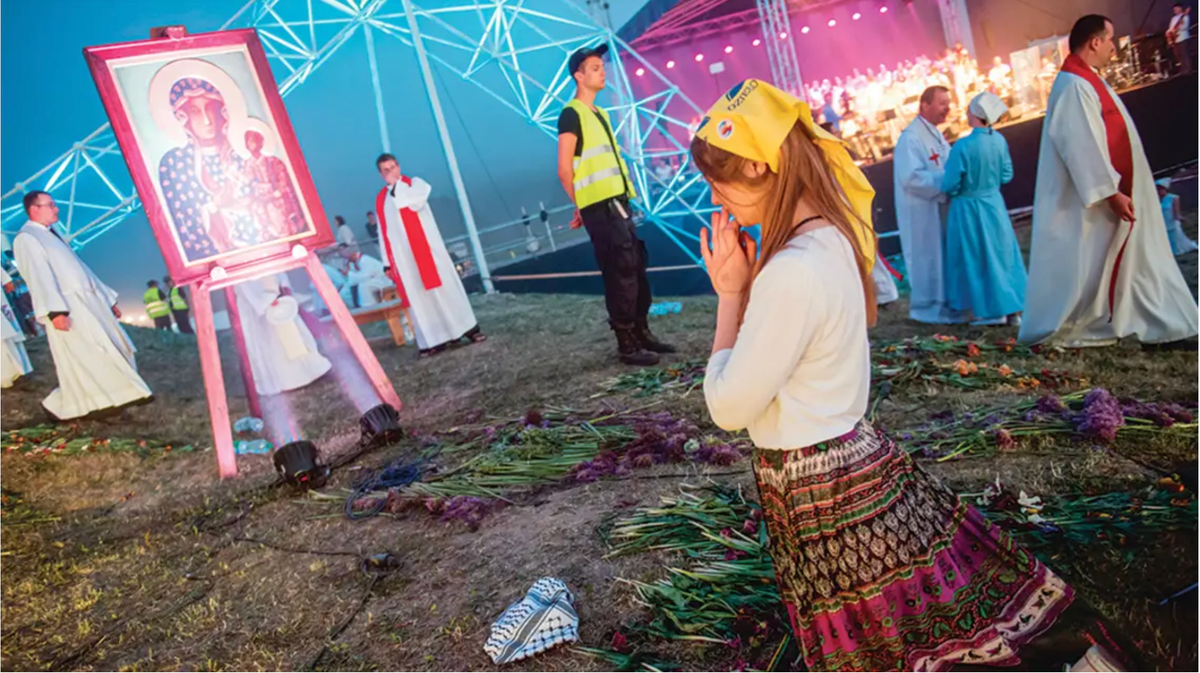
Lednica 2000 youth gathering. Lednica Fields near Gniezno, June 6, 2015 / MAREK LAPIS / FORUM

Media attention focuses on the Church's crisis and accelerating secularization. But many young people still find their spiritual home in Catholicism.

By Piotr Sikora


"Faith is above all a decision. From the moment of that decision, my conscious faith began. Faith is trust arising from experiencing God in everyday life. Believers are people who have an open heart to His presence and who learn to find Him in the ordinary. For me, faith means seeking God in every single second," says twenty-five-year-old Weronika from Łódź, founder of the popular Instagram profiles @zbogiemsprawa and @kato_single.

A Conscious Minority

Weronika's profiles have tens of thousands of followers. Statistically speaking, however, Weronika is a representative of a minority within her generation. As sociological research indicates, the secularization of Polish society accelerated sharply during the pandemic. This applies in particular to young Poles — compared to 2015, in 2021 twice as many people aged 18–25 were not attending church at all. Today it is one in every three young people, while only one in four attends services regularly. Among people in their thirties, we find only slightly more believers.

Young people who remain in the Church are aware that more and more of their peers are making different choices, and that they themselves must in one way or another defend their faith — if only within themselves.

Take Maciek from Gdańsk. The Church — and being part of it — is something he takes for granted. His parents are strongly devout. He was a pupil at a Catholic secondary school. Like his brother, he attended Magis, a Jesuit youth community. He later joined a university chaplaincy. He played guitar during Mass. Today he is a leader of one of the communities. He is responsible for ensuring that each subgroup has its own animator, that someone takes care of the music. He keeps an eye on the planned schedule of conferences and helps organize retreats.

"A significant portion of religiously engaged young people are able to distinguish between a community in which direct bonds exist and a hierarchical institution." — Irena Borowik, sociologist of religion

He became aware of belonging to a minority in secondary school. It was 2016, the time of the Black Protest. During religious education class, the catechist asked them to stand up. "Do you think it is permissible to kill people?" he asked. Standing by the left wall meant answering "no." By the right wall: "yes." The entire class therefore stood by the left wall. Several more questions followed, the last concerning abortion. Only Maciek was left by the left wall — with one classmate. The whole rest of the class moved to the right.

Maciek felt that framing things that way would not help them understand each other. He remembers being afraid of rejection by his classmates at the time. Today, at 22, he no longer is. Sometimes he only fears being misunderstood — being written off as a fanatic before he even has the chance to explain what he means.

"I try not to impose anything on anyone," he says. "I like talking, but without expecting either side to change their mind."

He then has to seek answers to questions he had not posed to himself. A doctor he knew was arguing that the Polish hierarchy had been discredited. And Maciek could not honestly disagree: "But am I credible when I say I believe?"

That question occurred to him for the first time as he stood facing his class. Under their gaze, he felt it mattered.

Faith on Social Media

If faith is ceasing to be self-evident for the younger generation, as Weronika observes, it is increasingly becoming a conscious choice. In her case, that turning point was a prayer for healing.

"When I walked out of the church," she says, "I had to decide whether I was a believer because I had been raised in that tradition, or whether this was going to be my personal matter. When we witness great miracles happening before our eyes, when someone wrests from us the 'comfortable God' who doesn't surprise us — who is present, but doesn't pose great challenges — we have to decide whether we are capable of moving beyond a merely human view of faith. It dawned on me that God is someone far greater and far more omnipotent than I had imagined."

Before that decisive moment arrived, she had been struggling with her studies. She felt helpless: "I started arguing with God, even cursing Him a little. If He exists, if I had entrusted my medical studies to Him, why wasn't He helping me?"

She then had an experience she describes as resting in the Holy Spirit: "I don't know how long that moment lasted — whether it was five minutes or an hour. But when I came to afterward, life had a different flavor and color. And even though many difficult moments came after that, I had the sense that everything was moving in the right direction — that everything that happened was happening for a reason."

Weronika sees her activity on Instagram as a vocation given to her by God. The idea of starting an account came to her at a moment of uncertainty about what to do with her life. Searching for an answer, she took part in a charismatic prayer for vocations: "Nothing around me could have suggested such a thought. It kept coming back to me, along with the conviction that it didn't come from us, from people. It really had to be done. It's the kind of thought that says: 'I'm hungry and I need to go to the fridge.' It's a desire that appears suddenly, for no apparent reason and with no obvious purpose."

The internet, and social media in particular, is a natural space for the activity of young Catholics. Instagram profiles — like Weronika's. Numerous YouTube channels. Or TikTok, where in 2020 the hashtag #jaramniewiara ("faith fires me up") was created, which to this day has over 20 million views. Priests doing evangelization on TikTok have anywhere from tens of thousands to several hundred thousand followers. Young laypeople are also active there, likewise followed by several hundred thousand people, and their posts frequently spark heated debate — some "secular" Catholic hashtags have tens of millions of views.

It sometimes happens that young active laypeople are considerably more conservative than the priests who appear on TikTok. This is visible, for example, in the disputes sparked by posts from the popular TikToker Najjjka (over 170,000 followers), who presents radically rigorous views. Most of the young users who follow her — including those who identify as believers — express opposition to her stance or at least reservations about it. The balance of views in this and similar discussions seems to suggest that among young believers (who also care about what priests say, since they try to ask the chaplains active on TikTok) liberal attitudes toward morality predominate, though there is also a smaller group of conservative or rigorous individuals.

Divine Therapy

Many sociologists advance the hypothesis that the increasingly rapid secularization of the younger generation visible in quantitative research reflects more of a flight from the Church — or more broadly from institutionalized forms of religiosity — than a departure from faith or spirituality as such. This hypothesis is supported, among other things, by research conducted by Prof. Ewa Wysocka among students at Silesian universities. The results were surprising: today more people declare that faith is very important or important to them than did so in the second half of the 1990s.

The greatest change, however, has occurred in what role students assign to this sphere. Whereas a quarter of a century ago, faith essentially served a "self-creative" function — that is, it was a factor that informed choices and gave life meaning — today it plays a "self-therapeutic" role: it helps people cope emotionally with life's difficulties, and in a smaller number of cases constitutes one of the more important elements of social belonging. The shift is clear: whereas in the 1990s self-creative functions dominated among twice as many students as self-therapeutic ones, by 2019 the proportions had reversed.

The research also shows that among students, "emotionalist" religiosity predominates — and, to a somewhat lesser degree, "traditionalist" religiosity. In the former, what counts is essentially inner (psychological) experience, while consistent participation in religious practices and intellectual deepening of faith matter less. Traditionalist religiosity is — to a degree — the opposite: what is most important is attachment to doctrine and ritual practice. The common thread linking both types of religiosity is a lack of deepened understanding of religious convictions.

The tendencies visible among Silesian students appear to be consistent with what emerges in many other studies examining the relationship between morality and religion — or more precisely, the role played by religious institutions in individual moral choices. Here the findings are unambiguous: all Poles are increasingly guided less by the moral directives of church institutions. The collapse of the authority of those institutions among the younger generation has been precipitous in recent years.

Help from God — Helping People

The dominance of the self-therapeutic function of faith is also apparent among people younger than the Silesian students — for example, among secondary school students in Krosno, studied by Katarzyna Mosur. The majority of answers to the question "what does it mean to believe?" include formulations such as: "to have God deep in one's heart"; "to trust and surrender oneself to God"; "to have Someone to lean on"; "to place one's hope in God"; "to entrust one's life to God"; "to trust Him"; "to place oneself in His hands, under His care." Without faith, believing secondary school pupils admit, "life would be harder." The God they believe in "is someone close," "a friend," and so faith is "a helping hand from Someone superhuman"; it "gives me strength in life and hope that everything will work out," "helps me in life"; faith is "psychological support"; "motivation to live well"; "having God in one's heart"; "something without which one cannot survive." Such faith "gives a sense of security," and "life without God would be empty." In the minority were those who treated faith as "being forced to go to church."

Prayer "is a support in difficult moments," "brings joy" and "comfort in hardship"; in it one can "find answers to questions." Confession brings "a sense of relief," of "liberation"; it allows one "not to lose one's bond with God" and "to live in a state of grace," but also to "experience peace." Those who attend church services do so to "pray together with others," because "the holy Mass is an encounter with Jesus"; "to meet God, especially in the Eucharist," "to talk with God"; Mass "gives an escape," "peace"; in Mass young people seek "consolation," "God's help," "inspiration"; they say: "I can rest," "I confide my problems and He always helps me."

Young people are not uncritical of the Church. They want it "to be more modest," "to be more of a community," "to focus on prayer," for "Masses to be more joyful" and "homilies more interesting, wiser." They also have more radical demands: "abolish celibacy," "let the Church allow cohabitation before marriage," "same-sex marriage"; that it introduce "exceptions to the ban on abortion"; they call for "women to be priests" and for changes to "the teaching on contraception."

Among secondary school-age youth, the social dimension of faith is disappearing. Few of the young people from Krosno drew attention to interpersonal relations, recognizing, for example, that to believe is also "to see God in the other person," "to be good to one's neighbor," "to be a good person."

This aspect becomes more important for older people. It is among students and recent graduates that one finds activists who — like members of Warsaw's KIK (Catholic Intelligentsia Club) — traveled to the Polish-Belarusian border to help refugees. It is people of that age who make up the majority of volunteers engaged in charitable initiatives such as Zupa Na Plantach (Soup on the Planty). As one of them, Monika, says: "Through these activities I also want to bear witness that faith is important to me. It is sharing love, creating a living Gospel in everyday life."

Paulina, a student at one of Kraków's universities, expresses it similarly: "At the 'Barrel' (the academic chaplaincy run by the Dominicans) we translate faith into actions connected with various charitable initiatives. It isn't the case that our faith exists only when we come to the 'Barrel' once a week. What matters is being able to carry that approach and those experiences of a young, living Church into everyday life."

Crisis in Life — Crisis in the Church

But even for these people, the beginning of conscious engagement is often connected with difficult moments in life and the experience that God — present in a close, living religious community — enables them to cope with those difficulties.

"The God I believe in is love — a God who accepts, who does not reject, who is present in difficult moments," says Paulina. "Difficult experiences made me feel the need to seek that kind of transcendent relationship. I was raised in a Catholic family, but without a close relationship with God, and when a crisis hit, I decided to find out whether there was something in this Church that could help me."

Monika from Zupa Na Plantach shares a similar experience: "Some time ago I was about to get married. It turned out that nothing came of it. God placed someone on my path who made me realize it was not the right moment for such a step. It was the most difficult and most painful decision of my life. I was not left alone with it — other people appeared, thanks to whom I found the courage and strength to cope. That event strengthened my faith. I did not lose my faith, but for a time I lost hope. Now I realize that it was God who led me out of that. I emerged from a dark valley. I became stronger, happier."

Having lived through such experiences and having found in the church space an inspiration for a more positive view of one's own life means that the evil bound up in church institutions is not, for them, a reason to leave the Church.

"On the day the story about Paweł M. broke publicly," says Weronika, "a well-known public figure in the Church wrote that her foot would never cross the threshold of a Dominican church again. That same day I was walking to my Dominican chaplaincy for the Eucharist. I said on Instagram that I was going to those Dominicans, because I have the sense that life with God bestows the grace of not focusing on evil, but of nurturing what is good. I know there are many people in the Church who cause harm, but that does not discourage me, because I also have the experience of everything that is beautiful."

When asked about the crisis in the Church, Monika replies: "You have to treat it case by case. The Church is not only evil — it is not made up only of people who harm others, who have the wrong attitude. We too make up this Church, and so we should give the Church a chance when it goes astray. It is deeply painful when I hear of situations in which a priest has harmed someone young, someone trusting. I am not able to understand that. But one must also search for the good. That requires great faith — I don't know whether my faith is equal to it, but I try to seek and to trust."

Paulina echoes her: "Whenever someone is harmed by people in the Church, those are the hardest moments. But again you have to come back to seeing that these are people. My own relationship with God also began with being let down by a human approach. All those bad things are not God. I sometimes find myself doubting the Church, but not God. He is above all of that."

Maciek would like to live in a way that inspires his friends to do their own searching. He would like believers — where necessary — to inspire some bishops to conversion. He does not think the Church is in any particular crisis right now: "The Church has been in crisis for a long time. Now it's becoming visible. Those who talk about a crisis are the ones for whom things were conveniently hidden before."

Maciek sees what is happening as evolution. He is not angry at his Church. He believes humility is important. He understands, however, the peers who are leaving. He himself could not. Not in good conscience with himself: "Through the Church I can bring my individual experiences together into a coherent whole. Perceive their greater meaning. That meaning makes me feel that life has flavor. And I don't think I could find that anywhere else."

Collaboration: Artur Sporniak, Jan Rybicki, and Jacek Taran

Sources:

  • Ewa Wysocka, "Religijność młodzieży studenckiej — przypisywane religii znaczenia w życiu codziennym (dwie dekady zmian)" [The religiosity of student youth — meanings attributed to religion in everyday life (two decades of change)], "Przegląd Religioznawczy" 4 (274)/2019
  • Łukasz Juda, "#Jaramniewiara. Ewangelizacja online na platformie TikTok" [#FaithFiresMeUp. Online evangelization on the TikTok platform], "Media i Społeczeństwo", 14/2021
  • Katarzyna Mosur, "Religijność młodzieży. Wybrane aspekty badań jakościowych" [The religiosity of youth. Selected aspects of qualitative research]
  • Krystyna Skarżyńska (ed.), "Młodzi dorośli: identyfikacje, postawy, aktywizm i problemy życiowe" [Young adults: identifications, attitudes, activism, and life problems], Warsaw 2021

Orginally published in Tygodnik Powszechny, 3 August 2023. Translated with AI.

Read more