How to Turn Old Technologies and Being Offline Into a Luxury

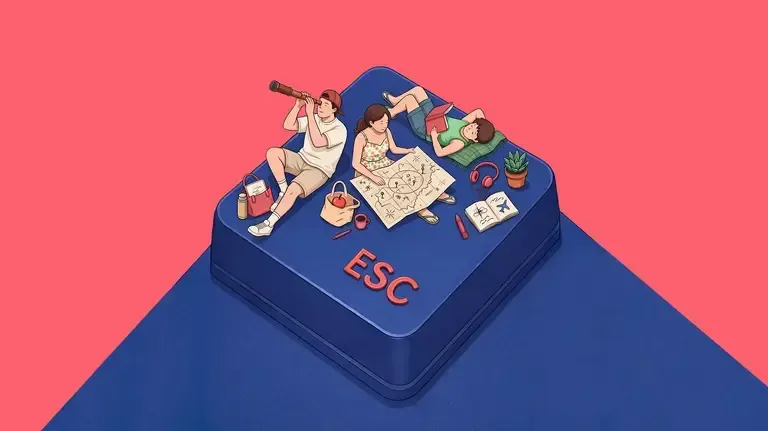
Digital tools are causing us to do more and more things without thinking. We become passive and exhausted — outrightly done-to-death by convenience. But this process can be reversed.
By Olga Drenda
Michał was born in the early 1980s. At school he was good at orienteering. He could calculate reasonably well in his head, though he sometimes stumbled on 7 times 8. He finished university with a cupboard full of written notebooks and photocopies scrawled with notes, even though his handwriting always resembled the clumsy attempts of a primary school pupil.
He knew the phone numbers and email addresses of quite a few people by heart, not to mention their addresses with postcodes. Friends envied him his composure — he genuinely rarely lost his temper over morning traffic jams or a slightly lagging computer. He could always listen to music or doodle silly drawings on a piece of paper.
That was still ten years ago.
Millennials: Has the Smartphone Taken Something From Them?
Today Michał uses the same convenient solutions as most of us: a smartphone in his pocket, a sat nav in the car, chatbots occasionally but without excess.
Recently, however, he noticed that everything had become too slow for him — unwieldy, labor-intensive. He couldn't remember the last time he had felt like puzzling over a simple problem.
When trying to explain directions in an area he knew reasonably well, he struggled considerably without the map on his phone. A simple percentage calculation in his head required such mental acrobatics that he felt embarrassed. He couldn't remember the last time he had waited for something without that unpleasant, gnawing impatience.
He felt that everything in his life was theoretically more convenient, yet he himself could remember and do less and less — and didn't feel particularly lighter for it. As if he had signed a tempting contract to be relieved of everyday tasks, or even to have his inner laziness pampered, in exchange for the independence and skills that had previously cost him no effort. The contract was paying off less and less, and was beginning to look suspiciously like a pact with the devil.
Gen Z: The Internet Was Always There
Michał's daughter Maja came into the world as a citizen not only of Poland and the European Union but of the digital world. Her childhood companion was Peppa Pig on the tablet screen, and later her favorite YouTubers. She never used a paper map; when planning trips with her dad they would drop pins into Google Maps and select the optimal route.
She has a tendency toward uncritical trust in what she hears on video blogs, and toward taking shortcuts — chatbots wrote her cribs and summarized set texts. Mastering games, apps, graphic editing, and video production comes to her effortlessly.
Part of Maja's school years fell during lockdown, so the internet is her natural environment for contact with peers. She participates there in K-pop fan communities, whom she later meets at conventions. But the internet has also motivated her to acquire and share skills that are very offline — requiring patience, precision, and handwork: costume-making, makeup, calligraphy in a bullet journal. Lately she meets up with friends online for group drawing sessions.
The Google Effect: You Remember What You Searched For, Not What You Found
Michał and Maja are characters created for the purposes of this article, but assembled from entirely real experiences heard in conversations with entirely real people.
All generations feel the consequences of excessive cognitive offloading, but in slightly different ways. Cognitive offloading is a practice that predates the invention of computers and is probably used by everyone — it encompasses all the ways we delegate a little mental effort outward: Post-it notes and calendars that help us remember, calculators that relieve us of arithmetic. Piglet in the old Polish children's show Miś Uszatek would tie a knot in his handkerchief when he wanted to remind himself of something important. Used in moderation, the practice can free up mental capacity, allowing us to focus on more complex matters without getting bogged down in routine problems.
The more we rely on such aids, however, the greater the risk that the mind, instead of acting like a razor, will blunt and grow lazy. As early as 2011, Betsy Sparrow, Jenny Liu, and Daniel Wegner of Harvard University described the "Google effect" — the tendency to remember what we searched for, but not the answer itself.
Today, the loss of cognitive skills is sometimes referred to by a term borrowed from economics that sounds ominously apt: "deskilling." In the industrial context it described the situation when a company replaced a skilled worker with an unskilled machine operator, weakening the former's position. Today, when we reduce all effort by allowing devices to do everything for us, we are doing this to ourselves.
Digital Amnesia: When Knowledge Goes Rusty
Older people — those who acquired analogue skills and then took a headfirst plunge into digital reality — face a specific form of atrophy: a decline in cognitive competence similar to the weakening of muscles after very prolonged inactivity. The phenomenon has become widespread enough to have acquired the ominously (and rightly) named label of "digital amnesia."
Knowledge does not vanish entirely, but it rusts heavily, and returning to one's former proficiency can be frustrating — reminding us of our own neglect. It is to them that the main character of Jakub Żulczyk's 2014 novel Blinded by the Lights might be directing his words: "You took everything out of your head and put it in a tablet, a computer, a cloud, whatever... What will happen when the external memory breaks down?"
Younger people — "digital natives" — often face a harder but perhaps more exciting challenge: learning something entirely from scratch. They do not need to remember something or take a step backward, because certain things — obvious to their parents' generation — were simply never taught to them. Research by Swiss sociologist and behavioral analyst Michael Gerlich shows that the youngest users are most vulnerable to dependence on technological assistance and, consequently, to a weakening of the capacity for independent and critical thinking.
The Digital Impulse: You Can Return to the Real
It is not written, however, that we are on a one-way road — as research findings also suggest. Designer and lecturer George Hajian, for example, shared his observations from classes with students who had worked in a digital environment from the outset. The more tasks requiring hands-on work he assigned, the more precise and accomplished their projects became when they returned to working on computers.
It also happens that the digital world itself provides the impulse to step beyond its own boundaries, drawing people into communities of interest. These may sometimes have newfangled names that help their members find each other online, but the next step is a move into the so-called real world: birdwatching, urban sketching (drawing outdoors).
On your next train journey, I encourage you to discreetly look around: many passengers will be sitting with their noses in their phones, but those doing a crossword or knitting will probably be in their twenties — and they were most likely drawn to their new hobby by the internet.
Analogue skills are, of course, chronologically older — but for people who have lived in a digital environment from birth, they can be an entirely new discovery. Some are taking it upon themselves to master them.
An American Experiment: Life Without a Phone
Jeremy Rellosa, a journalist at New York Magazine, decided to spend a month living his ordinary life — working, traveling, socializing — but without a mobile phone. It resembled a trip to the world of twenty years ago: he had a landline installed at home and asked callers to leave messages on the answering machine; he listened to music on an MP3 player with a radio; he printed paper maps and booking confirmations from his computer; he took photos with a standalone camera.
His greatest challenge was not being able to change plans on the fly — the absence of a phone forced him to be punctual. His greatest surprise was a chance encounter with a friend on the other side of the country. It turned out they had both been invited to the same wedding. For a millennial this might all sound like small beer, but Rellosa — a member of Generation Z — had to work these strategies out for himself from scratch. "I had never arranged a date with anyone by email," he admitted frankly.
The Analogue Journey: Maps Are Everything
As a happy coincidence, just as I begin working on this article, a good friend of mine casually announces that he is about to embark on the first trip of his life using a paper map. He has a good guide: Bartek Szabat, born in the year 2000, a musician in the band Poczta Polska, who regularly draws friends into "analogue" expeditions.
"The basic rule is that we don't take smartphones. For all the functions that accumulate in one small, flat electronic device, we have to find analogue equivalents — so the luggage expands a bit. We have one phone in the boot, some old brick, for emergencies. We drive an old car, we have a map, a camera, two suitcases full of cassette tapes, and an old Japanese Victor camcorder I once bought for 20 złoty," Bartek tells me. "It started when I bought an old map of Czechia and Slovakia from 1997. They build new motorways, but they don't plough up the old roads and plant fields on them, right? And since I wasn't planning to drive on new roads anyway — that's boring — I figured the old maps would do. We travel without a destination; usually we start from the Slovak border, because I'm from the south. We fill the car up to the brim and just drive until we run out of fuel. When we run out, we fill up again and head back to Poland."
Maps are everything. Bartek admits he has been a "map person" since childhood — riding in the car with his parents, he loved to follow and memorize routes. He jokes that he has a natural compass in his head, or perhaps even a mental minimap in the bottom right corner of his vision, like in Need for Speed. All his travel companions so far have been "GPS generation" — complete novices when it comes to maps.
Spatial Awareness: When Getting Lost Is Worth It
"At first I imagined it would look like the passenger spreading the map across half the windscreen, that we'd get lost. Everyone picks it up surprisingly quickly and manages to build a rough spatial picture in their mind — though of course we do turn around," Bartek laughs, adding that learning to navigate and cope with travel in general comes to participants with surprising naturalness.
"When I told friends at university what I was planning before the first trip, everyone said I was mad, that we'd get lost like someone's auntie in Czechia. It turned out all the difficulties were illusory. You simply keep your eyes open — looking for signs for a petrol station, a pharmacy, accommodation. If we can't find something in a village, we head for the nearest town. Driving by signs is a bit like a treasure hunt. It's also simpler, looser, and more pleasant for the mind," he says.
"Since I started doing this," he adds, "I've completely stopped searching online for somewhere good to eat — I just look around, choose at random, and judge for myself. Those seemingly convenient things — checking everything on your smartphone, choosing endlessly, comparing — are in reality very demanding."
The Restorative Aspect: In Search of Natural Emotions
The trips without a smartphone were initially supposed to be simply an adventure with an element of controlled risk. It turned out they had, as Bartek puts it, a restorative aspect.
"We didn't yet know how relaxing it would be. A two- or three-day expedition into the unknown is like a road movie. You encounter various difficulties along the way, which is also great — because if everything is planned, nothing will surprise you and you don't experience natural emotions."
And those can be enormous — for example, when after a whole day of wandering you manage to find a friend you arranged to meet "somewhere around here."
"Once we set ourselves a specific goal: to visit a dear friend of ours who was in Vienna. We called him before setting off and asked him not to stray too far. We had a map that reached exactly as far as Vienna, a small piece of paper with the address, and the information that Roman lived opposite some pizzeria. That was all. We had to improvise using tourist maps available in the metro, and communicate in broken German. After several hours of wandering the city we found the pizzeria. Roman happened to be taking out the rubbish and spotted our red Mazda. We have it on film — the moment we all start hugging each other. I thought I was hardened, but even for me it was an extraordinary experience," my interlocutor recalls.
An attempt to repeat the challenge — this time with a friend in Budapest — came to nothing due to what has been, so far, the only dangerous situation in the offline trips: a fainting episode requiring a doctor to be called. The event also made Bartek realize which skill is the hardest to reclaim from technology: communicating with other people.
"Having a smartphone makes you completely self-sufficient. Sometimes you don't need to communicate with anyone at all. When you rely on more limited means, you have to ask for help from people you meet, who don't always speak English. Smartphones have made it so you don't need to talk to people to solve a problem in the moment. No one asks for directions anymore — unless their phone has run out of battery. It's the basis of language courses, but in real life no one does it."
A Digital Camera at a House Party: A Tip for the Exhausted
Embracing analogue technologies is sometimes dismissed by sceptics as either an impractical attempt to turn back the tide, or a harmless retrofetishism — art for art's sake, a kind of aestheticization of life in which the point is mainly that older-generation devices look good in social media photos. That aspect does exist, but focusing exclusively on it misses the most interesting part of the picture: what using non-default solutions and departing from the obvious course teaches us and changes in us.
Sometimes it brings unexpected results. "I regularly make forays into older technologies, with varying results," says Antoni Przesławski, known as 63anton — a visual artist and decidedly not a digital ascetic, but rather someone who constantly weaves the online and offline dimensions of his life together.
"Among the most successful are those involving cameras. People grow tired of the constant photographing, stressed by the possibility of being caught in an unflattering moment and immediately posted on social media. But when someone turns up at a house party with a digital camera, it creates a special ritual. Instead of fleeing the lens, everyone suddenly — regardless of their current state — wants to be in a posed photo, to be part of the captured moment. Most people may not have held such a device in their hands, so they'll happily strike up a conversation with whoever has one, and try taking a few shots themselves. Photos taken on a phone usually become part of an Instagram story immediately, while photos from a digital camera have to wait a few days. Because of their distinctive style, they have value both as an in-the-moment record and in terms of the energy they bring to a gathering — and they're also attractive as mementos. Instead of ending up on stories, they'll probably land in a post, perhaps even on someone's wall as an image with a story. And it's not only applicable to social gatherings — carrying a camera every day changed how I perceived my surroundings," he says.
His current favorite camera is a thirteen-year-old smartphone, an iPhone 5s, which he uses solely for photography. It produces the desired imperfection of image and fits in a pocket. It works prosocially too — as a model no longer commonly seen, somewhere between new and already vintage, it arouses people's curiosity and invites conversation.
Twelve Hours of Screen Time: Can This Be Refreshed?
Antoni is an example of someone who treats retro technology as a way of expanding his capabilities and experiences — not as a vehicle for nostalgia. Testing it through trial and error, he learns something about himself along the way: what he pays attention to and what he is looking for.
In the case of music, he abandoned the currently fashionable retro device — the iPod Shuffle, whose mode of playback differed too much from his habits as an engaged audio consumer — but when it comes to film, he firmly opts for vintage.
"The biggest problem is that modern macOS doesn't get along with a sixteen-year-old media player, so to load music onto it I had to use two other computers. Given that I'm constantly discovering new music and it accompanies me almost around the clock, that kind of library management issue is fairly crucial. With films I hold the opposite philosophy. Despite treating my laptop almost as an extension of myself, I'm not a fan of watching films on it — especially on streaming platforms that compress quality, losing grain, ruining gradients, and distorting color contrast. If I want to watch a film at home, I'm willing to spend even an hour sailing uncharted waters in search of the right Blu-ray rip, in order to squeeze the maximum out of my laptop screen — which is genuinely visually impressive. Or I'll simply go to an art-house cinema. After a cinema screening there's usually a discussion, then a tram ride home and, along the way, reflections on the cinematic experience. That way it isn't just another colorful image on my screen during my daily twelve hours of screen time, but an actual encounter with a work of culture in the way it was created."
The Power of Friction: Long Live Minor Inconvenience
My interlocutors, independently of one another, point to a similar benefit of consciously choosing older technological solutions: exposing oneself to minor inconveniences, deliberately making life slightly harder — I use that word with deliberate exaggeration — in order to get more out of it, to experience, remember, and live it more fully.
When American writer Kathryn Jezer-Morton introduced the term "friction" to describe a more concrete, independent engagement with the world, it caught on immediately. Jezer-Morton had named something people widely experience. Contemporary digital solutions smooth over all experiences and minimize user involvement to such a degree that we pass through them without thinking. Crossing the threshold of optimal cognitive offloading makes a person simultaneously passive and exhausted. You might say — done to death by convenience.
Seeking positive friction — a creative tension between oneself and the world — is not complicated. It requires only one step backward: a walk without GPS, going somewhere on foot instead of by car, cooking a meal yourself. Sometimes: distributing the functions of a smartphone among separate tools. Jezer-Morton argues that such simple expansions of self-reliance and renouncing of excessive convenience bring benefits to the mind and psyche similar to those that physical movement brings to the body.
A Notebook Instead of a Tablet: It Helps You Remember
"I don't want to make things unnecessarily difficult for myself, but the ease with which absolutely everything can be digitized is too tempting," says Bartek Szabat. "As part of the de-digitization I'm trying to introduce into everyday life, I bought myself a little notebook. A B5 exercise book. Thanks to it I've stopped using iPhone notes — which are now the standard way of recording thoughts — and I use Google Calendar less and less. I always have my notebook with me, with a nice date stamp at the top. It gives me a wider field for recording my thoughts than the iPhone keyboard, which is limited to characters. Here I can draw something, add an arrow. Writing in this notebook is a real pleasure."
Numerous researchers would add that it is not merely pleasurable, but also beneficial for memory and the capacity for deep learning.
Antoni says that in his experiments with older technologies he is searching for something he misses most in contemporary life: the dimension of touch and muscle memory. He argues that the smartphone has become too universal a combine harvester for our senses, and that unlearning reliance on it alone brings considerable benefits.
"We listen to music on phones, take photos on phones, watch films on phones, navigate by phone, read on phones, work on phones, and socialize on phones. Every activity in our daily life takes place with one object, with one mode of interaction, delivering primarily visual stimuli. Even the washing machine, dishwasher, and induction hob are touch-controlled. So is the air conditioning in the car, and the door-open button on the bus," he says.
Body Memory: Touch Cannot Be Generated
And he concludes: "I have the sense that through this approach to design we are terribly overloading certain senses while not using others at all. To this day I remember the way the door handle worked in the family car we had when I was small. I can recall the physical sensation of that moment even faster than the mental image — having flashing colored pictures in front of your eyes 24/7 simply makes them harder to remember. Especially when those images can be generated at will by computer, while physical sensations — fortunately — cannot yet."
Antoni says he is searching for unpredictability — something that contemporary solutions eliminate as an obstacle, while it is precisely unpredictability that generates discoveries, stimulates inspiration, and consequently increases satisfaction.
"The crackle on a vinyl record, an unevenly lit display, a dirty magnetic tape, an underexposed photographic film. Each of these phenomena introduces into the creative process a certain unknown — an intervention of natural forces in our actions, an element of uncertainty as to whether everything will turn out as planned, or whether we might stumble upon some interesting, unforeseen surprise. Physical media have their limits, and it is far more interesting to navigate those limits and try to bend them, as opposed to the unlimited sandbox of the digital era, where the abundance of possibilities leads to decision paralysis and overstimulation."
In 1970, Alvin Toffler wrote that "the illiterates of the 21st century will not be those who cannot read and write, but those who cannot learn, unlearn, and relearn." From the perspective of 2026, it is clear what a valuable skill it is in that process to pause in the uncritical forward drift — and sometimes to take an apparent step backward, in order to integrate the digital with the organic, the online with the offline.
Orginally published in Tygodnik Powszechny, 23 June 2026. Translated with AI.