How to Step Off the Seesaw of Rivalry and Reclaim Peace of Mind


Jean-Michel Oughourlian, neuropsychiatrist: When we look at someone, we reconstruct their intention. We desire to have what that person has — even to be who they are. If that fails, our model turns into a rival.
By Jean-Michel Oughourlian and Michał Łuczewski
Michał Łuczewski: We live in a time of war. Not only the war being waged between states and nations — but in every community, and within each of us. Because that is surely what we must call the rivalry we are constantly engaged in: for prestige, attention, and influence.
Jean-Michel Oughourlian: Rivalry is the most terrible thing that can happen to us. It robs individuals and entire nations of their mental health. All people, from all nations and all continents, are caught up in it. Everyone wants to show that they are stronger, better, more moral.
You too?
I always tried to avoid rivalry. But that is very difficult among doctors! Thirty years ago, the five-hundred-strong staff of the American Hospital of Paris elected me president of their association. When I retired ten years ago, they urged me to stay on. They said I had never treated anyone in an aggressive or brutal way. I had not entered into conflict with anyone. But recently, when a new group of doctors appeared — young and ready to fight for position — I stepped down.
Your friend René Girard, with whom you wrote Things Hidden Since the Foundation of the World, argued that every king is a scapegoat — only that his sentence is deferred.
The young ones would have killed me without the sacrifice. I'm in no hurry for that. (laughs) René was my master, my model, and my friend. I devoted my entire professional life — more than half a century — to building a new psychology grounded in his mimetic theory.
Girard discovered the universality of the scapegoat mechanism across all cultures. Can we resist these mechanisms of persecution in any way?
We must challenge the unanimity of the crowd that seeks scapegoats without seeing its own guilt. In Girard's thought, the victim is more of a sociological than a psychological phenomenon. The scapegoat mechanism requires the unanimity of the entire community.
To free ourselves from violence, should we oppose our own tribe, our own bubble?
Do you remember the woman who was brought to Jesus to be stoned for adultery? Jesus does not enter into rivalry. He writes in the sand and says: "Let him who is without sin cast the first stone." That is the moment when unanimity is undermined. And suddenly, one by one, everyone gradually withdraws — because they realize that none of them is without guilt. The point is to dissolve the unanimity. When a crowd kills a victim, each person believes they themselves are without guilt.
Where does this mechanism come from? Why is it so easy for us to chant along with the crowd?
Because of imitation — what Girard called mimetism. Your desires are unconsciously indicated to you by other people, who become your models. The model has something you do not have. They point toward the object of your desire. You imitate them in order to have what they have, to be like them.
What are the consequences?
The effect of imitation is the "possession" of our self by someone else — an "entering in." In this way countless parts come into being within our psyche. From birth we imitate and draw inspiration from various people. At first it is our parents, then educators, teachers, authority figures. Throughout our lives we follow dozens of successive models, which are not necessarily imposed on us, because we can choose them. Each one brings us something. Each becomes part of our personality, just as a master becomes part of a student. We are a mosaic of all the models we have had in life.
This phenomenon is clearly visible in the example of hypnosis. Through suggestion — of which we are unaware — a hypnotist can generate a part of our self that will have its own desires, sensations, memory, and consciousness. Because our imitation is largely unconscious, every model is a kind of hypnotist for us.
A very powerful metaphor. Society "enters" us. We are possessed by others. We are all in one great trance, a hypnosis.
We commonly assume that our desires flow from our self. Mimetic psychology — interindividual psychology, as Girard and I called it — shows that our self is formed by the desires of others. Psychology cannot therefore be a science of individuals, but of what lies between them. My friend Eugene Webb found the right word for this: interself. Our self emerges from its relationship with others; it is a self-between, a self between. In reality, we are always in relation.
If I know that someone is trying to influence me, can I turn away?
Mimetism in the social world is like gravity in the physical world. The model is always a fixed point of reference. We can do nothing but orbit around it, as the Earth orbits the Sun. We can choose who we want to orbit, but orbit we must. We can choose our relationship to the model, but we cannot bypass models altogether.
So if I turn away from one model, I must find another. My freedom is only the freedom to choose whom I imitate?
We have no choice, because every human brain has mirror neurons. Their discovery by Giacomo Rizzolatti and his team in the early 1990s was a revolution in neuroscience. It turned out that mimetism has a biological basis. Mirror neurons mean that when we observe someone else's action, we not only see it — a readiness to mirror that action automatically arises within us. This automatism has been observed in macaques and in newborns, who, just a few hours after birth, seeing someone stick out their tongue, stick out their own.
How does this translate to the adult world?
The further development of mirror neurons means that when we look at someone, we automatically reconstruct their intention — accurately or not. We reconstruct their desire. Mirror neurons make us desire what the other person points toward. We desire to have what they have — even to be who they are.
And if that fails?
Our model turns into an obstacle and a rival. And ultimately into our scapegoat.
Why?
Because the model showed you what you may desire. As a consequence, you begin pursuing the same thing. The object of your desire is the same. Your shared desire makes you resemble each other — you become each other's doubles, even though you think you are entirely different. And suddenly you become obstacles to each other, and ultimately rivals trying to destroy each other.
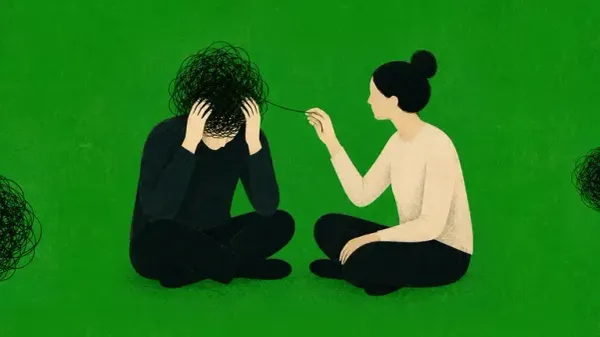
People consumed by conflict believe that one must be on top and the other on the bottom — that one person's victory depends on the other's defeat. It is like children on a seesaw in a playground. One can only go up when the other goes down. The one at the bottom can only rise again when the other descends. It is a diabolical seesaw.
Can I not satisfy my desire in some other way? As on a free market — buy myself the object of desire rather than competing for it with others?
If it were a car, and you had sufficient means — yes. But what if it is a person who appeals to your model and to you? Or a position in a corporation that cannot be divided? That is how rivalry and conflict arise. On the free market, you can sometimes satisfy a desire without entering into rivalry — but even so, you are constantly imitating others. And in a more radical way than in traditional societies.
I had patients who worked in a prestigious firm run by a charismatic leader. Their work essentially consisted in mirroring and fulfilling the boss's desires — who himself mirrored and fulfilled the desires of the corporation's owners. Modern innovative corporations are built precisely on the mimetic mechanism: on the liberation of mimetic desire on a global scale. These people came to me because when they were laid off, they could no longer function. They had suddenly lost the star around which they had been orbiting.
What can be done to escape the hypnotic power of our models and rebuild the unity of our self?
The main challenge is learning to distinguish who is a model, who is a rival, and who is an obstacle — not to blur them in one's mind. And to strive to turn the negative rival whom you want to destroy back into a positive model from whom you can learn. And when you encounter an obstacle, to try to go around it.
This was described by La Fontaine in the fable of the fox and the grapes. The fox wants to eat the grapes and cannot reach them, so he negates their value: "They are too green — good only for gluttons." Then he can walk away in peace. The same mechanism is illustrated by a story about two Russian soldiers I heard in the Soviet era. One says to his friend: "You'll never guess what happened to me! I came home today and found my wife in bed with a general!" And the other soldier replies: "You poor man! What did you do?" "Nothing," says the first. "I was lucky. The general didn't see me." He did not want to make the general his rival, so he slipped away unnoticed.
Quite. Except that he avoided that rivalry at the cost of deceiving himself and his own suffering. So are we ultimately condemned to living in illusion about our rivals? Or can therapy save us?
I believe that in the psychiatrist's consulting room there are no separate, independent individuals. There is no patient and no doctor. There are three interrelated subjects: the doctor, the patient, and the illness. Do not expect too much from therapy. If you come to me as a psychiatrist, and I give you to understand that I am more intelligent because I am capable of helping you — rivalry will emerge. Because on the diabolical seesaw of conflict, the therapist and patient can sit together too. The only thing one can do is step off it. Never open the door to rivalry.
The whole game consists in finding out whether the patient is allying themselves with the illness — that is, with their model — against the psychiatrist, in order to prove that the psychiatrist is an idiot; or whether they are trying to ally themselves with the psychiatrist in order to get rid of the illness and free themselves from rivalry with the model.
In my practice I often saw people arriving with a stack of documents, saying: "I have been to sixteen doctors, I have undergone every test, here are the results. No one has been able to cure me."
I immediately knew that this person was trying to make me yet another victim of their neurosis. I would say: "I am very sorry. Since all those brilliant doctors were unable to do anything, I too will be unable to do anything for you. I am only a simple psychiatrist." "No, you must help me, give me something." "You have tried everything. I am very sorry." "But I will not leave this office until I receive a medication." Then I would say: "Very well, I will give you something. But I can tell you now that it will not work. I will prescribe it since you insist." And I would write something mild, almost a placebo. A week later the patient would call and say the medication had helped.
So the patient wanted to cast you in the role of hero, whom they could then attack for incompetence. And you immediately took the role of the bungler. You did not want to imitate the patient's desire.
Exactly. I brought about a situation in which using my medication made the patient the winner. I allowed them to think of me as stupid for giving them a drug I said would not work. By recovering, they were defeating me.
Does this mean that ultimately we can only help ourselves?
A good therapeutic relationship means that if the client tries to help themselves, I as therapist am there to support them in that. I always tell my patients: step off that seesaw and go play something else. There are so many other, wonderful possibilities.
But how can one do that when we are bound to our rivals? Stepping off the seesaw, we lose our identity — our fake identity, as James Alison writes.
When you see a patient, you usually ask what is hurting them. I believe there is a more important question that should be asked in mimetic therapy: who is your pain?
Who is your illness? In other words: who is your hidden model?
If I ask who is your pain, you will realize that the pain is only a symptom. Symptoms develop because a person is not conscious of their causes. For example, they cannot see that a person close to them is making their life very difficult — precisely because this is someone close, whom they love or respect. They cannot accept it. Once they notice this, they will gradually be able to free themselves from that person.
This is what happens in families, in couples, in all kinds of situations in which someone becomes attached to another person — "hangs" on them — thinking they cannot live without them.
What does that mean in practice?
A sister, a mother, a husband, or someone else entirely may be responsible for the emergence of a symptom. Instead of recognizing your rivalry with them, you express it through the symptom. My back hurts. I cannot sleep. I feel anxious. I have a panic attack. I cry. All kinds of things that are connected with the fact that you cannot free yourself from your model. Cannot escape from a toxic situation.
To preserve your mental health, you must avoid rivalry. Never — under any circumstances — open the door to rivalry.
How does one translate that into everyday life?
The first step toward liberation is awareness. When you are talking with someone, you have, in a sense, a new, different self. You do not talk with your wife the way you talk with your boss. You change. You adapt your identity to your interlocutor. To their desire. You imitate others who knew and showed you how to navigate a given context. Over time you begin to see that in a given situation, the part of you that imitates one of your models is activated. If you observe yourself carefully, you will become aware of it.
Does this apply to societies and nations as well? You argue that psychology without politics is powerless, and politics without psychology is shallow.
I can point to similarities between the reactions of national leaders and the reactions of patients in my consulting room. In Psychopolitics I tried to show that nations act like people. All nations, states, and peoples — just like individuals — are caught up in mimetic rivalry. On the international stage they are each other's models, obstacles, and rivals in turn.
What is the struggle about today?
About peace. States and nations compete to occupy the position of victim and to accuse whoever stands against them of being a persecutor. Suddenly no one is the aggressor. Everyone says they are defending themselves. A global struggle is underway over who is the greatest victim. That is the primary desire that unites everyone. But because we perceive ourselves as victims, in the next step we find that our enemies can be eliminated. Even Putin says he is defending Russians in Ukraine and responding to NATO aggression.
The Moscow Patriarch Kirill emphasizes that Russians and Ukrainians are brotherly nations. But since the Ukrainians refuse to acknowledge that brotherhood, we must kill them.
Kirill does not realize that he is a prisoner of mimetic rivalry. Precisely. After all, the conflict between brothers began with Cain and Abel. Brother killed brother because of rivalry for God's blessing. Now Kirill is justifying Cain, while casting himself as Abel. It repeats throughout the whole of human history.
Girard spoke of those "things hidden since the foundation of the world" — the founding murders of human culture. The American bishop Robert Barron even said that Girard should be declared a saint or a Father of the Church.
For me, Girard — unlike Paul Ricœur, with whom I was also friends — was not a Christian thinker. He was an anthropologist who devoted himself to analyzing social reality and the figures in great works of literature.
And was there rivalry between them?
Long ago I tried to persuade Girard to meet with Ricœur. He happened to be in Chicago at a time when Ricœur was teaching at the university there.
That would have been quite a debate! Mircea Eliade was also teaching at the University of Chicago at that time...
He was also supposed to take part in that meeting!
And Leszek Kołakowski as well!
But I was unable to organize it. Everyone had some excuse. In my view, none of them wanted to admit that there was a grain of truth in their colleagues' thinking. (laughs)
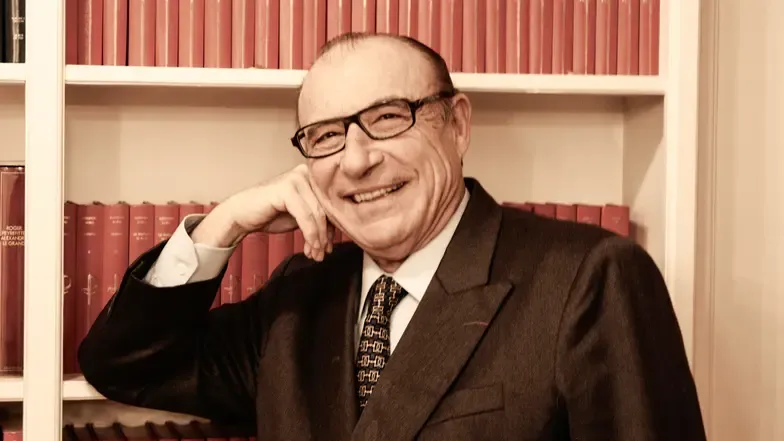
JEAN-MICHEL OUGHOURLIAN is a neuropsychiatrist. Emeritus professor of clinical psychopathology at the Sorbonne and former head of the psychiatry department at the American Hospital of Paris, he was one of René Girard's closest collaborators, co-author of mimetic theory and of the book Things Hidden Since the Foundation of the World, and author of numerous publications on desire, the psychology of relationships, and the "interindividual self."
Orginally published in Tygodnik Powszechny, 10 February 2026. Translated with AI.