Could Friendship Become a Remedy for Widespread Loneliness?

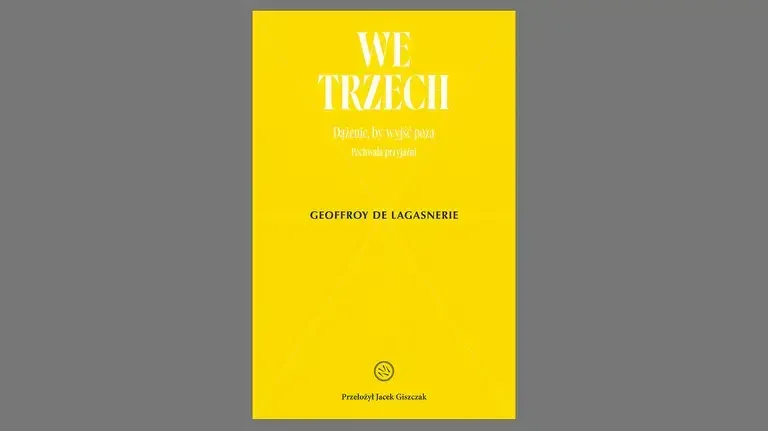
In his book We Three: The Endeavour to Go Beyond, Geoffroy de Lagasnerie proposes a new, revolutionary dimension of friendship that could lead to liberation from the rules of social life.
By Radosław Kobierski
This is the first translation of the French sociologist and philosopher's work into Polish. It is a remarkable book, because it takes as its research subject and object of reflection the phenomenon of friendship — something universal and deeply rooted in culture, yet at the same time curiously unclear when one tries to understand its relationship to systems of power and law. It is precisely at the intersection of these two spheres — intimate relationship (which the author would most like to see existing outside the system) and the politics of roles — that Lagasnerie places his multi-threaded narrative.
Friendship as a Form of Life and the Centre of Existence
This is a book organized by the rhythm of a scholarly essay, but also by a rare genre: that of collective biography. The author describes the lives of people close to him — the writer Édouard Louis, the sociologist Didier Eribon, and himself — at a pivotal moment in their relationship, when friendship becomes a way of life, the centre of existence.
The central thesis of Lagasnerie's essay — from which further arguments radiate in accordance with the logic he establishes — appears at the outset: "To experience a life-form that takes power over us, making us who we are, means experiencing life and certain ways of existing, though others might suit us better and make us happier. It means allowing society to steal our existence."
For if most relationships are functional in character, inscribed within a socially established game of identities and roles that are complementary to the traditional frameworks of existence defined by families and family policy, then the transferring of all one's vital activity, ambitions, and above all one's entire time into a radical, creative friendship — one that can also become a structure of resistance and a source of new counterculture — is like waking from a long sleep into which the Matrix had plunged us.
Is the Family an Oppressive System of Control?
Lagasnerie is of course right when he argues that, within the logics of systems of reproduction and domination, friendship is regarded as a transitional moment, a matter of youth from which one must eventually graduate into real life — married and family life. He is right when he observes that friendship is for us a somewhat frivolous phenomenon, one that does not merit institutional support (if we take civil partnerships as a form of practicing friendship, the Polish reality is the most telling example of this).
Nor is it easy to deny that old and new totalitarianisms and populisms valorize and radicalize the primacy of the family, establishing it as the only healthy form of relational practice. Through the family and the idea of the family run all the threads — or cables, to stay with the Matrix — connecting us to systems of control and management.
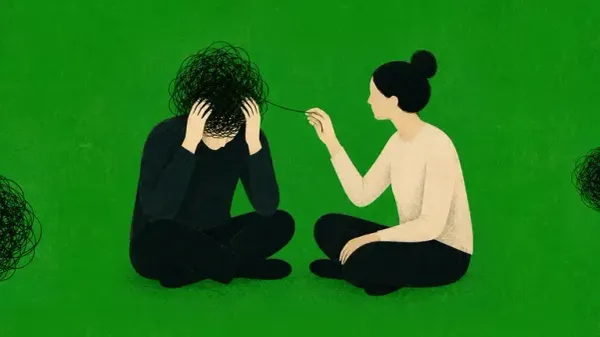
This new ethical, awakened, and in essence revolutionary dimension of friendship could become something like a remedy for isolation: a liberation from the rules of social life, a Tolstoyan "living from the heart" that drives itself like a wedge into "living by the rules" — the seed of a new countercultural awakening toward which Lagasnerie gazes with obvious longing. He even writes explicitly that he would like his book to become a tract for the younger generation, a kind of new social contract, a "manual of anti-institutional life."
At the same time, however, the author calls for the institutionalization of new forms of coexistence, knowing full well the dangers that come with this (late capitalism has unlimited capacity for absorbing things into the system). He also notes that he has no intention of turning their life-as-three into some kind of model of participation or existence.
Can Radical Friendship Break Social Bonds?
I also note that despite the egalitarian postulates that permeate its class structures and associated privileges, this model seems very elitist — even hermetic in a psychological sense, and privileged — for it applies to people who, thanks to academic and creative professions, can afford to cultivate independence.
If the radicalism of the proposed friendship is to rest, among other things, on the severing of social and economic bonds — though paradoxically it is also meant to lead toward ever-greater participation — who will be able to afford it? In the material and symbolic sense alike.
There is another ambiguity. At a certain point Lagasnerie confesses: "What binds us is not love, but more than friendship." "Didier and I are a couple, and Édouard on his side is in a couple." The differentiating element here is the fact that all of them live separately — as if to forestall the doubt that their form of radical friendship nonetheless enters into the systemic framework. And love — the admission of it — might weaken the argument about the proposed centre of life. The centre is therefore decentralized, though I am not sure this strategy convinces me.
Orginally published in Tygodnik Powszechny, 18 November 2025. Translated with AI.