Chess Without a King. Why Magnus Carlsen Grew Tired of Competition

The whole chess world is begging Carlsen, the maverick and perhaps the most inspiring contemporary athlete: King Magnus, come back!
By Rafał Stec
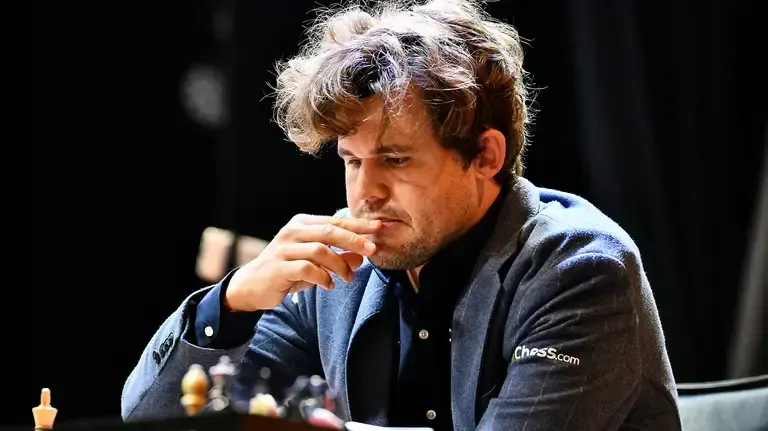
He hasn't really left at all. The fascinating paradox is that the Norwegian champion abdicated, yet retained his power — and in many respects has even expanded it.
In July 2022, he shook the chess world by announcing he would not defend the world title he had held for a decade, but he didn't withdraw from competition entirely. He wasn't crushed by depression, as so many other famous athletes have been, nor did he feel burned out from constant pressure or fatigued by a discipline he had practiced since early childhood — unlike tennis player Ashleigh Barty, who put down her racket for good while leading the WTA rankings, shortly after winning the Australian Open.
Ding, Gukesh, Sindarov: Younger, Less Gifted
On the contrary, Magnus Carlsen still loses himself in winning tournaments, often utterly dominating the competition. He simply disdained the pursuit of the most precious trophy — one requiring extraordinary sacrifice, the details of which we will return to.
He allowed Ding Liren to take the crown, and then stayed out of the way in 2024 when the Chinese champion was dethroned by an then-17-year-old Indian, Gukesh D, who became the youngest world champion in the history of the royal game.
We also didn't see the Norwegian in the recently concluded Candidates Tournament, which produced yet another sensational challenger for the throne. The reigning champion will be challenged by 20-year-old Uzbek Javohir Sindarov — so another record will fall. For the first time in a world championship match, both players at the board will be men who have only just crossed the threshold of adulthood.
Both are phenomenally talented — no dispute there. But both will move their pieces knowing that chess enthusiasts would rather see them clash with Carlsen, and wonder whether these youngsters could hold their own against the true hegemon. Indeed, most would immediately answer: no, it seems unlikely.
Why Carlsen Got Tired
Dubbed the "Mozart of Chess," the 35-year-old grandmaster is considered the greatest player of all time, rivaled only by Garri Kasparov. And he made a move as unconventional as his entire sporting life has been. At the peak of his powers, he surrendered the title — yet continued to play classical games (i.e., multi-hour games) at smaller events, to demolish rivals in much shorter rapid and blitz formats, to triumph in the Grand Prix he himself designed (a series of events resembling a year-round racing calendar like Formula 1), and to dazzle at various commercial events. He is bursting with energy and a hunger for relentless winning. He remains the undisputed leader of global rankings in every format of chess, having reigned for fifteen years.
He relinquished the status of champion of champions because he cannot stand the format of the world championship match — stretched over three weeks, consisting of up to 14 games (plus potential tiebreakers), all played against the same opponent, with individual games in extreme cases lasting over seven hours.
It is a physically and psychologically grueling experience. Today's grandmasters, drawing on the accumulated knowledge of previous generations, practically never make outright blunders — at most, minor "inaccuracies." They approach perfection, and so a world championship match is preceded by months of painstaking theoretical preparation, during which players try to unearth any novelty that might catch their opponent off guard.
They spend this time with a computer and a second or a small circle of collaborators, often keeping their location secret. When Carlsen speaks of the torment of training camps — he has hidden away in rural Norway and Spain, in Oman and Qatar — connoisseurs of literature might picture the hero of Stefan Zweig's masterful Chess Story: a man kept in isolation who transfers his entire being to the chessboard, begins compulsively playing against himself, gradually loses touch with reality, and descends into madness.
Chess Can Be Dangerous
The motif of madness brought on by a passionate obsession with moving queens and knights is familiar both from art and from life.
Aleksandr Ivanovich Luzhin, born from Vladimir Nabokov's imagination, lost his mind — he saw chess pieces everywhere, detected patterns of chess moves in human behavior, hallucinated that life itself was a chess game, until he leapt from a window.
The very real 19th-century grandmaster Paul Morphy suffered a mental breakdown; paranoid delusions haunted the phenomenally gifted Bobby Fischer in the following century. And though we have no medical documentation or hard evidence linking chess to the disorders of either American, serious sources point to circumstantial evidence: the royal game is considered so all-consuming of the mind, and so demanding of enormous mental effort, that it can be dangerous.
Carlsen, however, never gave the impression of being at risk of losing his balance — his overwhelming superiority over rivals is explained in part by his almost inhuman psychological resilience. When, in his last world championship match, after a series of draws, he won a monumental game — the longest in the history of the championship, nearly eight hours, 136 moves — his Russian challenger Ian Nepomniachtchi fell to pieces: from that point on, according to commentating grandmasters, he began making "shockingly stupid" moves.
The victorious Norwegian later confided, however, that chess marathons gave him no pleasure, no inspiration — after each new success he felt not satisfied but hollowed out, drained of psychological resources.
He had warned before that he was considering an exit, and had called for the world championship format to be reformed, but the international governing body (FIDE) ignored his appeals. The final decision came when the Candidates Tournament once again produced Nepomniachtchi as his opponent. "I don't have the motivation, I don't have much to gain, I don't particularly enjoy it. The preparation process is too intense, too exhausting," Carlsen explained. After triumphs in 2013, 2014, 2016, 2018, and 2021, he sounded like a man terrified of the day he might come to hate chess.
FIDE in a Corner, Carlsen Having Fun
The fans grew sad, the faces of FIDE's leadership fell. For if King Magnus abandons the world championship, it is not he who finds himself in trouble — it is the championship itself. It loses prestige dramatically, its diminished sporting value discourages the generosity of sponsors, the board is overshadowed by the absent man who still reigns everywhere he appears.
Carlsen is the reigning world champion in rapid chess, blitz chess, and Chess960. He holds this triple supremacy compounded by his position as the leader of the global rankings in classical chess as well — let us recall that he has not given up playing long games; he has only withdrawn from one competition. Our collective misfortune is that it happens to be the most prestigious one.
Imagine Lionel Messi, in his prime, immediately after collecting another Ballon d'Or, snubbing the World Cup. Deciding to prove his superiority over every other footballer on the planet exclusively through other competitions. That is what Carlsen did.
The chess world has naturally urged him to reconsider. FIDE officials have attempted behind-the-scenes negotiations. To no avail — the likelihood of the champion's return seems to be dwindling, especially since he would now have to fight his way through the Candidates Tournament, which is equally grueling and equally repellent to him.
In the meantime, what the Norwegian has grown weary of above all is competing against peers from his own generation and older players. Even before his departure he signaled that only one rival might tempt him back to the world championship: Alireza Firouzja, an exceptional Iranian teenager who, already playing under the French flag (he accepted French citizenship because the Iranian regime barred him from playing against Israelis), had beaten several of Carlsen's own youthful records. Unfortunately, that desired opponent was eliminated in the qualifying rounds.
Who Niemann Can't Fool
The latest crop of young prodigies no longer motivates the virtuoso. Gukesh D has disappointed since winning the title — he has slipped to 15th place in the global rankings — while his future opponent Sindarov sits only four places higher. And though Sindarov performed brilliantly in the Candidates Tournament, going undefeated, every observer must have heard echoing in their minds the words of Kasparov, who declared he would not recognize any champion until that alleged champion had defeated the Norwegian head-to-head.
Carlsen himself, while acknowledging the inevitability of an approaching decline — "it will come gradually; I don't anticipate a sudden collapse" — has said on several occasions that he still considers himself better than "the kids," and that by virtue of his versatility he deserves his reputation as the greatest player in the world.
Anyone else we would dismiss as arrogant, but we know Carlsen for his brutal honesty, his capacity for rational self-assessment. He sounds credible both when he reviews his own play as perfect and when he confesses: "I know I'm smart, but I don't feel like a genius." He doesn't flirt with the crowd.
That quote comes from Untold: Chess Mates, a Netflix documentary released in April that tells the story of Hans Niemann, a talented American player accused of cheating. The accusation was made by Carlsen himself — after losing to the suspect, he first hinted that something strange had occurred, then stated outright that at moments he felt he had not been "playing against a human" (i.e., had been facing the computational power of a computer), then deliberately resigned after the first move in their next game, after which the world witnessed an ugly spectacle ending in a lawsuit filed by Niemann and a subsequent settlement.
That is a separate story, the details of which we won't explore here, but the documentary also contains words that are fundamental to understanding the Norwegian as a figure of far greater significance than merely the world's greatest chess player.
"He has total power in our sport — I don't stand a chance," Niemann says. And he speaks the truth, perhaps even understating it.
Magnus Play: Grandmaster, Celebrity, Innovator
Although the American admitted that as a young man he had cheated, using technology in online games, his testimony before the streaming platform's cameras strikes at his adversary with a degree of accuracy.
When the scandal broke, Niemann's shameful past was exposed by investigative analysts at Chess.com, who detected irregularities — moves assessed as having been suggested by computer engines — in as many as 102 games. And it so happened that this platform, the most popular chess destination on the internet, was at that very moment finalizing its acquisition of Magnus Play, an app belonging to Carlsen.
In the campaign against Niemann, the accuser was thus backed by the owners of an enormously influential company with which he had business ties — a company that functions as both a social network and a news portal, boasts over 200 million registered users, organizes commercial tournaments, co-shapes the architecture of world chess championships, and is growing more powerful by the day.
Carlsen himself is evolving in a similar direction, transforming into a one-man empire. He is growing as an entrepreneur, a celebrity, and an inspired innovator bent on revolutionizing his beloved discipline — and when decision-makers cross him, he often simply walks out, slamming the door behind him.
When he doubted Niemann's honesty, he withdrew from the Sinquefield Cup the very next day, giving no reason. He did not complete the World Rapid Chess Championship after being fined for violating the dress code — but the FIDE officials quickly capitulated, concluding that jeans did not offend their sense of occasion after all, and instructed referees to show "greater flexibility."
In the final of the blitz world championship, after several draws in the tiebreak games, he pressured officials into awarding two gold medals — to himself and to Nepomniachtchi — even though the rules made no provision for such an outcome.
Magnus Carlsen: The Self-Proclaimed Revolutionary of Chess
The habitual nonconformist, the greatest among grandmasters, also thumbed his nose at Norwegian law, which prohibits the advertising of gambling. During the pandemic — which chess owes a dazzling boom to — he demonstrated a creativity unavailable to international officials by inventing an online tournament series later transformed into the Grand Prix. Since FIDE refuses to embrace formats more appealing than classical chess, the Norwegian promotes them himself. And he wages fresh wars on the federation — as when he fell out with it over prize money from Chess960 tournaments.
That idea, too, was born in his beautiful mind, which simmers with a constant hunger for adventure. Classical games reward diligent students who memorize sequences of moves, while shorter formats demand instinct, reflexes, and spontaneity — they force mistakes, reduce the number of draws. And Chess960 represents an even more radical experiment: with 960 possible starting positions (the format is also known as Fischer Random Chess, after its inventor), no one can prepare for every variation; rote mechanical execution is simply out of the question.
All of this forms a coherent strategy pursued by a self-appointed revolutionary who has for years been championing the modernization of a discipline he considers stale, incapable in its current form of seducing the young.
The footballing analogy proposed earlier deserves elaboration. For Messi to imitate Carlsen, he would have to not only boycott the World Cup but also invent and organize his own competitions, consider himself greater than FIFA and make that superiority felt, dismiss the opinions of FIFA president Gianni Infantino, force concessions from him, withdraw from competitions in protest at rulings he deemed unjust, demand sweeping rule changes, and — when met with resistance — successfully deploy blackmail. All without provoking a wholesale public backlash.
In conclusion: no athlete has ever dominated their sport to the degree that Carlsen dominates chess today. He is creator and creation, a demiurge wielding power that approaches the absolute. If he lived on a chessboard, a single square could not contain him. He would rampage as a hybrid of queen, knight, and pawn — the only piece permitted to transform into any other, as circumstances demand.
Classical, Rapid, Blitz: Time for Total Championship
That is why, in the autumn of 2026, we will witness the inaugural edition of a competition unlike any before it. The Total Chess World Championship will be held under the FIDE flag, but it was developed in consultation with the Norwegian — it is meant to be a compromise between his push for revolution and the conservative stance of the international authorities. It will combine classical, rapid, and blitz chess; a thrilling knockout system (lose and you're out) will determine the winner; and it will reward all-round ability.
Will this expanded, 24-player spectacle eventually kill off the individual match between the reigning champion and the challenger — a tradition cherished since the 19th century? That would be yet another spectacular achievement for a man who holds any and all conventions in contempt.
To describe him adequately, one must raid the dictionary without restraint. An intellectual monster who occasionally shows vulnerability, who confesses to uncertainty about his own greatness. A rebel and an anti-establishment figure. An enemy of formula and a lover of sharp confrontation. A ruthless businessman. An adventurer driven to explore new territories.
And above all, an adrenaline-addicted sportsman to his very core. He has competed in poker tournaments and achieved success in the internet phenomenon of Fantasy Premier League — the game of predicting results in the English football league that draws millions of followers. He plays online through the night against amateurs, as MagzyBogues or DrNykterstein on Lichess.com. He is forever seeking challenges, of any kind.
And he is not growing old — he is growing younger. He listens to the pulse of the age, following the generations fused with modern technology, who want their entertainment faster and shorter, who crave more of those infamous dopamine hits, who recoil from anything longer than a few seconds, who demand permanent spectacle and shimmering audiovisual trinkets — the things internet slang calls virals. And who demand contact with their idols, even if mediated through digital connections.
Recently, Carlsen agreed to a series of games against Kenny Williams, an elite esports player in Call of Duty — including one absurd game in which his opponent, a complete chess beginner, was given 23 queens. The "favorite" duly lost, of course. But what does that matter? In truth, he won. As always.
Orginally published in Tygodnik Powszechny, 28 April 2026. Translated with AI.