The Sound of Leonardo da Vinci

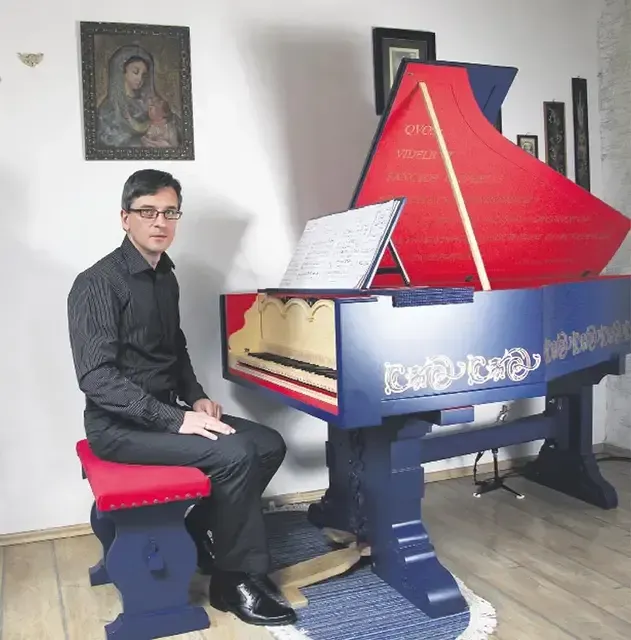
Sławomir Zubrzycki: From the very start, the instrument promised to be a revelation. According to Praetorius, the viola organista could play both town and country music, convey all kinds of feelings, and even imitate a drunk.
By Jacek Ślusarczyk and Sławomir Zubrzycki
Jacek Ślusarczyk: At a time when The Da Vinci Code is such a staggering success, anything connected with Leonardo causes a sensation. How did you come across an instrument devised by da Vinci and long since forgotten?
Sławomir Zubrzycki: The first clue came through a Polish connection. A colleague of mine, Kazimierz Pyzik, a musician and music theorist with whom I've been playing contemporary music for twenty years, told me about a curious instrument built in the 1830s near Łańcut. It was called the klawiolin, or the “humpbacked piano.” It was built by Fr. Jan Jarmusiewicz — a remarkable figure: a music theorist and a member of musical societies in Lviv and Vienna. The instrument itself hasn't survived — all that remains is a brief description in the Kurier Warszawski. I was thrilled to read that the klawiolin had a unique property: played from a keyboard, using piano technique, it could produce the sound of bowed strings. Back in the early 1990s, though, I'd become interested in a different instrument: the clavichord.
Did you reconstruct one?
Yes — in 1992 I built a copy of Johann Silbermann's magnificent 1775 clavichord, which is now held in Nuremberg. Plenty of people, even in early-music circles, thought it was a bad idea: why build an instrument for concert performance? But once I'd built it, I discovered a certain secret of music.