Love by the Calendar: The Intimate Dramas of Catholic Marriages

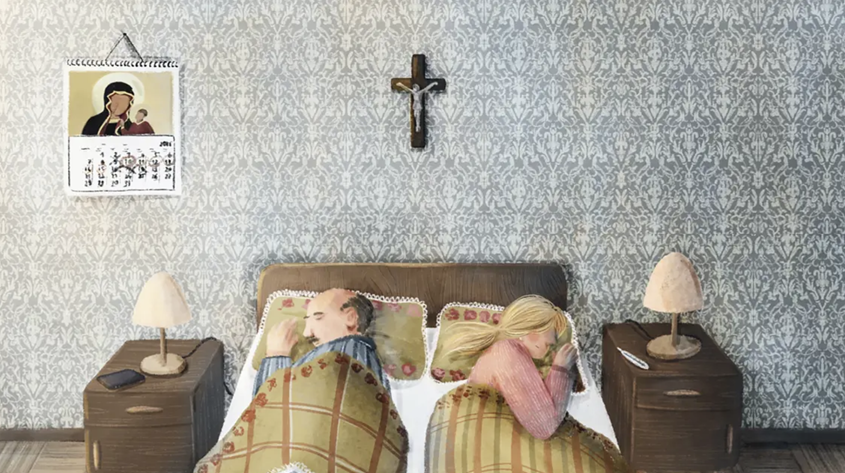
They feel the Church robbed them of the best years of their lives. Catholic couples speak frankly about the natural methods of fertility regulation.
By Monika Białkowska
I keep wondering what to call what I feel, says Magda, forty-something, married for over twenty years. The most accurate word is probably “deceived.” I feel deceived, because a quarter of a century ago I believed the Church when it told me that natural family planning (NFP) was a wonderful thing — that, demanding as it was, it would give us the joy of living in harmony with nature and with God’s plan. I waited until the wedding to start having sex. I accepted every child God gave us. If another child had appeared despite our not trying, I’d have given birth to it. And this whole faith of mine isn’t worth a damn.
For more than twenty years I’ve lived with a calendar and a thermometer in hand and mucus between my fingers. When we plan the occasional trip for just the two of us, I count whether there’s a chance, on those dates, that we’ll finally be able to be truly close. During the fertile phase, when I’d like to make love with my husband, I keep my distance in bed, and then I force myself to have sex at moments when I have absolutely no desire for it, during the infertile phase.
Natural family planning: something here is wrong
The NFP methods gave me neither closeness with my husband, nor freedom, nor joy, nor fulfillment. I don’t know whether being able to use some form of contraception would have given me that, but at least I’d have had a choice. Now that choice means either closing off my path to communion because of contraception, or torturing myself for another decade until I reach menopause. I think it was easier for me when I wasn’t married. I couldn’t have sex because I had no husband. Now I have one — and… most of the time I still can’t.
Magda is one of more than a dozen women who agreed to talk to me over the span of just two days, when I asked women who are now mature how the NFP methods had affected their lives and their relationships within marriage. Did they believe in them? Yes. They knew the method and trusted that following it would be good for the relationship they were going to build.
Magda’s life story is representative of many of theirs. She met her husband at the parish. Neither of them had ever had sex before the wedding. They decided to marry quickly so they could be closer to one another. She began tracking her cycles as soon as they started seeing each other, because she felt the relationship had a future. When, before the wedding, they reported to the mandatory counseling session, they were credited with all the classes at once: the woman working there was impressed by the charts Magda had been keeping.
They had no wedding night. Magda happened to be in the middle of her cycle, mid-ovulation. During the pregnancy the doctor forbade them from having sex. Then their son woke up over a dozen times in a single night. There was no chance of a few hours of unbroken sleep, nor of taking her temperature at a fixed time. Monitoring her fertility cycle became impossible.
“For more than a year we didn’t have sex at all,” Magda recalls. “We were drifting further and further apart. We missed each other, and at the same time we couldn’t satisfy that longing. The arguments and the silent days began. That was the first time I thought there was something wrong with this NFP.”
The Church’s teaching on planning as a cause of marital crises
Kinga is approaching fifty; her husband is ten years older. From the very start she had a positive attitude toward NFP. She knew her body, she wasn’t afraid, she trusted the method. Right after the wedding it turned out her husband had erection problems: a sexologist explained to them that for a man, an even, regular rhythm of intercourse is healthier. After the birth of their first child, Kinga had trouble reading the signs of fertility. For weeks at a time it was impossible to designate even a single day for sex.
After the pregnancy and a difficult delivery, a physiotherapist concluded that another pregnancy would mean a wheelchair for Kinga. Their confessor then gave them permission to use condoms as an added safeguard, though they felt it shouldn’t be that way.
“The years went by,” Kinga recalls. “Over time, less and less sex, because of the children’s illnesses, because of shift work. When a period was late in coming, we’d fall into a panic. Following the rules led to a lack of sex, and that in turn led to frustration, irritability — it broke down our bond. In practice, living according to the Church’s teaching bore bad fruit. It frightened me when I found myself envying my sister-in-law for having had a hysterectomy — for finally having some peace at last. When I entered premenopause, we came round to using condoms permanently.
“Neither of us can bring ourselves to call this a sin. Does anyone really expect middle-aged people to be open to life, to fertility? This isn’t that stage. At this stage, openness means that if there’s an accident, you don’t have an abortion. I recently realized that for years I’d been a slave to the thermometer. Now I don’t have to plan my life around the infertile phase. Freedom. Yes, giving up NFP is freedom. Fortunately, I’m close to menopause now.
“When I look at our marriage from a certain distance, I see that the cause of the crises in our relationship was one thing and one thing only: the lack of sex, caused in large part by NFP. I feel robbed of so many chances for closeness, robbed of the best years. Now that I don’t have to worry about it, age is catching up with us. Especially with my husband. I’m convinced this is not God’s plan for Catholic marriages.”
Marital sex: a matter between a wife, a husband, and God
Not everyone accepts the primacy of conscience when it comes into conflict with the Church’s teaching. Most wage a years-long struggle with themselves.
Anna waited until the wedding for sex and, despite irregular cycles, used NFP. She and her husband both wanted children. First a daughter was born. Then a son. They were happy about the third pregnancy too; he gave her flowers. She miscarried on Good Friday, feeling she was walking with Jesus to Golgotha. To this day she cries when she speaks of it. Six months later a pregnancy test again showed two lines. Almost simultaneously she learned of a suspected tumor. The final diagnosis seemed like better news: it was an ectopic pregnancy.
“The most important thing is that on the ultrasound I didn’t see a beating heart. I have the feeling that would have killed me. I believe the pregnancy was no longer alive by then.”
After these experiences, Anna didn’t have the courage to try for a child again.
“Time passed, things got worse and worse. Despite our prayers and our desire to grow the family, I wasn’t able to risk going through a similar situation again. It was toying with serious consequences for me and for those close to me. I was able to do without sex, just to stay clean with the Church’s teaching. My husband — who came to the conclusion faster than I did that you can’t live this way — suffered too. He didn’t want to cross my boundaries or violate my conscience, and yet he felt he couldn’t bear it.
“The periods of abstinence dragged on mercilessly, and we drifted apart. There were no rows, no betrayals, no wish to leave, but we were becoming more and more like strangers to each other. I don’t know where this marital ‘purity’ would have led us. Fortunately, step by step, I began to mature into living according to my conscience. I don’t accept methods that are even potentially abortifacient in the early stages. The rest is a matter between me, my husband, and God.”
Contraception and openness to life
Kasia isn’t yet forty, and menopause is far off — but she’s certain that if she’d kept using NFP, as she did at the beginning, her marriage wouldn’t have survived.
“The best time in our marriage was the pregnancies,” Kasia recalls. “Without the need for constant observation and the constant stress of getting it wrong. After our fourth child we still saw no option other than NFP, and when using it became impossible, we stopped having sex altogether. That arrangement was more convenient, and at a certain point I realized I didn’t even mind, if it was going to mean stress and frustration again. In the meantime, though, we went to therapy and realized you can’t function like that.
“We started using condoms. Thanks to that, there was finally room in our marriage for spontaneity, for resting together, for pleasure without complications. At first I had a lot of doubts and pangs of conscience. Fortunately, in confession I came across a wise priest who said that a married couple’s duty is to have sex, not to avoid it.
“It saddens me to be accused of not being open to life because I use contraception. I have four children, and I’m certain that if another comes along, I’ll give birth to it. Even though we no longer have the resources — we can barely manage the needs of the children we already have. I’d like the Church one day to recognize that openness to life also means properly caring for the needs of the children already born.”
NFP as a cause of marital breakdown
Not everyone, like Kasia, comes across a therapist and a wise confessor in time. Sometimes it’s too late to save the relationship.
During their engagement, Karolina went with her future husband to a natural family planning course. Later they both completed training to become teachers of the method. They gave lectures, co-led retreats. The trouble began after childbirth. Karolina says her body stopped fitting the theory of fertility awareness. At that point she could rely only on observing the mucus, which showed signs of fertility the whole time.
“We were comprehensively trained in this, we had the support of experienced instructors, we ourselves helped others with interpretation. But the practice overwhelmed us. We couldn’t rely on the mucus, so that left temperature. The problem is that for this indicator to be reliable, you have to sleep through the night and take your temperature every day at the same time, before getting out of bed.
“My children had an exceptional gift for waking up at exactly those moments, to make an accurate reading impossible. I learned to use yet another sign — the position of the cervix. It’s not an objective or reliable indicator, but I saw no other way. Our sex life, though, was very rare. My husband was afraid of another conception. Three years after my last delivery, in November 2012, I became pregnant for the third time. That was the last time we had sex.
“My husband stopped trusting the natural methods completely. He began refusing sex. Entirely. We talked, I asked, I listened, I was open. I suggested sex with a condom: our bond was more important to me than the prohibitions. At first he accepted the idea, then he decided he wouldn’t violate my conscience after all — that he didn’t want me later confessing to some stranger what we did in bed. My promises that I was ready to keep silent about it, since it was so hard for him, came to nothing.
“I tried various approaches: talking, encouraging, seducing. The result was that a few times it came to caresses without penetration, always on my initiative. Afterward I felt no pangs of conscience, but a sense that I was forcing my husband into sexual activity, that I was humiliating myself, because he didn’t want me, was rejecting me.
“Did NFP contribute to the collapse of our sex life? I think to some degree, yes, though I don’t blame the whole thing on the method. We both put enormous effort into learning Catholic sexual ethics and conforming to them. Along the way we ran into difficulties that the great minds couldn’t help us overcome. They say that in a good relationship a solution can be found to any problem, that NFP is a litmus test of a marriage, that it brings difficulties to the surface. Well, in our case it brought them to the surface.”
The husband’s perspective: humiliation and harm
For Jan and Ala — after two miscarriages, two very difficult but happily concluded pregnancies, and a bout of depression with a medical recommendation against having more children — NFP became a method of avoiding another conception.
“We didn’t plan our lives around the cycle, but when the infertile phases came, tension would appear,” Jan recalls. “I know that women, late in the cycle, when they can safely have sex, feel worse and have a lowered libido, but they agree to it because they know their husband has been waiting, that they love him. From my point of view, that’s humiliating. I don’t want my wife to force herself into anything. I don’t want to use her, as if I were an ape that can’t restrain itself. I don’t want a woman to serve me as a means of releasing tension. Is this supposed to be the theology of the body?”
Twenty years ago, at the start of his studies, Karol went to an NFP course and was a committed advocate of the methods. Then he married. Everything was going wonderfully.
“We were young, childless, usually well-rested. I took an active part in using NFP, keeping notes and supporting my wife with the measurements,” Karol recalls.
After the birth of their first child there was less time and energy for sex within the marriage, but they both knew they wanted more children, and sooner rather than later, so they didn’t have to limit themselves. After the second child, things stopped being rosy.
“For important reasons we couldn’t afford more children. We considered it at least several times,” Karol says. “Maybe some people have the means, maybe better health, a stronger psyche? We didn’t. We wanted to live in harmony with the Church, and so our sexuality — and with it our closeness — faded away. Some people say it’s ‘just like during the engagement,’ when you have to refrain from sex. But during the engagement we didn’t lie down next to each other every evening, scantily dressed, in bed. Tension, and the impossibility of acting on it, leads over time to indifference.
“The frustration brought me to question the Church’s teaching, and to doubt. I don’t blame my wife for wanting to hold to the Church’s teaching when, at a certain point, I let it go. My grievance is with the Church. For me, this ricocheting off moral teaching led to depressive states. I have a sense of profound harm. I feel like a slave whose sexual activity is tightly controlled by obedience to an institution. I’m not demanding that the Church change its teaching for me. I’d like it to show me the sense of it.”
This article touches on miscarriage, depression, and intimate marital struggles. If any of it resonates with something you’re going through, it may help to talk it over with someone you trust or a professional.
Originally published in Tygodnik Powszechny, 10 June 2025. Translated with support of AI.