Jon Fosse: “What I write doesn’t come from me”

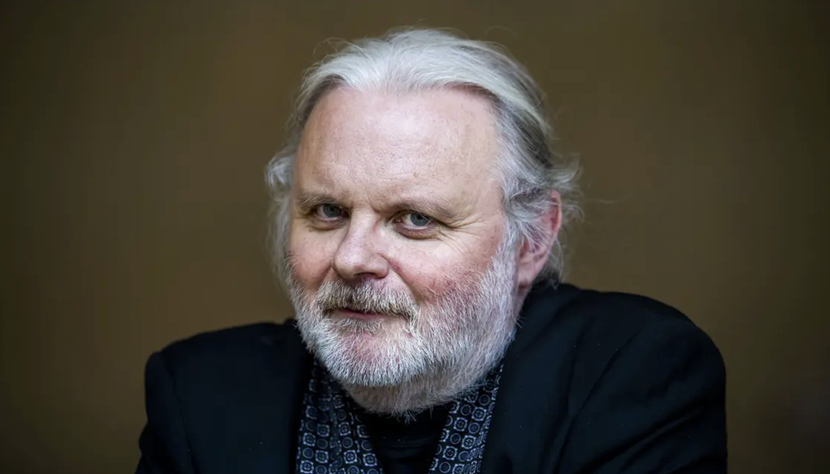
The best prayer is prayer in silence. The best literature, too, comes into being when silence enters your writing, says the Norwegian writer.
Interview by Wojciech Bonowicz
Wojciech Bonowicz: What time do you usually wake up?
Jon Fosse: When I was a teenager, I slept as long as I possibly could. Later, as an adult, for a long time I’d wake up around seven. And for the last ten, maybe fifteen years, I’ve been getting up around four. I wrote my longest novel, Septology, between five and nine in the morning.
I ask because, reading your work, one gets the impression that early dawn is your favorite time of day. It’s not even about when the events take place. It’s about the mood we associate with daybreak — when everything is only just beginning, light and dark are mingling, and it’s actually impossible to say which is which. Everything is still possible.
Yes, I think that’s true. Though when I write, I don’t think about it at all. What matters to me is calm. At such an early hour the world is calm and I myself am calm. Bergman called this time “the hour of the wolf,” but I love it. The best time to write.
That mood of suspension, of indecision, seems to me characteristic of your work. As if you wanted to capture some reality before the first judgments about it arise. Before it turns out to be good or bad, sublime or trivial.
My task as a writer is not to pass judgment. Kundera once wrote that in a novel everyone has the right to be understood. So I try to treat each of my characters with sympathy, even those who aren’t especially likable. I’d go so far as to say that I love all my characters. You won’t find harsh irony or sarcasm in my work.
I discovered fairly early that in order to write, I can’t have a predetermined attitude toward any character or subject.
Understanding reality, taking one stance toward it rather than another, and writing — are these two different things?
I wrote my first novel in my early twenties. I was studying philosophy and literary theory at the time. And I quickly realized that theoretical, conceptual language is something entirely different from the concrete language of literature. I also worked as a journalist, but the awareness that literature is something else never left me. Literature — valuable literature — produces its own, separate language.
Which doesn’t change the fact that theoretical reflection enters your work. At any rate, it enters Septology.
Septology is an exception. I’ve written more than seventy different works, but only in this one did I allow myself to include more theoretical or essayistic passages. In fact, it’s the one and only time in my work that the names of artists or thinkers appear — figures like Lars Hertervig, Georg Trakl, or Meister Eckhart. I had some misgivings, but I decided that in this particular novel the essayistic passages might serve a purpose.
But since we’re on the subject, I have to confess there were far more of them, and in the final edit I cut a great many. I think the ones I left don’t burden the novel excessively.
The main character, Asle, is a reflective nature — an artist who poses himself questions about the meaning of the art he creates.
And about what his own life is about, right? He repeats that he’s not a thinker, yet he keeps returning to those questions. And he answers them as best he can. Although the novel isn’t realistic in the strict sense, I wanted his reflections to sound natural. He speaks of what he has read and thought through.
I have the impression that the most important thing in your work is the creation of a certain aura, the building of a space one would be tempted to call a space of mystery. Do you agree that this matters more than the individual threads, characters, or events?
Yes, I agree. Neither the characters, nor the subject, nor even the language is the key thing here. When I write, I do it without a plan. I simply listen to what I’ve already written. Heidegger said that art happens to us. And that’s exactly how it is. When I write, I don’t invent anything — I listen. It’s like composing music or painting a picture.
It’s hard for me to talk about this; I’m too involved in what I write. But this metaphor of space seems apt to me. My writing surely contains some message, but when people ask me what it is, I answer: I don’t know, I’m trying to find out.
I listen, and then I try to write down what I’ve heard. And I try to do it as well as I can, using all my knowledge of literature and language. Nevertheless, the listening is the crucial thing. I follow intuition, though intuition is more than a feel for language. Actually, maybe “intuition” isn’t the best word. Intuition comes from inside me, and here we’re dealing with something else. Instead of intuition, I prefer to speak of necessity.
In what sense?
I have a very strong conviction that what I write doesn’t come from me, but from beyond me. That it exists before I sit down to write, and that it will disappear if I don’t manage to write it down in time. I often say that I don’t write to express myself, but to escape myself.
A good example of building the mysterious space we’re talking about is the short novel A Shining. Under some obscure impulse, the protagonist drives into a forest; his car gets stuck in the snow, so he abandons it and begins to wander in the dark in search of help. The forest is for him as much an outer space as an inner one. And suddenly, in that darkness, a “shining being” appears — no telling whether an angel, God, or a hallucination. And in the ending everything is submerged in a strong light, described as a void, a nothingness. Is it a story about transformation? About death?
The most honest answer is: I have no idea. Who is this shining being? Why, at a certain point, does the protagonist meet his parents in the forest? And what does that light at the end of the journey mean? I don’t know. I know that this light has to be there. That for the text to work, some other dimension has to appear — a transcendent one, let’s say. Something greater than life. I feel I have to introduce that dimension, and when I do, the story takes wing, it rises, it flies. That’s all I can say.
Incidentally, I wrote A Shining after finishing work on Septology. I wanted it to be something short, in contrast to a work that ran to some fifteen hundred pages. I needed a rest.
Literature and spirituality don’t often go hand in hand these days. But in your case they do.
Indeed. But I have to make a reservation: it’s not about any dogmas, but about the presence of a transcendent dimension that affects our lives. I’ve experienced this many times, as a writer too.
What made me start writing, for instance? That’s a hard question to answer. What certainly helped me was the awareness that the visible is not all that exists. Many people ignore the invisible. But even as a very young man, I felt that it can’t be ignored. I’d go so far as to say that a good poem — or good literature in general — is one in which the invisible becomes present.
Each of the seven parts of Septology ends with a prayer that the main character recites first in Latin, then in his native language. A rather bold idea.
I had many misgivings about that novel. I worried it was too long, and that an aging painter (or two painters, if you like) wasn’t a character who would interest anyone. On top of that he’s a Catholic, so the novel necessarily had to include reflections on the path that led him to faith. I was afraid no one would like the novel — neither in Norway nor in the whole heavily secularized world.
I was surprised when it turned out to be quite the opposite. The novel was very well received, sold splendidly in many countries, and won several important prizes. I wasn’t worried about its form — I knew it succeeded aesthetically — but I thought the spiritual thread would be a burden on it. Instead, the very opposite happened.
You often emphasize that your works are far from autobiographical. But in the case of Septology — even though you made the protagonist a painter — it’s hard to escape the associations. You went through a path similar to Asle’s.
That novel is a kind of summing-up of everything I’ve done so far. And of course it isn’t autobiographical. Whenever I tried to describe my experiences as I had lived them, it was a literary failure. The space we talked about was missing — that transcendent flight.
For literature to come into being, I had to find the right form. And by form I also mean a certain musical component, the rhythm in which it’s written. And even all sorts of small things — for instance, deciding whether to use a particular metaphor or not.
I’ll say it again: listening is the crucial thing. It’s still my voice, and at the same time the result of that listening to something beyond me. There’s a series of similarities between me and Asle, and at the same time a great many dissimilarities. In the past there were periods when I painted a little, and I also have a lot of painter friends. I don’t know why, but I probably wouldn’t be able to write a novel whose protagonist was a writer. For literature to come into being, distance is needed. So yes — that novel is not about me.
They say every writer has his demon — or demons — that he must wrestle with. Is Septology a struggle with personal demons?
There’s probably something to it. When you write, you wage a battle with your demons, and at the same time, in a way, you collaborate with them. I don’t know whether it’s possible to create literature without feeling that demonic force within yourself. Of course, I ask God for something good to come of it. For the ancient Greeks a demon wasn’t necessarily evil; it was the Christian tradition that gave the word its pejorative meaning.
There can be different demons — for instance, as in Asle’s case and mine, the demon of drink. The consequences of such a demon’s workings can be bad: you wound yourself and those close to you. But on the other hand, this demon, this force, shapes your life, influences who you are. Without those experiences you’d be someone else. I think each of us feels this struggle of various forces within.
When I write, I feel that what I’m doing has a demonic dimension. But there’s also another dimension — an angelic one. As I write, I begin to understand more and more. Everything falls into place.
You say that writing is listening. But listening to what? To the voices of reality? To the voice of God? To silence?
I don’t know. And I think that if I knew the answer, writing would stop interesting me. It’s interesting only as a road to something new, something unknown. Through writing, something that wasn’t there before can appear. Something that existed out there somewhere, waiting to be heard.
Writing resembles prayer. Prayer, after all, is also an escape from oneself. It’s not about expressing yourself, but about turning toward something greater than yourself. This turn toward the unknown is telling.
If, while writing, I thought about some particular person reading my novel or watching my play, I’d probably write nothing. I’d lose all desire. So when I write, I don’t address anyone in particular — and yet I do address someone. And I think the one I address can be called God. That’s why I compared writing to prayer. God is the first reader.
The best prayer is prayer in silence. And the best literature comes into being when silence enters your writing.
What does that mean?
Somewhere behind the language you use, a second one appears — the language of silence. There’s another side of reality, which speaks through silence. In good literature you can hear that silence.
I take it you don’t mean merely ordinary pauses.
Of course, it’s about something more. You can call it silence, you can call it space, you can call it God. It’s very hard to explain. It’s something that eludes description and at the same time decides whether literature will be good or not.
Sometimes in the theater, during a performance, a moment comes when everything suddenly fits together, everything is as it should be. You feel some current flowing through the stage and through the audience, something you can’t name but that is at the same time real, almost tangible. And this applies to all of literature. Joyce called it epiphany. Literature needs epiphany, fulfillment.
The book of conversations with you recently published in Polish — Mysterium of Faith — came about not long after you entered the Catholic Church. What lay behind that decision?
I went a long way. First, like most of my countrymen, I belonged to the Church of Norway — that is, I was a Lutheran. It was a largely formal belonging; and on top of that, what I heard in my church struck me as simply foolish, so at sixteen I decided to leave. For a time I considered myself an atheist; as a teenager I read Marx. And at the same time I was writing. And it was literature that brought me back to religion.
In what way?
I began to wonder where, exactly, my writing comes from. Materialist attempts to explain what creativity is didn’t strike me as convincing. Writing opened me up to spirituality. I concluded that I was a believer. That the word “God” was important to me, even if I couldn’t say anything about God.
I longed to be among people who believe. That’s how I came to the Quaker community in Bergen. It was a small group, five or six people. In all of Norway there are barely 150 Quakers. They have no clergy or dogmas; they’re pacifists. During the meetings we sat in a circle saying nothing, just concentrating on the inner light through which God spoke to us.
After some time I left that community, but to some degree I still consider myself a Quaker. My way of thinking is very Quaker, undogmatic.
Why, then, did you leave?
Meetings in such a small group weren’t enough for me. One time, in Bergen, I went to Mass at a Catholic church and I liked it. Quaker religiosity needs no liturgy or signs of any kind. But I came to like the liturgy, its rhythm. On top of that, I’d been reading Meister Eckhart for years, alongside my philosophical studies. I said to myself: if Eckhart was a Catholic and died a Catholic, then I can be one too. This was already in the 1980s, but back then I wasn’t yet ready to enter the Church.
So what decided it?
My second wife, who is Slovak, comes from a Catholic family. Thanks to her I began to get to know Catholicism in practical terms, to understand the liturgy better — why at some moments you have to stand and at others kneel. For believers these are obvious things, but for me everything was new. I was also reading a great deal the whole time. When I was finally ready to convert, a friend put me in touch with a bishop.
In Mysterium of Faith you call yourself a “back-pew Catholic.”
Because that’s what I am. Most things in the Church’s teaching I like. There are also those I find hard to accept. For instance, the fact that whole groups of people — those living in non-sacramental relationships, or homosexual people — are barred on principle from access to communion. They may be very devout, very engaged, may long deeply for that communion, and yet they aren’t admitted to the Lord’s Supper. That seems unjust to me. Can one speak so much of God’s mercy while imposing such restrictions on people? I myself can receive communion, because my first marriage wasn’t sacramental…
At the same time, you care that the Catholic Church preserve its liturgy, that it not be “Protestantized.” You have nothing against the ordination of women, but you’d like to keep priestly celibacy.
Yes, I’m a rather peculiar mixture of conservatism and progressivism. I think Pope Francis was someone like that too. After the Nobel I received a very kind, personal letter from him.
In the book you say: “The Church’s dogmas trouble me less than the wild, brutal capitalism running rampant all over the world.”
When mystery disappears, life starts being explained and treated too mechanically. Religion doesn’t allow it to be reduced to one aspect or another. I read the whole catechism, and even if I disagree with this or that, I accept most of it. The Church’s strength is that it preserves tradition and at the same time is constantly changing.
And what does Catholicism have to offer a writer?
For many years I was heavily dependent on alcohol. I drank day and night. I drank for the same reason I wrote — to escape myself. But when I was drunk I couldn’t write; writing went well for me only sober.
And when I finally managed to stop drinking, I had to look for something that would let me escape myself in a different, less suicidal way. Instead of going to the bar as usual, I went to Mass. And that Mass swept me away. It literally took me away from the someone I was — and didn’t want to be — and carried me elsewhere.
So Catholicism did influence my life — although I stopped drinking earlier, before I turned to it. Whether it influences what I write, I don’t know. Asle, the protagonist of Septology, is a Catholic, so there are necessarily many passages devoted to faith.
But really, everything I’ve written I could have written without being a Catholic. A Shining could just as well have been created before my conversion. Although… I remember, many years ago there was a premiere in Stockholm of my second or third play, titled The Child. And one of the influential Swedish critics, Leif Zern, after seeing the performance, declared that the author of the play must surely be a Catholic.
One more reason to speak of faith as a mystery.
Faith is grace. And today’s world doesn’t much believe in grace. Even believers don’t always believe in it. And when you stop believing in grace, you start believing in power. And one of the Church’s main problems is precisely this: that it still can’t resolve, in any legible way, whether to trust power or grace.
JON FOSSE (b. 1959) is a Norwegian writer and playwright, winner of the 2023 Nobel Prize in Literature. In English, his work — including Septology and A Shining — is published in Damion Searls’s translation. The book of conversations, A New Name: Jon Fosse in Conversation with Eskil Skjeldal, originally appeared in Norwegian.
Orginally published 31 March 2026. Translated with AI.