David Remnick, editor-in-chief of The New Yorker: “I’d sooner jump out a window than let The New Yorker go dumb"

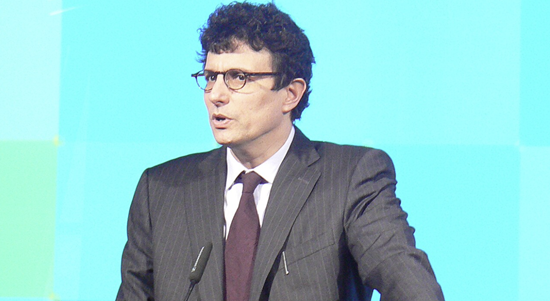
DAVID REMNICK, editor-in-chief of The New Yorker: “I’d sooner jump out a window than let The New Yorker go dumb. I’m enormously lucky, because my owner thinks the same way. There are readers who appreciate that. Maybe there aren’t 300 million of them, but a million is more than enough.”
Interview by Magdalena Rittenhouse
Magdalena Rittenhouse: When did you start reading The New Yorker? How old were you?
David Remnick: I’d probably have to make something up, because I have absolutely no memory of it. My father was a dentist. American dentists subscribe to a ton of magazines. They need something for the waiting room, for bored patients waiting for their portion of pain. My father subscribed to loads of magazines, some of which no longer exist: Life, Look, Newsweek, Time, The New Yorker, Esquire. So I was used to them from a young age — they were always lying around the house. I grew up at the turn of the ‘60s and ‘70s, and I have to say that back then The New Yorker was not the most exciting magazine in the world. Especially from a young person’s point of view. There was a certain aura around it…
Was it boring?
Yes. In high school I read Rolling Stone and Esquire. Excellent writers published there — Hunter Thompson, Gay Talese, Norman Mailer. They were masters of the language.
And you preferred Norman Mailer to E. B. White? The former could be a little hard to digest at times…
Absolutely. Remember what era we’re talking about. The Vietnam War was on. Mailer was writing about the protests in Washington, while E. B. White sat in the quiet state of Maine writing essays about the passage of time. That’s not exactly reading that grips a seventeen-year-old.
It’s true that the New Journalism — a genre that was just beginning to make its way in magazines like Esquire and Rolling Stone — could be pretentious, overwrought, even hysterical. It was easy to parody. And yes, some of the New Yorker pieces have probably aged a bit better. But when you’re young, you read what’s of the moment.
And when did that young man grow into The New Yorker?
During my studies at Princeton. Even though it was the same state I grew up in, the gulf couldn’t have been wider. I came from the world of the Sopranos (yes, those Sopranos!), and I found myself in the place where the Great Gatsby had lived. [The author of The Great Gatsby, Francis Scott Fitzgerald, studied at Princeton from 1913 to 1917 — MR] Very high shelf. And that’s where I ended up in John McPhee’s class. [an American writer and reporter who has published in The New Yorker for many years — MR]
Usually most academic instructors in literature departments are critics or theorists. I had the good fortune of having a writer for a teacher! He wasn’t someone in the mold of my beloved Thompson. Instead of unbridled hysteria, there was restraint and a light irony. He was probably closer, in truth, to E. B. White. But he impressed me enormously. It was thanks to him that I came to appreciate The New Yorker and discovered just how varied it was. After all, Milan Kundera and Philip Roth were publishing there at the time. E. B. White had been dead for years. In short, it was thanks to John McPhee that I caught the bug.
Did you start subscribing?
No. I was too poor for that. I read it in the library.
And a dozen-odd years later you became editor-in-chief…
The whole thing was a little surreal… Usually when someone is going to become editor of, say, The New York Times, they start at the very bottom and slowly, over years, climb one rung at a time. I’d started working at the magazine a few years earlier. I’d just come back from Moscow. I was finishing a book about Russia — Lenin’s Tomb — and I was supposed to become the Washington Post‘s correspondent in New York. Contrary to how it sounds, that wasn’t a very attractive prospect, because in Washington nobody cares about New York — they only pretend to. And that was exactly when this strange woman — Tina Brown — called me with an offer to write for The New Yorker.
The editor-in-chief at the time. Legends circulate about her; she was apparently quite a colorful figure…
On one hand she’s a social butterfly, on the other a woman of iron. A cross between Margaret Thatcher and Princess Diana. Though that’s a caricature, so — like all caricatures — it’s unfair. In reality Tina Brown is an extraordinarily intelligent woman. Her absolutely exceptional intelligence is proven, if nothing else, by the fact that she hired me at The New Yorker (laughs).
Soon after that she left the magazine, and you took her place. Were you a little terrified?
I wasn’t a little terrified. I was terrified out of my mind. I had never edited anything before. No-thing! But The New Yorker is unusual. It’s a small magazine. In large institutions — at The New York Times, at Harvard, or, let’s say, in the Communist Party — inertia rules. If someone tries to change things too fast, the whole thing collapses — just like in the Soviet Union. The New Yorker, on the other hand, was a bit like the small film studios of the 1930s: an owner and a few directors who produce five films a year. In a small studio or magazine like that, anything is possible.
S. I. Newhouse, the owner of The New Yorker, initially offered the job to Michael Kinsley, the well-known American journalist and editor of the online magazine Slate. And Kinsley wanted a moment to think it over. I was in New York at the time; I remember that July weekend in 1998 well. The whole city was buzzing — no one talked about anything else…
The New Yorker is an institution in the States. It had had only five editors-in-chief up to that point. Kinsley would have been excellent. He’d worked for the best magazines — Harper’s, The New Republic. A very interesting personality. It’s a bit of a shame it didn’t work out. Though of course I have reason to be glad it didn’t. What really passed between them, I don’t know. But the contract, ready to be signed, was apparently already on the table. Newhouse invited Kinsley and his family to dinner. But when Michael got back to his hotel, there was a message waiting on the answering machine — Newhouse had changed his mind. I understand it a little. Over the past twelve years as an editor I’ve hired and fired a lot of people. And I’ve learned that if someone has even the shadow of a doubt — if you can’t see in them that they really, badly want to be here — then there’s no point in their staying.
You yourself, despite the fear, had no doubts?
No. The next morning, when I came in to work, we had breakfast together and I learned that I was becoming editor-in-chief.
You moved your things into the office (with its breathtaking view) — and then what?
For some time I hadn’t been thrilled with the fiction The New Yorker was publishing. I happened to be reading Philip Roth’s new novel, I Married a Communist. So the first thing I did was call him and tell him we’d like to publish an excerpt. He said: OK. And that’s how it began. As Mel Brooks says: it’s good to be the king!
When he founded The New Yorker, Harold Ross wrote that he’d decided to create a satirical magazine because he wanted to have a good time and spend his days reading funny stories. Is that what your job is?
I like what I do. Working at a small, nimble magazine is a great pleasure. I worked at big newspapers in the past — that was something else entirely. But what Ross wrote is, of course, not true. He himself worked without rest.
Above all, you have to remember how much The New Yorker has changed since then. It started as a small idea, light as a bubble of champagne. It was a magazine for a narrow social circle. It was the Jazz Age. Avant la chute. Before the fall. Before the Great Depression. Before the war.
America was still a very carefree country. Ross — a cheerful man with a thick mop of hair — grew up in Colorado and earned his journalistic stripes working during the First World War for the army paper Stars and Stripes. He’d been knocked about all over the world. He came to New York and was intoxicated by Manhattan. He drank, smoked, played poker. He played the part of a hippie one moment and a Hasid the next. He was intelligent, but he was certainly no intellectual. He dropped out of school at a very young age. He never went to college.
But Ross surrounded himself with people who could fill in his gaps. He hired Katharine White, who was his exact opposite. She came from a good family and had been educated with extraordinary care. You could say she was a representative of the old bourgeoisie. She’d graduated from Bryn Mawr [a prestigious college that was one of the first in the U.S. to educate women — MR]. It was she who led The New Yorker to start publishing more serious texts and fiction. Her son, who turns ninety this year, still writes for us to this day. He comes in to work every day; he has an office at the end of the hall. In any case, you could say that Ross and White created the leaven. They were the magazine’s DNA. Journalistic, and at the same time comic and playful.
What made The New Yorker grow serious, and when?
First of all, the Second World War, which demanded serious responses from serious authors and editors. That bubble of champagne it all began with was no longer enough. Second — William Shawn, Ross’s successor, who became editor-in-chief after his death in 1951. He came from Chicago. Slight of build, quiet and calm, he spoke almost in a whisper. On a sweltering day he’d come to work in a cashmere vest and a suit. He was afraid of taking the elevator, afraid of driving through tunnels and over bridges. Maybe this is an oversimplification, a kind of caricature, but if Ross was a hippie-Hasid, then Shawn was a secular Buddha. Under his influence the magazine grew serious; it sailed into deeper waters.
Today serious commentary takes up a great deal of space in our pages. The New Yorker is not a political magazine in the strict sense, like, say, The Nation, The New Republic, or The Weekly Standard. We’re not an opinion magazine. But we do devote a great deal of space — especially after September 11 — to politics. One of our strengths is in-depth reporting from Iraq, Iran, China, and other important corners of the world that journalists at many outlets simply can’t reach. We can devote a great deal of time and far greater resources to producing it.
One of The New Yorker‘s specialties is the portrait of a person — those on the front pages, but often also lesser-known figures — known as Profiles. Ross apparently even wanted to patent the name?
He didn’t patent the name, but he introduced the custom of writing the word with a capital P. The first Profile to appear in The New Yorker, in 1925, was devoted to the director of the Metropolitan Opera. It took up just a single page. Today the form is nearly ubiquitous in the media — everyone around is writing about more or less famous people.
Our portraits, though, are a little different. They’re not biographies; instead they try to capture the essence of a given person and present it in the form of an interesting narrative, analysis, or description. Facts alone aren’t enough for that — you need observation. One of the masters of the genre in the 1970s was Kenneth Tynan. He wrote about show-business people — he created Profiles of Mel Brooks, Ralph Richardson, Alec Guinness, among others. He spent a great deal of time with each of them. He understood what was really most important in their lives, who they were, what set them apart from others.
Well-written Profiles have magical properties, but it’s hard to say what really accounts for that. They certainly have to contain a lot of vivid detail. Their driving force is a skilled narrative. Writing a Profile like that is in many ways like producing a documentary film. It’s a very expensive and time-consuming process.
In one of your recent issues you published a Profile of the Republican politician Mike Huckabee. How long did the author, Ari Levi, work on it?
I’m not sure, but I think about three months. She visited him in Arkansas. They were then supposed to go hunting, but at the last minute he cancelled the trip. So she traveled with him through Israel, and what she gathered there forms the core of the piece.
But they surely met at least several more times in other places — including in New York, where Huckabee hosts a television program. Sometimes our writers work on various Profiles for over a year.
Mark Singer, who once created a phenomenal portrait of the magician Ricky Jay, worked on it, on and off, for two years.
I, on the other hand, put together a Profile of Al Gore a few years ago after spending just two days with him. Granted, they were two very intense days — I showed up at his place for breakfast and barely left his side for forty-eight hours. We didn’t spend much time, but Al Gore isn’t someone who’d be inclined to agree to more. Unlike, say, Bill Clinton. While working on his Profile I accompanied him for eight or nine days on a trip through Africa. Then I had a long conversation with him in his home state of Arkansas, followed by several shorter interviews with his associates and friends. So there’s no rule here.
Another hallmark of The New Yorker is its excellent drawings and illustrations…
Yes, drawings have accompanied The New Yorker from the very beginning. They ensure there’s a dose of humor in every issue. In American papers the popular genre was always the satirical political cartoon, which comes out of the European tradition. Ours usually have nothing to do with politics, and if they do, they go about it in a disguised way. Broadly speaking, they’re about life.
You could say that over the years we’ve developed certain characteristic motifs or themes — a bit like traditional folk melodies that keep returning to the same figures. So we often get the desert island, the two dogs in a bar, the husband and wife. Just like the writers, the various cartoonists have their own characteristic tone that readers are used to. They’re also used to the fact that a jokey cartoon like that can appear in the middle of a long, serious article about Afghanistan. You could say there’s something perverse about it.
If we were founding a new magazine today, publishing jokey cartoons unrelated to the subject matter would be unacceptable. But in The New Yorker‘s case it’s a long tradition by now, and it bothers no one. It’s simply part of our style.
Just like the famous covers, with their drawings and graphics, which often refer to some current event or issue but don’t necessarily illustrate the texts inside. With no titles whatsoever, no advertising of the issue’s contents…
Yes, those covers are also something that sets us apart. All over the world, from Los Angeles to Kraków, newsstands look the same today. Every cover has photographs of girls in bikinis or young men with impressive muscles. Like every New Yorker editor, I once thought about putting photographs on ours. But in the end I concluded it would be foolish. Everyone around is doing it. And we want to be different. So I dropped the idea.
But why don’t you even publish a masthead?
My mother always asks me that. We don’t publish one because we’re the coolest in the whole school! What Ross had in mind, I think, was to avoid editorial squabbling and rivalry. Besides, he liked to set himself apart. That doesn’t mean we always chase strangeness and originality at any cost. At one point, for instance, we decided to introduce a table of contents, which once didn’t exist either. There’s a line between what’s cool and what’s perverse. The lack of a table of contents confounded readers terribly. But they can live without a masthead, and it makes us a bit mysterious.
In 1925 Harold Ross declared that The New Yorker would not be edited for the little old lady in Dubuque. Is that still true? Who do you edit this magazine for today?
I don’t edit it for anyone. My colleagues and I publish what we consider worthwhile. We don’t try to guess what you, or John McPhee, whoever that is, would like. We take pains to make the magazine we offer our readers each week reliable, comprehensible, clear. And to make sure it contains what we ourselves find interesting.
Have you ever been to Dubuque?
I don’t think so. But I’ve been to many other towns like it. I worked for a while as a sports reporter for the Washington Post, so I traveled to college football games. God is my witness, I’ve been just about everywhere. But it doesn’t much matter, because Dubuque was of course only a metaphor. In that sentence Ross meant everything that isn’t New York.
The magazine he founded pulsed with the rhythm of this city; it was a thoroughly New York magazine. And today?
Today we have more readers in California than in New York State. But this city is still the country’s cultural capital. It draws many talented people, artists. Yet the United States is not France, which has a single, unquestioned capital. We’re a much larger and far less centralized country. We breathe with full lungs. At The New Yorker we very much appreciate that and try to give it expression. New York is an important cultural center, but it’s certainly not the only one. The New Yorker is anchored in this city, but beyond any doubt it’s a national magazine today. It has been for a long time.
Is there such a thing as New York writing?
No.
But there’s surely something special about this city? Nearly every American writer of note, if they didn’t spend the greater part of their life here, at least had to go through a “New York phase.” Henry James, who lived here only five years as a child, once wrote in a letter to Edith Wharton: “You have to do New York,” trying to convince her that she absolutely had to write in New York.
Henry James was not a New York writer. Nor were many others who appear in the pages of The New Yorker. John Updike spent about ten minutes in New York and considered them the worst minutes of his life. He fled as fast as he could and lived in Massachusetts and Pennsylvania. Cormac McCarthy lived out west and I suspect he never set foot in New York. Saul Bellow was a Chicago writer. New York is certainly no special distinction today. True, there are moments when some school or milieu appears — the Beats, the surrealists, the New York poets — John Ashbery, Frank O’Hara. But those are rather the exceptions.
Besides the big names, in The New Yorker you also publish prose by authors not yet widely known. How do you find them?
That’s an important question. On one hand, we want to support authors who’ve published with us for a long time. As far as fiction goes, if I wanted to, I could probably fill every issue with prose by writers who are already proven: William Trevor, John Updike, and many, many others. But in the long run that’s neither good nor very exciting. We care about discovering people who are new, young, promising. We don’t want to miss them. So it’s a question of balance, and it’s difficult. Of course we often say no, but we read every text sent to us.
How many do you get?
When it comes to poetry and fiction, I’d say a few hundred a week. Unlike nonfiction, which requires considerable outlays of time and money, all you need to write stories and poems is a desk and a pen. You can even do without the desk. Email makes sending us something fabulously easy. And even if someone decides to lick a stamp, that doesn’t cost much either.
So nothing stops the graduates of every imaginable writing workshop, who’ve just produced a dozen pieces, from sending them to us. But we read them all, because we know that sooner or later we’ll find something worthwhile. There’s a long tradition behind this, in fact. At the very beginning The New Yorker was too poor to publish big names. Stories by Hemingway and Fitzgerald appeared in the Saturday Evening Post — Ross couldn’t afford them. So Katharine White, who cared about publishing fiction, sought out lesser-known authors. And that’s how she discovered, for example, the then-unknown John Cheever, who lived in Greenwich Village and was poor as a church mouse [he published in The New Yorker for many years, becoming one of the magazine’s most important writers — MR].
A lot has changed since then — there are quite a few people living in New York today who’d probably be willing to pay extra to publish something in The New Yorker…
You said that, not me. I’m certainly not allowed to think that way. But it’s true that many authors want to publish with us. They care about it because they can reach a large readership of very intelligent people. They also care — however immodest this sounds — about working with excellent editors. So yes, we attract first-rate authors. Partly because the Saturday Evening Post no longer exists and few magazines publish literary work anymore.
When it comes to fiction, our difficulties today are not a matter of lacking money. The more serious problem is the relatively small number of authors who work in short forms. The kind of short stories you can publish in a magazine like ours is something most American writers do at the start of their careers. After that they usually write only novels. Philip Roth, for instance. In his youth he wrote maybe six short stories. Then came the collection Goodbye, Columbus, which he published at the age of, I think, twenty-six. After that he wrote only novels. There are a few exceptions among English-language writers — William Trevor, Alice Munro, Jhumpa Lahiri, John Updike, John Cheever — who often appear in The New Yorker. But that’s a rarity — a wonderful one, I won’t deny it.
All around, newspapers are going bankrupt, magazines are folding, publishers and editors are cursing, media scholars are prophesying the end of traditional journalism. And you, as though nothing were the matter, publish an ambitious title with a circulation of a million — which, on top of that, turns a profit…
This past year has been very hard. Condé Nast, which we belong to, is a private company, so I’m not allowed to discuss the details. But it’s no secret that the market is in very bad shape right now. On one side we’re dealing with a technological revolution, and on the other with a deep recession and the collapse of the advertising market.
There are only two ways to finance a publishing operation — revenue from subscriptions or revenue from advertising. If one falls, the other has to rise; otherwise you have to cut costs. Publishing a magazine isn’t running a hedge fund or a steel-industry holding company. It all rests on a very simple business model. Even I can understand it.
The titles that survive will be the ones that have something to offer that people need. The ones that are edited intelligently. The ones that can keep up with the times and make smart use of various innovations. Newsweek got into trouble because what it offers is past its expiration date. A magazine like that worked in the ‘50s and ‘60s, but today it’s no longer needed. You can turn on CNN or check The New York Times website. The world is changing, so we can’t stand still.
For a magazine as old and traditional as The New Yorker, is the technological revolution a major challenge?
Yes. But it also comes with many opportunities. If you’re reasonably good at English, you can read The New Yorker without leaving your home in Kraków or Warsaw, on the very same day it appears on newsstands in New York. When I went to Paris for a year during my studies, I missed The New Yorker terribly. It’s probably hard to imagine today, but I didn’t even have a laptop! All I had was a damn newsstand where you could buy an issue from five weeks earlier — if you happened to have ten dollars, of course. And I earned my money playing guitar in the metro, so I had to sweat quite a bit to scrape that together. Today it’s a few clicks. And soon, alongside the online version of The New Yorker, there’ll also be a special edition meant for reading on the iPad.
Harold Ross is probably turning in his grave… Aren’t you afraid that on the internet people read too fast and too superficially?
That’s not my problem. If people want to read this magazine that way, my job is to deliver it to them in the right form. And to make sure it’s beautiful and appealing. And that’s what I intend to do. But not for free — I’m terribly sorry. I have no desire to go bankrupt. And that’s why it matters to me that young readers who are just starting to read The New Yorker don’t get used to the idea that what we offer them is like water from the tap. They’ll have to pay for it. To publish a beautiful, appealing magazine, we have to make money. We don’t operate like the BBC [financed by license fees and taxes — MR].
Yet you still claim that you edit this magazine as you see fit, without trying to guess what anyone will like…
It sounds arrogant, I know… There are, after all, things in the world created with the largest possible group of customers in mind. McDonald’s, for example. It’s really something remarkable. You can walk into a McDonald’s in Moscow or in Ulaanbaatar, or right across the street here on Times Square, and unfailingly, everywhere, you’ll get the same portion of fries and a hamburger. You may not like the food (though — God’s honest truth — we all like it sometimes), but it’s a genuinely remarkable achievement. And that’s why McDonald’s has such an enormous mass of customers all over the world.
But you can also go to a little place in a dark Paris alley that friends recommended. A mom and dad run it. There’s no menu. At most there’s a blackboard where they’ve written in chalk what they’re serving that day. Sometimes what they bring you will taste wonderful, sometimes less so. An adventure, that’s all. Not everyone likes that. But those who love such places are loyal to them. And that’s exactly what our readers are like.
We try to find a table for everyone who wants to come. We’re not an uncompromisingly intellectual magazine. Alongside difficult, ambitious pieces of literary criticism, we also publish funny bits by David Sedaris and Woody Allen. It’s a rather strange recipe, but somehow it works.
Few people are in such a comfortable position today. Why does it work for you and not for others?
It’s true that we have an owner who isn’t only interested in making money. He believes in something, he has ambitions, convictions. He understands that a magazine of this kind isn’t a money-making machine. If that’s what someone cares about above all, they should take an interest in some other industry — the oil business, for instance. Lately it seems impervious to everything — unfortunately.
The New Yorker has a reputation as a wealthy magazine, because we don’t economize on the things one shouldn’t economize on. Not everyone is willing to operate that way. Among the whole array of newsrooms crying that they can’t afford to practice this kind of journalism, a fair percentage are publications that have forgotten what they were founded to do.
Why does it work for us? Because we do everything within human power to practice journalism of the highest caliber. Because we’re terribly ambitious. Because we give the lie to the received wisdom about contemporary culture: that no one has time for anything; that no one reads anything anymore; that everyone around is an idiot who can only stare at their cell phone and play PlayStation. There may be a grain of truth in it. We have no intention of lending it a hand. I won’t destroy one of the world’s greatest cultural institutions that way.
Originally published in Tygodnik Powszechny, 28 September 2010. Translated with support of AI